Interactive map! Click and drag to navigate. To view larger version, click here.

[cue fanfare music]
This time around, we're on the second route not served by Metro Rail (though it is Metrolink-accessible), and visit the Los Angeles community of Atwater Village and the Jewel City of Glendale. Even though this route is a mini-CicLAvia route of just a little over three miles, there's tons of historical and notable points of interest along this route, and in fact, The Militant had to pare down the list just so he doesn't stay up until 5 a.m. like he usually does when he does these posts (ya, really)! So, without any delay...let's get it started!

1928
Hyperion Avenue, Silver Lake/Atwater Village
This 400 foot-long concrete arch bridge links the community of Silver Lake in the south with Atwater Village in the north, traversing the Los Angeles River below. Designed by Merrill Butler, who also designed another iconic Los Angeles River bridge downstream, the Sixth Street Viaduct (R.I.P.), the bridge replaced an old 1910 wooden crossing that was severely damaged during a 1927 flood. The current bridge was built later that year and opened in September 1928, which was also dedicated to World War I veterans and honorarily dubbed "Victory Memorial." In 1988, the bridge appeared in the movie, Who Framed Roger Rabbit? (and thus a smaller replica of the bridge was later built at Disney's California Adventure theme park in Anaheim, paying homage to the original Walt Disney Studios' neighborhood (located where the Gelson's supermarket stands today)). Recently, the bridge was Ground Zero in a 2013-2015 controversy over whether the eventual renovation of the bridge should be designed in a more bicycle/pedestrian-friendly manner vs. a more automobile-centric design.
The Militant visited this bridge in July of 2007 in a very early MA blog post.

1929 (dismantled 1955); 2004
Los Angeles River at Glendale Blvd, Atwater Village
If you follow The Militant, you should know by now that his legendary epic Pacific Electric Archaeology Map from 2015 features a set of seven concrete bridge abutments across the Los Angeles River as one of the remnant traces of Red Car infrastructure. A bridge once rested on these abutments from 1929 to 1955 that carried the beloved trolleys between Downtown Los Angeles to Burbank. In 2004, local Atwater Village muralist Rafael Escamilla painted a mural on one of the abutments, which faces Red Car River Park, which was part of the old trolley's right-of-way. The line continued up Glendale Blvd and on to Brand Blvd in Glendale, before veering west on Glenoaks Blvd to Burbank.

Opened 1996
3101 Glendale Blvd, Atwater Village
This nondescript brown two-story building on the corner of Glendale Blvd and Glenfeliz Ave features a recording studio (on the 2nd floor) owned by Los Angeles hip-hop/pop group Black Eyed Peas. Their first few albums were recorded here, including this '90s-era jam. Though the group uses more high-end recording facilities around the world, and will.i.am now has his own home studio in his Los Feliz residence, the facility is still used by members of the band and their extended musical family.

Opened 1991
3208 1/2 Glendale Blvd, Atwater Village
The Peas aren't the only hip-hop influence on da AWV. Groundbreaking NY rap trio the Beastie Boys transplanted themselves to this part of Los Angeles during the 1990s (influenced by their producer and musical collaborator, the Los Angeles-raised Mario Caldato, Jr.) and recorded the albums, Check Your Head, Ill Communication and Hello Nasty here in this loft space, known as G-Son Studios, located above today's State Farm insurance office. The facility was also the headquarters of the Beasties' record label and magazine, Grand Royal. The studio was sold in 2006.
Oh yeah, R.I.P. MCA.

1964
Glendale Blvd median at Larga Ave., Atwater Village
You don't have to travel 203 miles to a national park in the Sierra Nevadas to see a redwood tree -- you can see one right here in Atwater Village during CicLAvia! This lone redwood was planted in the Glendale Blvd median by community members in 1964 and today stands at nearly 90 feet tall. Each December, the redwood is lighted by the Atwater Village Chamber of Commerce as a Christmas tree and the lighting ceremony has been an annual holiday community event for over 20 years.

1925/1946
1800 S. Brand Blvd, Glendale
Built in 1925 as a Spanish Baroque bank building by local architect Alfred Priest, the George Seeley Furniture Company took over the building in 1931, expanded it in 1939, and in 1946 got the Streamline Moderne make-over that remains today. The furniture store with the iconic large red neon sign was in operation until 1994, when the company closed for good. The building underwent an $8 million restoration and re-opened in 2012 as a collection of leased offices and artists' studios now known as Seeley Studios.

1906
1712 S. Glendale Ave, Glendale
Past the world's largest wrought iron gates at the entrance is the original location of the Southern California cemetery chain and the final resting place of over 250,000 people, including the likes of Elizabeth Taylor, Walt Disney (no, he was not frozen), Michael Jackson and someone you know. Forest Lawn was founded in 1906 by businessman Hubert Eaton, who wanted to re-invent the cemetery by doing away with large tombstones and emphasizing landscaping and art. He also innovated the industry with an on-site mortuary. The large white building at the top of the hill with the cross on top of it (changed to a star during the Christmas holiday season) houses a free museum with rotating exhibitions, as well as the world's largest framed canvas painting, the 195-foot long The Crucifixion, completed in 1896 by Polish artist Jan Styka, who brought it to the U.S. to be displayed at the St. Louis 1904 World's Fair. Too large to be transported back to Poland, it remained in the U.S. and was lost for years until Eaton bought it in 1944 and constructed the building to display it. The Militant once rode his bike here to pay his respects to a departed operative, but was told by security that bikes weren't allowed. He asked the security where in the Forest Lawn's policies were bikes not allowed (it does not appear in any signs in the park) and the security staff couldn't find it. So there.
1924
400 W. Cerritos Ave, Glendale
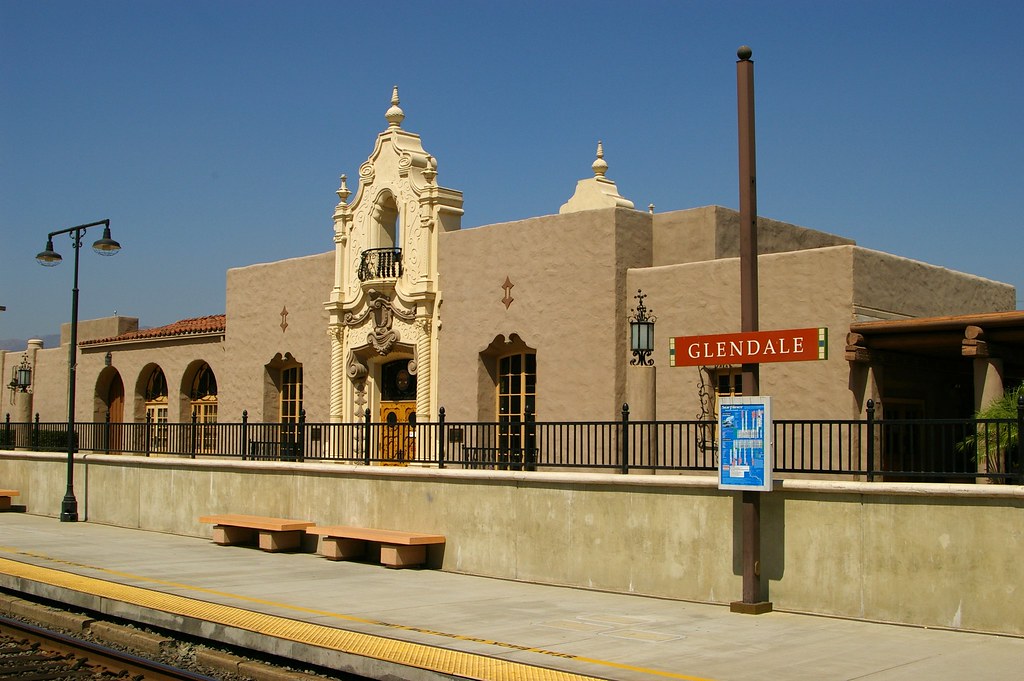
Originally known as the Tropico depot (more on this later), this Spanish Colonial Revival station, designed by MacDonald & Cuchot and opened in 1924, was built by the Southern Pacific Railroad, eventually serving Bay Area-bound trains such as the Daylight and the Lark. Amtrak took over train service in 1971. In 1982-1983, the Glendale station was a stop for the short-lived proto-commuter rail experiment known as CalTrain which ran from Los Angeles to Oxnard for all but 6 months. In 1989, the City of Glendale purchased the station from the Southern Pacific and in 1992, the station found real commuter service in the form of Metrolink, which serves Ventura County and the Antelope Valley. The station was renovated in 1999 and expanded to a multi-modal transportation center.

1887
Glendale south of Chevy Chase Drive
The southwestern section of Glendale was once an independent town named Tropico. With fertile soil formed by the floodplains of the nearby Los Angeles River, the area was famous for its strawberry farms. It also grew a business district centered at San Fernando Road and Central Avenue (pictured left), and Forest Lawn Memorial Park was born as part of Tropico in 1906. The town became incorporated in 1911, but in 1917 its residents voted to be annexed to Glendale. Not much remains of any reference of Tropico, except for the Tropico Motel (401 W. Chevy Chase Dr) and the Tropico U.S. Post Office (120 E. Chevy Chase Dr).

1967
4106 San Fernando Rd, Glendale
Just a couple blocks west of the CicLAvia route is Glendale's iconic Dinah's Fried Chicken, serving its popular boxes of fried chicken and gizzards since 1967. Established by a group of golfers, the Dinah's soft-of-chain operated a handful of restaurants around Southern California that were independently owned and operated but shared common recipes and branding (the Dinah's Family Restaurant in Culver City is the other remaining establishment). The 2006 motion picture, Little Miss Sunshine made Dinah's world-famous as their brightly-colored fried chicken buckets were featured in the film.

c. 1920s
Chevy Chase Drive, Glendale
When The Militant was much younger (known as Lil'Mil), he used to wonder, when the family car drove through Glendale, why that guy from Saturday Night Live had a street named after him. It turns out the street was not named after the comedian born Cornelius Chase of Fletch and Clark Griswold fame (the name was apparently a nickname given to him by his grandmother), but after Scottish folklore, namely a story entitled The Ballad of Chevy Chase. The story refers to an apocryphal battle (the "chase") in the Cheviot Hills (no, not that Cheviot Hills) of Scotland (a.k.a. "Chevy") that thwarted off an invasion of the country. Why the Scottish reference? The Jewel City was developed in the 1880s by Leslie Coombs "L.C." Brand, a Scottish American businessman and real estate dude, whose name adorns the city's main street. And also, if it's noot Scottish, it's crap!

2008
Riverdale Dr and Columbus Ave, Glendale
Since the last CicLAvia (Culver City meets Venice) in March featured a traffic circle, it's only fitting that you visit Glendale's only traffic circle, where Riverdale Drive intersects with Columbus Avenue, just a few short blocks west of the CicLAvia route. In 2008, Riverdale became Glendale's bike-friendly guinea pig, with the street re-configured with bike lanes to form an east-west corridor linking various parks within Glendale. So yes, you can visit this traffic circle via Glendale's existing bike infrastructure.

1926/1975
500 S. Central Ave, Glendale
Los Angeles might have Little Armenia, but Glendale has Big Armenia, with a population of 40% of all Glendalians being of Armenian descent. Though Glendale has had an Armenian community dating back to the 1920s, the majority of them arrived in the late 1970s, when the diasporic Armenian community in Lebanon fled that country during its civil war, and when Armenians in Iran likewise left when the Shah fell from power and the current Islamic fundamentalist regime took over. They settled in Glendale as it was close to the existing Armenian community in East Hollywood (now Little Armenia), yet more affordable to live. In the 1990s, another wave of Armenians arrived in Glendale, this time from the former Soviet republic of Armenia, after the dissolution of the USSR. The community established its first house of worship in a small building on Carlton Drive in 1975, and in 1988, the growing congregation took over the 1926 Colonial-style former First Church of Christ Scientist on Central Avenue. Although the St. Mary's wanted to build a dome on the structure in the 1990s to match the traditional church architecture of the motherland, the building's historic preservation status prevented them from doing it.

1976
100 W. Broadway, Glendale
Built as a means to invigorate the Glendale economy and to fill a regional void for The Broadway department store between Panorama City and Pasadena (the local chain was one of the mall's development partners and the anchor tenant), the Glendale Galleria opened on October 14, 1976. And while its sister shopping center in Sherman Oaks laid claim as the, like, total epicenter of 1980s Valley Girl culture, the more alliterate Glendale Galleria went on to become the fourth largest shopping mall in Southern California and the first location for chains such as Panda Express, The Disney Store and The Apple Store. Designed by architect Jon Jerde, its layout and style became an archetype for indoor shopping malls across the country during the 1970s and 1980s. The mall was expanded with a new eastern wing across Central Ave in 1983 and underwent a 21st century facelift in 2012 in the wake of the opening of its next-door neighbor, The Americana at Brand.
The Militant may or many not have had his first date at this mall. In November 1992, during his first visit to California after winning the presidential election, then-president-elect Bill Clinton did some Holiday shopping at the Galleria with a crowd of over 30,000 to greet him (The Militant may or may not have been there, and may or may not have caught a glimpse of him in his limo as he left).

1980
313 W. Broadway, Glendale
In addition to a large Armenian community, Glendale is also home to a notable Filipino immigrant population. This rustic-looking building is the first American location (opened 1980) of a major Philippine restaurant chain, specializing in Filipino-style fried chicken (sounds like a culinary theme for this CicLAvia...). If this building looks familiar, the facade is used as the setting for Louis Huang's Orlando restaurant Cattleman's Ranch in the hit ABC TV series, Fresh Off The Boat.
1923
100 N. Brand Blvd, Glendale
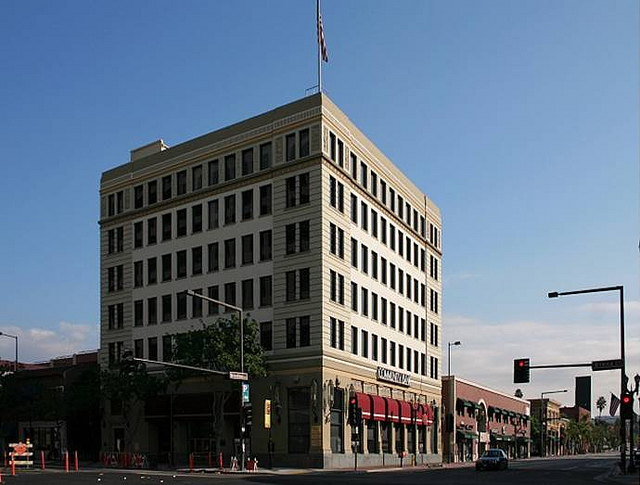
The first "high-rise" (as in over two stories) building in Glendale was this Classical style six-story building on the northeast corner of Brand Blvd and Broadway, designed by Alfred Priest (who also designed the Seeley's Furniture building down the street). This was the home of the Security Trust and Savings Bank, which was a popular local bank chain in Southern California at the time. The bank took over the former First National Bank of Glendale (founded by L.C. Brand) in 1921 and eventually became Security Pacific Bank, and is now part of the Bank of America borg. Before the bank building was built, this was the site of the Glendale Pacific Electric depot, built in 1906 to serve the electric railway line that ran up and down Brand Boulevard. L.C. Brand sought the help of his friend and fellow real estate guy Henry Huntington to build his electric trolley line through Glendale to help sell property tracts and to spur development. The rest is history. You can say the place has Brand's brand all over it. This building has a historical marker placed by the city recognizing the bank building's history and the PE station that stood here prior to it.

1925
216 N. Brand Blvd, Glendale
Designed by the architectural firm of Meyer & Holler (who also designed Grauman's Chinese and Egyptian theatres in Hollywood), The Alexander Theatre (named after Alexander Langley, of the Langley family that operated theatres around Southern California at the time) opened in 1925 as a venue for vaudeville entertainment, silent movies and staged plays. In 1939 the iconic facade and spire was built, designed by Lindley & Selkirk. The theatre also features a Wurlizer pipe organ, which was played by a live organist, which was the typical soundtrack for silent movies. The design of The Alex made it a popular location for world premieres of motion pictures, and from the 1940s to the 1980s, it existed as Glendale's premier movie palace. It was renovated in 1993 and is now owned by the City of Glendale for arts programming (The Los Angeles Chamber Orchestra makes its seasonal home here) and special events.

1982
315 N. Brand Blvd, Glendale
Three things are absolutely guaranteed at Sunday's CicLAvia: 1) Sunny skies; 2) Smiling faces; and 3) A seriously long-ass line in front of Porto's.
The legendary bakery was founded by the Porto family, who fled Fidel Castro's Cuba in the 1960s. The original location was actually in Silver Lake, on Sunset Boulevard and Silver Lake Drive (Los Angeles' Cuban community was once concentrated in the Echo Park-Silver Lake vicinity). In 1982, the family moved the bakery to Glendale where they actually did it and became legends. After over 45 years in business, Porto's sells 1.5 million cheese rolls and about 600,000 potato balls each month, and a little Yelp hype last year didn't hurt either. Porto's now boasts locations in Burbank, Downey, Buena Park and soon in West

1959
401 N. Brand Blvd, Glendale
All you Mid-Century Modern fetishists, prepare to have an archigasm at CicLAvia! This quirky 10-story building, originally the home of Glendale Federal Savings, was designed by Peruvian-born architect W.A. Sarmiento, who made some bank out of drawing up bank buildings. But this was his most well-known structure, recognized by the Los Angeles Conservancy, which features an external elevator bank. Glendale Federal merged with California Federal in 1998, and today it's part of Citi Bank. The building is now home to the Hollywood Production Center (despite not actually being in Hollywood).

1937-1938
Verdugo Wash at Geneva Street, Glendale
Verdugo Wash at Glenoaks Blvd, Glendale
Verdugo Wash at Kenilworth Ave, Glendale
We began our Epic CicLAvia Tour with a bridge, so it's appropo that we end it with a bridge. Verdugo Wash, a 9 1/2-mile tributary of the Los Angeles River, runs south from La Crescenta paralleling the 2 Freeway, and west paralleling the 134 Freeway, where it flows in to the river near the Los Angeles Zoo area. As a part of President Franklin Roosevelt's Works Progress Administration program, the War Department's U.S. Engineers (the predecessor of the U.S. Army Corps of Engineers) built a series of eight steel bridges (using local steel manufactured by Consolidated Steel Corp. of Los Angeles) traversing Verdugo Wash, all in the Vierendeel Truss design, which was invented in 1896 by Belgian engineer Arthur Vierendeel. Unlike standard truss bridges, there are no diagonal members. Glendale is the home of the only Vierendeel Truss Bridges in the United States, the first of which was built at the Verdugo Wash's Central Avenue crossing. Brand Boulevard had a twin bridge, which had a separate girder bridge for the Pacific Electric in the middle. In the mid-1980s, all but three of the bridges (at Geneva Street, Glenoaks Avenue and Kenilworth Avenue) were torn down by the City of Glendale and replaced with boring concrete bridges (You can say that Glendale had some truss issues). Today you can admire the last remaining Vierendeel Truss bridges in America.
The Militant wants to raise a fist and give massive props to the Tropico Station Glendale blog, which provided an additional source of research info for this post! Happy CicLAvia on Sunday, and see you or not see you on the streets!


