Showing posts with label Natives. Show all posts

Tuesday, November 15, 2011

SGV Week: Made In The San Gabriel Valley


Hot and sprawling, you wouldn't think anything of any value could come from a place like the San Gabriel Valley, but think again, it's actually given birth to many people and things, some of which you'd never guess originated here.

For instance, the whole concept of college football "bowl" games started on New Year's Day 1902 in Pasadena with the inaugural "Tournament East-West Football Game" -- eventually renamed "The Rose Bowl" 21 years later. And erryone else be bitin' afta dat.

Speaking of bites, being heavily influenced by Route 66, the postwar car culture and associated suburbanism, a number of well-known food chains were born here in the SGV. By far the most famous is Baldwin Park's In-N-Out Burger, established in 1948. Also started that year was a Temple City donut shop owned by Verne Winchell -- Winchell's Donut House. Supermarket entrepreneur Joe Coulombe started the first Trader Joe's market on Arroyo Parkway in Pasadena in 1967, and on the other side of town six years later, Chinese immigrants Andrew Cheng, his wife Peggy and his father Ming Tsai opened Panda Inn on Foothill Blvd, spawning the Panda Express chain.

But perhaps the biggest contribution the SGV gave to the food world was the cheeseburger. Yes, the food that LOLcats everywhere crave was invented in Pasadena by 16-year old cook Lionel Sternberger who worked at his father's now-defunct restaurant The Rite Spot on 1500 W. Colorado in the mid 1920s and "experimentally dropped a slab of American cheese on a sizzling hamburger."

A couple legendary toys were introduced to the world in the SGV -- in the 1950s, the then-San Gabriel-based Wham-O Manufacturing Company gave us the frisbee and the hula hoop (Though both had origins from other times and places, the plastic toy versions we know and love were 100% SGV product).

Even everyone's most beloved little green slab of clay, Gumby, is an SGV native. He was created in the early 1950s by recent USC film school grad Art Clokey and his wife Ruth in their Covina home. GUMBY!!! GUMBY, DAMNIT!!!

Other famous San Gabriel Valley natives inclue World War II General George S. Patton (San Gabriel), former New Mexico governor and presidential candidate Bill Richardson (Pasadena) and cooking legend Julia Child (Pasadena).

The SGV's biggest contribution to music is Pasadena's own Van Halen (none of its members were SGV natives, but the band itself originated here), formed in 1972 as "Mammoth" and renamed to VH two years later. The Black Eyed Peas' singer Fergie (Hacienda Heights), the late scatting '90s Euro-house singer Scatman John (El Monte) and "Toy Soldiers" singer Martika (Whittier) also all hail from the SGV.

Remember this guy? Straight Outta Whittier.
Two major Oscar-winning actors were also born in the San Gabriel Valley: Sally Field (Pasadena) and Tim Robbins (West Covina).

A number of TV child stars also came from the SGV: Punky Brewster's Soleil Moon Frye (Glendora), Family Ties' Tina Yothers (Whittier) and even Steve Urkel himself, Jaleel White (Pasadena).

Being full of recreation areas, the SGV also spawned a number of professional athletes -- most notably former UCLA Bruins and Dallas Cowboys quarterback Troy Aikman (West Covina), former Yankees and A's (and current Rockies) slugger Jason Giambi (West Covina) and Phillies second baseman Chase Utley (Pasadena). but the SGV-born athlete The Militant is most partial to is none other than former Dodger Nomar Garciaparra (Whittier). Oh yeah, he played on some Boston team too.

Yes, great things can and do emerge from that vast flatland surrounded by the San Gabriel Mountains, and the San Rafael, Monterey, Puente, Brea and Pomona hills. SGV, you definitely can has cheezburger.

Monday, September 26, 2011

Native Month: The Secret Life Of Local Plants (Part 2)

In his last post, The Militant introduced you to the wonderful world of California native plants. But where can these fantastic flora be found? They're not as rare as you think they are! One day, an operative took The Militant for a walk around the neighborhood and pointed out various native plants growing in people's front yards. It was like another world opened up to him.

But instead of The Militant pointing out where his neighborhood is (and thusly blowing part of his cover), here are some places around Los Angeles and the Southland where you can be in the presence of native plants -- and true to Militant fashion, they're all 100% free to visit!

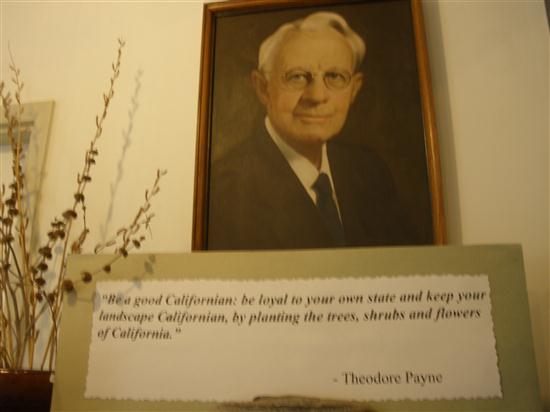
Theodore Payne Foundation Nursery & Gardens, Sun Valley - Theodore Payne (or T-Payne for short...ay) was an Englishman in the late 19th century who was so fascinated with California native plants, he moved here, only to discover that agricultural development in Southern California was depleting the land of its native vegetation. So, as part Luther Burbank, part Johnny Appleseed, he dedicated his life to preserving native plants, even going up into the hills and fields to collect seeds. T-Payne created native plant displays in Exposition Park, Cal Tech and Descanso Gardens and owned nurseries in Downtown and in Atwater (before it became a "Village," yo). T-Payne retired and died in the early 1960s, but The Theodore Payne Foundation was formed to carry on his work. In Sun Valley, the nonprofit operates a nursery where one can buy numerous varieties of potted natives and a living native plant environment growing in the hillside (you can even just drop by and have a picnic -- there's even tables there). They also conduct classes and native garden tours.  They should be the first place to check out if you want to learn about native plants!
Real talk from T-Payne.
Vista Hermosa Natural Park, Downtown - The Militant covered its opening back in '08, revealing a new place to get a killer Downtown skyline view. But this 10.5-acre plot of land, originally intended to be part of the LAUSD's beleaguered (isn't that being redundant?) Belmont Learning Center complex features the scent of sage and other native varieties. It's run by the Santa Monica Mountains Conservancy for the specific purpose of re-introducing native plant environments in urban Los Angeles.

Angels Knoll Park, Downtown - Speaking of DTLA, this mini-park, directly adjacent to Angels Flight Railway, is a virtual mini-version of Vista Hermosa, with fragrant Cleveland Sage bushes growing abundantly, as well as decorative native succulent plants (Of course, the pleasant sage aroma was likely intended to help mask the smell of the local homeless people's urine...)

Griffith Park - Toyon, chamise, sage and other chaparaal plants grow here in the eastern end of the Santa Monica Mountains. Hop on any of the 4.310-acre park's hiking trails and you'll see them. In some cases, they've been growing there just as they have in the days of the Tongva.

Bernard Field Station, Claremont - This 86-acre wildlife peserve along Foothill Blvd on the campus of The Claremont Colleges exists for both conservation and study, with both wild and human-planted native growth in a coastal sage scrub environment. As a bonus, native birds, reptiles, insects and wild mammals can be seen roaming the grounds.


'Cause native wetlands have a way with B-A-L-L-O-N-A...
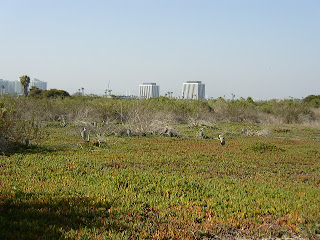
Ballona Wetlands, Playa Del Rey - Even before he learned about Tongva culture, The Militant was downright outraged at Steve Soboroff's Playa Vista development taking over our last vestige of natural wetland in Los Angeles (apparently bad ideas aren't foreign to him...). Having biked the adjacent Ballona Creek bike path for nearly two decades, The Militant couldn't help but try to mentally block out all modern development and imagine taking a look back in time. Eventually, he did learn that this was the Tongva village of Saangna, which also included a large ancient sacred burial ground which was discovered during Playa Vista excavation.

Others have recently listed traits and criteria on being a true Angeleno -- well, The Militant believes that you can't be a true Angeleno without visiting the Ballona Wetlands and appreciating the (relatively) untouched serenity that have lasted for centuries. Developments can always be built elsewhere, but the wetlands are irreplaceable. May this land be disturbed no more!

Friday, September 23, 2011

Native Month: The Secret Life Of Local Plants (Part 1)


Los Angeles might frequently be dismissed as a "desert," but that's not actually accurate. The Militant believes people who tend to use that term are usually transplants want to secretly push a negative image of emptiness, of lifelessness, that there was nothing here to begin with, and therefore this place means nothing.

The truth is, Los Angeles is in a Mediterranean climate zone that is shared by only a handful of places in the world: Southwestern Australia, Southwestern South Africa, the central coast of Chile and the coast regions of the Mediterranean Sea. Is Cannes, France also considered an "empty, lifeless desert?"

The other truth is, before colonization, all of California was a lush paradise filled with an amazing biodiversity. In an example of life imitating art, The Spaniards named this part of the world after a paradside-like island of the same name fron a 16th century novel called Las Sergas de Esplandián by Garci Rodríguez de Montalvo.

Many of the indigenous plants are gone, either supplanted by introduced species from other parts of the globe or outright torn out by human development. But in our remaining wetlands, meadows and hillsides, they prosper. And thanks to contemporary issues like water conservation and ecological sustainability, California native plants are making a comeback in our parks and frontyards.

The Militant consulted one of his operatives, who started a few native plant gardens in his neighborhood and got a crash course in this whole native plant business. Needless to say, he can't wait to start a native plant garden in his compound!

Nearly all of our native flora are drought-tolerant since their growth cycles are compatible with our dry, rainy and blooming seasons (see, we do have seasons after all). They need no fertilizer since they know the soil. They also prosper by growing roots deep enough into the soil where moisture or a water source is always present. And best of all, they are a source of food, shade and shelter for some of our native insects and animals, being a foundation for our native ecosystem.

The plants in this post are but a sampling of the many varieties of So Cal indigenous flora and is by no means a comprehensive guide. But they are common and/or interesting enough for you to take notice when you spot them.

Native Plants
 
White Sage - This was perhaps the most important native plant to the Tongva and neighboring tribes. Its leaves are burned as incense for ceremonial uses, which is why white hippie/new age types like to rape and pillage the plant in the wild and sell for a profit as smudge sticks (capitalism, yaaaaay). They also provide high medicinal value (usually drunken as a tea), curing everything from coughs to colds to stomach aches. The greenish-grey leaves give off a strong, distinct scent when rubbed. In the Spring, tall flower stalks come from seemingly out of nowhere and bloom, making it a favorite nectar source for bees -- it's also known in its Latin scientific name as "bee sage."


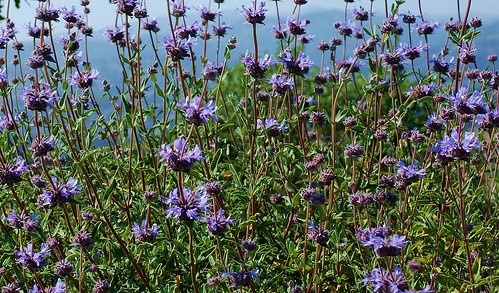
Cleveland Sage - Named after plant collector Daniel Cleveland, this sage (pictured at top of the post), popular with butterflies and hummingbirds, as well as California quails who seek shelter in its bushes, has an etremely pleasent, minty scent from its small green leaves (rub your fingers on one and take a sniff...ahhh). Its purplish-blue flowers bloom from orb-like stalks in the Spring and Summer. Got bedbugs (you know those bloodsucking parasites that East Coast people bring with them)? Take a bunch of Cleveland sage leaves and sprinkle them around your beddings. The sweet scent you smell is downright overpowering for them little critters, and they are naturally repelled by it. NATIVES FTW!


Toyon
- This hillside bush with dark, leathery green leaves and spiny edges are common sights in chaparral environments like the Santa Monica Mountains. If you hike Runyon Canyon or Griffith Park, you can't miss them. In the winter, they sprout berries (edible, but not very tasty, unless you're a deer or a bird) and resemble a holly. In fact, the toyon is also called the California Holly, and was the origin of the 9-letter name given to a famous landmark sign, the entertainment industry and an entire community that was built over the Tongva village of Cahugna. For more toyonic talk, check out The Militant's post from Christmas of last year.

Chamise - One of the most common chaparaal (the term "chaps" refers to the sturdy pants one must wear when navigating through the typically spiny plants in that environment) flora, this plant is also highly flammable during fire season due to its resin content. But like all natives, it adapts well to its conditions. In fact, fire is a part of its life cycle and not only germinates following a conflagration, but releases its own toxins into the soil to prevent competitor plants from growing on its turf. This plant is straight up gangsta!


Manzanita
- Not just a street in Silver Lake, but a type of plant of varying sizes known for its twisty branches, reddish hard wood trunks, bright floral blooms and berries that resemble tiny apples (hence its name in Español). The Tongva resourcefully used its leaves as toothbrushes, made cider from the berries and tea from its bark to cure stomach maladies. They also used its wood to make utensils and tools. Butterflies and hummingbirds can't get enough of their flowers.


Desert Agave
- This succulent plant that's grows primarily in the deser region can also be found in the Los Angeles area, in the more drier corners. This spiny plant lives for about 10-20 years and only flowers once in its lifetime, and then dies. But throughout its lifespan, agave "pups" will spring up from the ground, seemingly multiplying itself. Although agave is associated with tequila, this isn't the same variety that produces the booze (it's possible though, but not very commonplace). But the Tongva and the neighboring Cahuilla tribe used it for food, rops, utensils, weapons, soap and medicine.

Native Trees


Oak 
- The Coast Live Oak and the Scrub Oak most common varieties 'round these here parts. These trees were (and still are, relatively speaking), still numerous in the region, enough that places like Encino (Español for oak) and Thousand Oaks were named after the trees. The trees also grow acorns, popular not just with our native squirrels, but with the Tongva, who used them in multiple food uses. Aside from eating the acorn nuts, they also ground them and made them into flour, which was made into baked goods.

California Fan Palm - Palm trees are a Los Angeles icon no doubt, and developers and city planners were eager to plant them Like All Over The Freaking Place back in the 1920s-1940s. About half a dozen types of palms can be found locally, but only one is actually native: The California Fan Palm. It's actualy native environ is the lower desert region, where they grow in groves next to water sources. Places like Twentynine Palms and Palm Springs were named after these trees, but a few could be found in the Tongva nation. The Tongva's neighbors to the east, the Cahuillas (a.k.a. The Iviatim), used the fruit of the palms for food and flour, and used the leaves for sandals, baskets and roofing material.  


California Sycamore
-
This hardwood tree is known to grow near rivers, streams and foothills. It's also a deciduous tree, which means its green leaves turn orange in the fall (You East Coast people who constantly bitch about us "not having seasons" should cream in your pants just for that). Sycamore Avenue in Hollywood and Aliso Street in Downtown were named after the tree. And of course, our stately local sycamore was revered by the Tongva, most especially in center of the village of Yangna, especially one 400-year old specimen which you may or may not have heard of before.

If anything, The Militant noticed that our native plants share much in common with its native people: Deep roots, low maintenance and thrive best in this climate!

Having trouble spotting native plants? The Militant will show you where to find them in his next post!

Monday, September 5, 2011

Native Month: We Are A Part Of The Tongva Nation

This week month, to celebrate 230 years of Los Angeles, the Militant will help you understand the Los Angeles before September 4, 1781 - the indigenous people, animals, plants and even the literal ground we walk/drive/bike/take transit/skate on. Lots of militant research went into this folks, so the Militant would not only appreciate your reads, but passing the links on to others so that they may learn as well. With a better understanding of the Los Angeles before Los Angeles, we can be better and smarter Angelenos. So welcome to The Militant's second weeklong topical series -- NATIVE WEEK! MONTH!

Nachochan?!*

From the get-go The Militant firmly and blatantly established and identified himself as a Native Angeleno -- meaning someone who was born and raised in this City. Ever a defender of his fellow natives...

But us (Contemporary) Natives are relative transplants themselves compared to the real natives of Los Angeles. Like us (Contemporary) Natives, the Indigenous Natives were derided, considered culturally inferior and largely treated as though they never really existed by their respective invaders.

Yesterday, we celebrated the 230th anniversary of the founding of The Pueblo of Our Lady Queen Of The Angels of The River of The Little Portion. But history being multi-layered, multi-faceted and most of all, of multi-perspectives, September 4, 1781 also marked the end of an entire nation, a culture, a way of life.

That nation, that culture, that way of life was the Tongva.

They weren't even given the benefit of self-identity. Most history books refer to them as "Gabrielinos," the name given to them by the Spanish settlers, referencing the San Gabriel Archangel Mission. But they called themselves Tongva.

The Militant doesn't claim to be an expert on Tongva or Native American culture (already he has revealed that his parents were immigrants of an unspecified third world country, so that kinda assumes he doesn't have Tongva blood (that he knows of, at least...)). But he has done hours upon hours of militant research, so that you will have a better understanding of who the Real Los Angeles Natives were.

To understand the Tongva people, one must throw out most of the preconceptions we have of Native Americans. The Tongva didn't live in teepees, wear moccassins or beat on drums.

The Tongva, which meant, "People of the earth and ocean," were considered by historians to be pretty advanced and civil among the 60-plus Native American tribes of California. They were only one of two tribes (the other was the neighboring Chumash, a related coastal tribe that inhabited today's Ventura, Santa Barbara and San Luis Obispo counties) who built seafaring boats, called a te'aat. The Tongva built their craft out of wood planks and tule reed (a native marsh plant that also gave origin to the name of Tulare, CA) and waterproofed with tar (The Tongva knew of many places where to find this). They used boats not just for fishing, but for transportation - to visit villages in the eight islands offshore that we now know as the Channel Islands.

They lived in large dome-like huts called kiches (pictured, right) made of willow and tule reeds. They were multi-family dwellings, housing up to some 40-50 people. They all had a single entrance, plus a hole at the roof of the dome to allow for smoke ventilation when food was cooked in the center.

Like many Native American tribes, the villages, which were scattered all across the Southland, from the San Fernando Valley down to southern Orange County, were led by chiefs, who succeeded by heredity, like monarchs. They also devised a dispute resolution system where disputes between two village chiefs were settled by having a third-party chief intervene, and his verdict became the final word on the matter. Guilty parties were fined in the form of food or animal skins.

They were considered to be thoughtful, rational and unlike many other tribes, never let inter-tribal issues escalate into killings. Robbery was an unknown concept in the tribe and murder extremely rare (There was a death sentence for the rare occasions those things did happen). An attack on a single family was considered an attack on the entire tribe. Also, if a man was caught cheating on another man's wife, then the other man took the first man's wife.

The Tongva created art, in the form of weaving baskets and making sand paintings. Their music was performed on flutes, rattles and vocal melodies or chants, which was played during wardances, celebrations or religious rituals.

They had their own religion and even built houses of worship - a circular enclsure made of wooden stakes and willow twigs. They prayed to a Supreme Being, in the form of victory thanksgiving, vengeance requests and honoring the souls of dead relatives. In their creation belief, animals were created first, then man, then woman. Then the Supreme Being went to a heaven where he receives the souls of all who died. And unlike some other Native American tribes, the Tongva did not believe in the concept of bad or evil spirits.

They revered certain animals - the dolphin, which they believed to be an intelligent being created to guard the world from harm. They respected owls, which they never killed. They believed the sight of a crow was a warning that a stranger was approaching. They never hunted whales, though whenever a dead whale washed ashore (considered a blessing), the Tongva would cook its meat and blubber and used its bones to make tools or structure frames. They did eat rabbits and other birds, which were hunted with a two-foot long curved flat stick.

The Tongva were also thought to be dominant in that when they made contact with other tribes or foreign cultures, they were the more influential ones. With nearly all Tongva wiped out by the Spanish, Mexicans and Americans, that might not have been the case in the overall picture, but the Tongva people still left their mark on today's Southern California.

For one, the trade routes they established were recognized and continued by all of the colonizing cultures that followed. The Ramona Parkway (now the San Bernardino Freeway) started out as a trade route, as did the Cahuenga Parkway (now the Hollywood Freeway).

Signal Hill, which the Militant visited in his Long Beach Week series back in June, was named so because of the smoke signals emanating from its peak to communicate with villagers across the water in Pimugna (Catalina Island).


There were an estimated 5,000 to 10,000 Tongva living in Southern California prior to the arrival of Spanish missionaries and settlers. Most of them died of foreign diseases introduced by the Spanish, and treatment by the Mexicans and Americans wasn't any better. A few hundred people today do claim Tongva blood and keep their cultural traditions alive, although the tribe is not currently recognized by the U.S. Government, which is why there is no Tongva Reservation anywhere.


Another matter is that today's Tongva is fraught with intra-tribal infighting -- one side aims to build a Tongva gaming casino (they'e eyed Long Beach, Inglewood and Garden Grove as possible sites), while the other side wants nothing of it. The Militant doesn't yet have an opinion either way on the casino issue, but he definitely thinks they deserve to be federally recognized once they work out their differences (Maybe get a third party to help mediate...).

This is by no means a comprehensive profile of the Tongva. If any experts of Native American cultures or better yet, Tongva descendants want to correct and chime in, The Militant welcomes your comments wholeheartedly. The Militant also wishes to make no absolute moral judgment on the genocide of our indigenous peoples, nor desire to revise history - if the Tongva nation were never disturbed, there would obviously never have been a Los Angeles (and therefore no Militant Angeleno), and certainly nearly none of us would be here today. But he does wish that everything could have been handled much better, and that the Tongva should have been still numerous and intact enough to contribute to Los Angeles' unrivalled tapestry of cultural diversity.The Militant simply wants the inhabitants of 21st Century Los Angeles - (Contemporary) Natives, Immigrants and Transplants alike - to learn about the most forgotten of forgotten histories. And to make a blatant reference to a certain unspecified online rival, the most hidden of hidden Angelenos.

The entire Spanish/Mexican/Californian/American histories of this City - combined - spanned for a mere 230 years. But Tongva history is believed to have lasted some 10,000 years. If a hardcore Contemporary Native bows down and gives massive respect to the Tongva, then it must mean the most recent, arrogant, self-entitled, fresh-off-the-Greyhound transplant needs to bow down to several masters. It's only right to respect and understand those who walked the land many more miles than you yourself did. So let's all give long-overdue props to the Real Los Angeles natives - The Tongva.

* Translation: "Whatup?!" in Tongva.
Wednesday, April 20, 2011

Happy B-Day, George Takei - Actor, Activist, (Almost) City Councilman

Today is the 74th birthday of native Angeleno Geroge Takei, who is many things - actor, writer, Asian American and LGBT community activist and pop culture icon. But did you know he was almost elected to the Los Angeles City Council?

It goes like this - in 1973, after The Great Tom Bradley made history being elected as Los Angeles' first Mayor of African American descent in the May 29 General Municipal Election, he had to resign his incumbent seat as 10th District City Councilman, which he held since 1963.

With the seat vacant, a Special Election took place on September 18 of that year, which attracted around a dozen candidates for the seat. Being a Special Election filing a vacant seat, there was to be no run-off; the top vote-getter wins the office.

Takei ran for the Mid-City area council seat under the ballot description, "Television Moderator" - he was the co-host of Expression East/West, a local public affairs show that aired on KNBC at the time.

City legislative deputy David Cunningham won the election with 8,062 votes and served the seat until 1987, when he was succeeded by Nate Holden. The runner-up? Geroge Takei, with 6,387 votes - losing by a tally of only 1,675.

Had Takei been elected, he would have been the City's first Asian American on the Council, which was eventually achieved by Michael Woo, elected to the 13th District in 1985 (Takei would not have been the first openly-gay City Councilman (assuming he would have come out back then), as Joel Wachs preceded him in 1971). But he would have certainly become the first celebrity to serve in Los Angeles City office - not an unusual thing even back then, considering who was sitting in the Governor's office at the time.

Takei did have some experience in public policy; Mayor Bradley appointed him to the Board of Directors of the Southern California Rapid Transit District (the predecessor agency to today's Metro), where he served for 11 years. While filming Star Trek: The Motion Picture in 1978, he was called off the set to cast a tie-breaking vote for the RTD to create what we know now as the Metro Rail system. He was also credited with helping to create an arts program for Metro Rail, which is why nearly every Metro station is decorated with public art pieces.

Who knows what things would have been like had he been City Councilman? Mayor Sulu? Only a visit to a parallel universe through a multidimensional wormhole could tell.

George Takei campaign poster image from AngryAsianMan.com