Wednesday, September 21, 2011

Number 22 Gets His 20th

The Militant was there on Tuesday night to witness the first Dodger pitcher to get his 20th win since 1990. Back then, Clayton Kershaw was still in diapers. He's also the first Dodgers pitcher since 1946 to defeat the Giants five times in one season, and defeated two-time CyYoung winner Tim "Timmmeehhh" Lincecum in four out of four matches.

And speaking of Cy Young.... :)

You all should know that you can't spell "CLAYTON" without "CY."
The pwner of the San Francisco Giants, Clayton Kershaw.
It was also UCLA cap night, and the Militant may or may not have worn his. Despite being at the game (the turnout on Tuesday was actually fairly decent, judging by the slowness of the Dodger Stadium Express bus...), The Militant will let you all know that he still made good on his McCourt Boycott: He bought his Field Level tickets from a seller near Azucsagna who got an in with a sponsored ticket source, and got them for $15 each(!). The Militant also did not buy any food at The Stadium and took the Dodger Stadium Express bus. So Tuesday night's game by the numbers: Dodgers 2, Giants 1, Kershaw, 20-5 and Frank McCourt gets $0.00 from The Militant's wallet!
Das right...


Monday, September 19, 2011

U Can't Miss This - The Lyrical Map Of Los Angeles (Stop...Hammer Time!)

Last week, The Militant stealthily slipped into Westwood's Hammer Museum to attend a cartographical conversation by Los Angeles In Maps author Glen Creason and artist J. Michael Walker, best known for his All The Saints In The City Of Angels artwork based on saintly city street names.

The artist took his geographical themed creations to another level by creating "City in Mind: a  Lyrical Map of the Concept of Los Angeles" a 23-foot long colored pencil-on-butcher paper illustration of a Los Angeles map highlighted by quotes and drawings of literary and lyrical figures through the ages, centered on various written perspectives of Los Angeles.

Everyone from Fr. Juan Crespi to Raymond Chandler to Joan Didion to Octavio Paz to Charles Bukowski to Jonathan Gold to Tupac Shakur gets quoted here, in a horizontal swath cutting from The Eastside to The Westside, which, incidentally, was direction the City proper expanded.

The illustration, which the artist contends, "still isn't quite finished yet" (there's a good amount of empty real estate and some more quotes to add), involved months of his own literary research, but only took days to draw.

Obviously something like this is MILITANT APPROVED! You must check this thing out! The Militant commands you!

The map is on display until Sunday, October 9 (which is also a CicLAvia Day) as part of the Eastside-based Libros Schmibros' temporary Westwood bookstore, located in the lobby of the Hammer, also until 10/9. There are also a number of interesting lectures that Los Angeles geeks like The Militant and some of you reading this may or may be interested in, so check their site for the full schedule of events. The temporary bookstore is FREE to visit and does not require museum admission.

Will Rogers said it right, even back then.
The Militant hates Westwood traffic with a passion, but fortunately, Metro's Rapid Line 720 stop is right outside the Hammer's front door, so save yourself a headache or two and load up that TAP card!

Friday, September 16, 2011

Native Month: El Aliso - The Ancient Center Of Los Angeles

Kissing like a bandit, stealing time,
underneath the sycamore tree...

Much has been said about Los Angeles "not having a center." Back in 2008, while singlehandedly settling the whole Westside vs. so-called Eastside geographical dichotomy, The Militant did come to the conclusion that Los Angeles indeed has a center.
Many of you know that Los Angeles started out as El Pueblo de Nuestra SeƱora de la Reina de los Angeles del Rio Porciuncula. That pueblo was founded on the site of a Tongva village called Yangna, or Place of the Poison Oak (That oak is Poiiiisonnnnn!). Some of you are already aware of Yangna, though a few people out there have the concept all messed up.

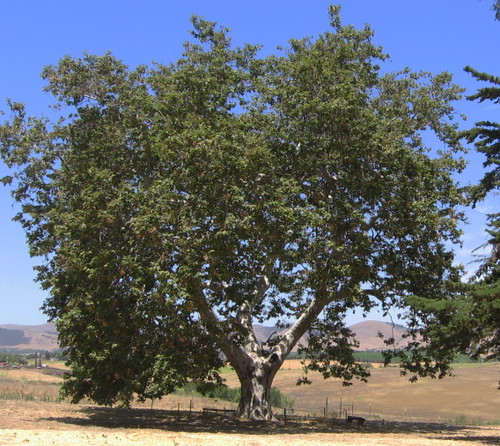
At the center of Yangna was a large, six-story sycamore tree that the Pobladores called "El Aliso." But to the native villagers of Yangna, it was no ordinary tree. It was a sacred site where chiefs of neaby villages would convene.

Over time, as the settlement grew, the Tongva were kicked out and their once-great village reduced to parcel property. In the 1830s, the land was bought by a Frenchman named Jean Louis Vignes, who used part of it as a vineyard. Name sounds familiar? You may or may not have been on the street that bears his name.

Here's a pic of the actual El Aliso tree
(note the "Philadelphia" in the lower right corner for the brewery)
Much thanks and props to militant reader Natalie Manarino for sending this to The Militant!

In 1892s, the tree was unceremoniously cut down for firewood to make more room for the Philadelphia brewery (damn those East Coasters...) which eventually became the Maier Brewing Company, and later Brew 102. The tree, which survived floods and droughts, was documented to have about 400 annual rings on it - when Columbus arrived from Europe, this tree was but a seed in the ground.

The early City planners were nice enough to name a street after the sacred Sycamore. The exact location of the tree was found to be in the Alameda on/off ramp for the 101 Freeway, just south of the train platforms of Union Station:

Next time you drive on the 101, ride on the (M) Gold Line on the overpass bridge or even visit that nearby strip club, take a moment to pay your respects to the Tongva people who once lived for millenia in the village of Yangna - The Los Angeles before Los Angeles.

Wednesday, September 7, 2011

Native Month: Wild Wild Life

Animals like this Brush Rabbit are only found
on the West Coast. Represent! 
One night, as The Militant took out the trash at his secret compound he saw it...just...staring at him.

The Militant, only rarely having seen it at his compound, simply blurted to the grey procyon:

"Dude, you're a raccoon!"

It just kind of stood there, with a "WTF?" look on its face, then deflty turned away.

Today on The Militant Angeleno's Native Week,after indroducing to you the native people and their villages, The Militant will talk about some the native animal life in the Los Angeles area.

Interestingly, despite heavy urbanization and development, most of the native animal species of this region are still around and can easily be seen, climbing on trees, scurrying on the grass, flying in the skies, prowling through the hillsides, and wading on the local waters. The Militant notes that in the past 230 years, the inhabitants of Los Angeles have actually done a better job preserving its native animals than its native people.

Although it is quite obvious that decades of developing the human environment have greatly compromised the habitats of these animals, either pushing them farther away or unintentionally pulling them closer.

Now, there are many animal species that are native to our area, and the Militant could even start another blog to talk about them all (he won't), but this list is a good primer. Birds are too numerous, but fortunately, public art comes to the rescue in this case. So the Militant will just limit the scope to land mammals you may or may not see on a daily basis.

Coyotes are probably the most popular animal of legend in the Southwestern U.S. A natural predator, they are naturally feared. But in actuality, most of the time, they actually fear humans, especially since development and sprawl have invaded their habitat. And with that, interactions between coyotes and humans and their domesticated animals have increased. Recent unfortunate human and pet encounters with coyotes have caused Orange County's Laguna Woods to make it legal to shoot them, but like The Red Hot Chili Peppers once said, True Men Don't Kill Coyotes.

The Mule Deer can be seen in hillsides. Straight up vegetarians, they have been a problem for some folks as these critters prey on garden plants. People can deer-proof their gardens via fencing or establishing plants and shrubs that deer aren't fawn'd fond of eating.

Mountain Lions, or more specifically, the North American Cougar (the Militant will refrain from making predictable older single women jokes, at least for now). But like the other kinds of cougars, the wildlife version is commonly feared (Okay, can't resist that one). Though there have been notable incients of mountain lion attacks, the animal is also normally afraid of humans, though will attack when provoked. Still, humans cause far more harm to mountain lions than the opposite. Just days ago, a mountain lion was struck by a car while crossing the 405 in the Carmageddon Pass.

Opossums - You see these critters all over the city, especially in backyards, making nasty hissing sounds (usually when they're afraid). People fear them because they are thought to carry rabies, but dem 'possums actually have a high level of immunity against rabies. The only marsupials found in North America, they're also omnivores that eat plants, berries, snails, snakes, rodents and even roadkill. Unfortunately, due to their slow velocity they themselves frequently become roadkill. Still they like to be left alone and it's best to keep your trash bins secure from them.

Rabbits were so numerous in the Southland, that an entire valley in southeastern Ventura County was named after them. As The Militant mentioned on Monday, the Tongva hunted rabbits for dinner. Two native species are common in the region: The Desert Cottontail, living in drier environs, and the smaller Brush Rabbit, which inhabits our local chapparal vegetation.

Raccoons, like opossums, are onivorous continental scavengers that fancy our trash cans. There have been incidents of them little masked marauders ravaging our local neighborhoods. Same as opossums, best to leave them alone and keep your trash bins secure from them. Unlike opossums, these dudes have attitude. Not just in The Militant's aforementioned encounter, but the fact that they can bite you and even have the ability to turn doorknobs.

Skunks are very common in hillside communities, especially noted for their stank, which can be smelled several freeway exits away. The Militant could easily recall the time he dropped on a Los Feliz-based operative off home one early morning and witnessed a Striped Skunk take a morning jog down the sidewalk on Hollywood Blvd. The Western Spotted Skunk is another native species that's common in these here parts. If you see one, try not to startle them. And if you get sprayed, run down to the store and get thee some baking soda and hydrogen peroxide to neutralize the stank and wash it off.

Squirrels are common in our backyards and parks, but the most visible one, the Eastern Fox Squirrel is not native. It was introduced by Civil and Spanish American war veterans around 1904 who stayed at the Sawtelle Veteran's Home. They brought them in as pets from Tennessee and soon got introduced to the wild. The native squirrels though are the California Ground Squirrel and the Western Grey Squirrel (mostly found in the foothill and mountain areas)

Despite being a large City, Los Angeles has its own animal kingdom. Again, they were here before we were so if ever there were another reason for discouraging suburban sprawl (other than traffic, long commutes, air pollution, obesity, real boring culture and Claim Jumpers), it would be to lay off their gang turf. Because these four-legged OGs don't mess around.


Tuesday, September 6, 2011

Native Month: Know Your "Na!"


Yesterday's first installment of Native Week gave you a profile of the Real Los Angeles Natives - The Tongva Native American tribe. Today, The Militant will show you where they lived.

We now know Los Angeles (the region) as a bustling metropolis megalopolis of some 15 million people - larger than the population of nations like Ecuador, Guatemala or Cambodia (!) And rightfully so -- this was a nation.

The Tongva was also surrounded by other nations - the Chumash (Ventura and Santa Barbara counties), the Tataviam (North San Fernando Valley and Santa Clarita Valley), the Cahulla (eastern Inland Empire) and the Payomkuishum (North San Diego County).

Take a look at the names and locations of Tongva villages, superimposed over a map of today's Los Angeles (Map updated 9/16/2011):
(Click on map to crumulently embiggen!)
This map was done with much Militant research, but it is no means comprehensive. There were more villages, whose names escaped documented hustory. Some of the locations are generalized and not precise.

Of course, the Tongva nation wasn't nearly as populous - it only had somewhere between 5,000 and 10,000 people.

By looking at the map, you would notice a few things. First, the densities of the villages. Unlike modern Los Angeles, which has its development and poulation centered around Downtown Los Angeles and the area slightly to the west of it, the villages were largely located along the rivers (from west to east on the map: Ballona Creek (which once connected with the Los Angeles River during certain seasons), The Los Angeles River, The San Gabriel River and The Santa Ana River). There were also large swaths of nothingness, mainly because, there were no natural resources (water source, farmable/huntable land) to take advantage of.The Tongva, being a seafaring people, also lived along the coast (Yes indeed, they before anyone else knew the value of beachfront property). There are also a large accumulation of villages (exact locations estimated only) clustered around the San Fernando and San Gabriel areas - of course, those are where the Spanish settlers established the Missions.

Second, though most of these names sound strange and exotic, some of them sound very familiar, and rightfully so -- their present-day names were Hispanicized versions of the original Tongva village name. Places like Cahugna (Cahuenga), Topagna (Topanga), Tuyunga (Tujunga), Azucsagna (Azusa) and Kukamogna (Rancho Cucamonga).

Lastly, most of them end with the letters "-na" or "-gna" (That was too weird sounding for the Spaniards, so they pronounced it "-nga"). That suffix meant, "place." These days, people ask you, "Where you from?" or "Where you stay?" The Militant asks, "Where's your na?"

Can you spot your neighborhood or city on the map?

Here's a list of Tongva villages (their name meanings if known) and their present-day locations (List updated 9/16/2011):

Achois – San Fernando
Ahaugna - North Long Beach, near Los Angeles River
Ahwaagna – Long Beach (Downtown/coast)
Akuuragna - Pasadena-San Marino
Ajaarvongna - Puente Hills
Amupungna - Compton
Apachiagna - Boyle Heights/East Los Angeles
Ashawagna - Chatsworth
Atavsangna - West Hills
Atavayagna - Palos Verdes
Awigna  - La Puente
Alyeupkigna – Santa Anita
Azucsagna (“Place of the grandmother”) – Azusa
Cahugna (“Place of the hill”) – Hollywood/Studio City
Chokishgna – Bellflower
Chowigna – Palos Verdes
Cucamogna – Rancho Cucamonga
Engvangna – Redondo Beach/Torrance
Guaspita – Westchester bluffs (LMU campus)
Hahamongna – Glendale/Pasadena
Homhoangna - Colton
Houtgna – Monterey Park/South San Gabriel
Huachongna - Culver City
Hutukgna - Anaheim
Huutngna - Watts/Willowbrook
Isantkagna - Mission Viejo
Isanthcogna – San Gabriel
Joatngna - Mt. Baldy area
Juyubit – San Gabriel, along the river
Kenyaangna - Newport Beach
Kinkipar - San Clemente Island
Komiikrangna - Malibu Canyon
Kowagna – San Fernando
Kuruvugna – West Los Angeles
Lukupangna – Huntington Beach/Costa Mesa
Masaugna – San Pedro
Maugna – Los Feliz
Momwahomomutngna - San Dimas
Moniikangna - Palos Verdes
Motuucheyngna - Seal Beach
Moyogna – Newport Beach
Muuhungna - Sylmar
Nacaugna – Downey
Okowvinjha – San Fernando
Ongoovangna - Redondo Beach
Ongobehangna - Malibu area
Pahav – Corona (southeast)
Pasbengna - Santa Ana
Pasinogna – Chino Hills
Paxauxa - Norco
Peruksngna - City of Industry
Pimocagna ("Place of the running water") – Pacoima
Pimugna – Santa Catalina Island
Pubugna – Long Beach (Alamitos/CSULB campus)
Puntitavjatngna - Pasadena
Pwingkuipar (“Full of Water”) – Playa Del Rey/Westchester
Quapa - Encino
Saangna – Santa Monica/Venice/Marina Del Rey
Sawayagna – San Fernando
Sehatgna – Whittier Narrows
Sheshiikuanungna - San Marino
Shiishongna - Corona
Shwaagna – Harbor City/Wilmington/Lomita
Sibagna – San Gabriel
Sisitcanogna – Northeast Pasadena
Siutcangna - Sherman Oaks
Sonagna - Downtown Los Angeles
Suangna – Cerritos
Tajauta - Willowbrook
Tibagna - North Long Beach/Lakewood
Toibigna - Pomona
Topagna (“The place above”) – Topanga
Torojoatngna - Claremont
Totongna - Northridge
Tovimongna - Coastal Palos Verdes
Toviseagna – San Gabriel
Tuyugna ("Place of the mountain range") – Tujunga
Wajijangna - Chino Hills
Watsngna - Fontana
Weningna - Covina
Wenot (“River”) – Los Angeles, along the river
Wikangna - Verdugo Hills
Yangna (“Place of the poison oak”) – Downtown Los Angeles

Do you know your Na?

Monday, September 5, 2011

Native Month: We Are A Part Of The Tongva Nation

This week month, to celebrate 230 years of Los Angeles, the Militant will help you understand the Los Angeles before September 4, 1781 - the indigenous people, animals, plants and even the literal ground we walk/drive/bike/take transit/skate on. Lots of militant research went into this folks, so the Militant would not only appreciate your reads, but passing the links on to others so that they may learn as well. With a better understanding of the Los Angeles before Los Angeles, we can be better and smarter Angelenos. So welcome to The Militant's second weeklong topical series -- NATIVE WEEK! MONTH!

Nachochan?!*

From the get-go The Militant firmly and blatantly established and identified himself as a Native Angeleno -- meaning someone who was born and raised in this City. Ever a defender of his fellow natives...

But us (Contemporary) Natives are relative transplants themselves compared to the real natives of Los Angeles. Like us (Contemporary) Natives, the Indigenous Natives were derided, considered culturally inferior and largely treated as though they never really existed by their respective invaders.

Yesterday, we celebrated the 230th anniversary of the founding of The Pueblo of Our Lady Queen Of The Angels of The River of The Little Portion. But history being multi-layered, multi-faceted and most of all, of multi-perspectives, September 4, 1781 also marked the end of an entire nation, a culture, a way of life.

That nation, that culture, that way of life was the Tongva.

They weren't even given the benefit of self-identity. Most history books refer to them as "Gabrielinos," the name given to them by the Spanish settlers, referencing the San Gabriel Archangel Mission. But they called themselves Tongva.

The Militant doesn't claim to be an expert on Tongva or Native American culture (already he has revealed that his parents were immigrants of an unspecified third world country, so that kinda assumes he doesn't have Tongva blood (that he knows of, at least...)). But he has done hours upon hours of militant research, so that you will have a better understanding of who the Real Los Angeles Natives were.

To understand the Tongva people, one must throw out most of the preconceptions we have of Native Americans. The Tongva didn't live in teepees, wear moccassins or beat on drums.

The Tongva, which meant, "People of the earth and ocean," were considered by historians to be pretty advanced and civil among the 60-plus Native American tribes of California. They were only one of two tribes (the other was the neighboring Chumash, a related coastal tribe that inhabited today's Ventura, Santa Barbara and San Luis Obispo counties) who built seafaring boats, called a te'aat. The Tongva built their craft out of wood planks and tule reed (a native marsh plant that also gave origin to the name of Tulare, CA) and waterproofed with tar (The Tongva knew of many places where to find this). They used boats not just for fishing, but for transportation - to visit villages in the eight islands offshore that we now know as the Channel Islands.

They lived in large dome-like huts called kiches (pictured, right) made of willow and tule reeds. They were multi-family dwellings, housing up to some 40-50 people. They all had a single entrance, plus a hole at the roof of the dome to allow for smoke ventilation when food was cooked in the center.

Like many Native American tribes, the villages, which were scattered all across the Southland, from the San Fernando Valley down to southern Orange County, were led by chiefs, who succeeded by heredity, like monarchs. They also devised a dispute resolution system where disputes between two village chiefs were settled by having a third-party chief intervene, and his verdict became the final word on the matter. Guilty parties were fined in the form of food or animal skins.

They were considered to be thoughtful, rational and unlike many other tribes, never let inter-tribal issues escalate into killings. Robbery was an unknown concept in the tribe and murder extremely rare (There was a death sentence for the rare occasions those things did happen). An attack on a single family was considered an attack on the entire tribe. Also, if a man was caught cheating on another man's wife, then the other man took the first man's wife.

The Tongva created art, in the form of weaving baskets and making sand paintings. Their music was performed on flutes, rattles and vocal melodies or chants, which was played during wardances, celebrations or religious rituals.

They had their own religion and even built houses of worship - a circular enclsure made of wooden stakes and willow twigs. They prayed to a Supreme Being, in the form of victory thanksgiving, vengeance requests and honoring the souls of dead relatives. In their creation belief, animals were created first, then man, then woman. Then the Supreme Being went to a heaven where he receives the souls of all who died. And unlike some other Native American tribes, the Tongva did not believe in the concept of bad or evil spirits.

They revered certain animals - the dolphin, which they believed to be an intelligent being created to guard the world from harm. They respected owls, which they never killed. They believed the sight of a crow was a warning that a stranger was approaching. They never hunted whales, though whenever a dead whale washed ashore (considered a blessing), the Tongva would cook its meat and blubber and used its bones to make tools or structure frames. They did eat rabbits and other birds, which were hunted with a two-foot long curved flat stick.

The Tongva were also thought to be dominant in that when they made contact with other tribes or foreign cultures, they were the more influential ones. With nearly all Tongva wiped out by the Spanish, Mexicans and Americans, that might not have been the case in the overall picture, but the Tongva people still left their mark on today's Southern California.

For one, the trade routes they established were recognized and continued by all of the colonizing cultures that followed. The Ramona Parkway (now the San Bernardino Freeway) started out as a trade route, as did the Cahuenga Parkway (now the Hollywood Freeway).

Signal Hill, which the Militant visited in his Long Beach Week series back in June, was named so because of the smoke signals emanating from its peak to communicate with villagers across the water in Pimugna (Catalina Island).


There were an estimated 5,000 to 10,000 Tongva living in Southern California prior to the arrival of Spanish missionaries and settlers. Most of them died of foreign diseases introduced by the Spanish, and treatment by the Mexicans and Americans wasn't any better. A few hundred people today do claim Tongva blood and keep their cultural traditions alive, although the tribe is not currently recognized by the U.S. Government, which is why there is no Tongva Reservation anywhere.


Another matter is that today's Tongva is fraught with intra-tribal infighting -- one side aims to build a Tongva gaming casino (they'e eyed Long Beach, Inglewood and Garden Grove as possible sites), while the other side wants nothing of it. The Militant doesn't yet have an opinion either way on the casino issue, but he definitely thinks they deserve to be federally recognized once they work out their differences (Maybe get a third party to help mediate...).

This is by no means a comprehensive profile of the Tongva. If any experts of Native American cultures or better yet, Tongva descendants want to correct and chime in, The Militant welcomes your comments wholeheartedly. The Militant also wishes to make no absolute moral judgment on the genocide of our indigenous peoples, nor desire to revise history - if the Tongva nation were never disturbed, there would obviously never have been a Los Angeles (and therefore no Militant Angeleno), and certainly nearly none of us would be here today. But he does wish that everything could have been handled much better, and that the Tongva should have been still numerous and intact enough to contribute to Los Angeles' unrivalled tapestry of cultural diversity.The Militant simply wants the inhabitants of 21st Century Los Angeles - (Contemporary) Natives, Immigrants and Transplants alike - to learn about the most forgotten of forgotten histories. And to make a blatant reference to a certain unspecified online rival, the most hidden of hidden Angelenos.

The entire Spanish/Mexican/Californian/American histories of this City - combined - spanned for a mere 230 years. But Tongva history is believed to have lasted some 10,000 years. If a hardcore Contemporary Native bows down and gives massive respect to the Tongva, then it must mean the most recent, arrogant, self-entitled, fresh-off-the-Greyhound transplant needs to bow down to several masters. It's only right to respect and understand those who walked the land many more miles than you yourself did. So let's all give long-overdue props to the Real Los Angeles natives - The Tongva.

* Translation: "Whatup?!" in Tongva.

Sunday, September 4, 2011

Go Los Angeles, It's Yo Birthday...The Militant's Annual Tribute On Our City's 230th

Spotted in back of a minivan in San Pedro this past April.
Classic!
Yes, today marks the 230th year since the founding of El Pueblo de Nuestra SeƱora de la Reina de los Angeles del Rio Porciuncula. Of course, if you're a frequent reader of The Militant's blog, you would have known this already (as well as the full name).

This being a decade year, The Militant is reminded of the time back in 1981 when Los Angeles was celebrating its big 200th. The City was amping up for rhe Olympics coming up three years later, and our beloved Dodgers were red hot that season, and were weeks away from winning their fourth World Series championship in this town.

Like the nation's own Bicentennial just five years prior, everyone seemed to know what was going on. It was heavily promoted with its own logo (pictured above) and its own slogan: "LA'S The PLAce!" Mayor Tom Bradley kicked off numerous festivities around town that week, and even back then Lil'Mil ordered his parents to take the family to Olvera Street on September 4 to bask in the festivities.  He just remembered a lot of people there and traditional Mexican dance performances. Legend has it that the idea of resurrecting the then-mothballed Angel's Flight Railway in a new location was started during one of the bicentennial celebration events. Took 15 years, but it happened.

Time passes by so quickly, and if you're a native, or at least a longtime resident, it's easy to take everything that's happened since then for granted. We've had great times and dark times. But stop for a second to look back and realize how much we've grown, not just in material development, but on a human scale. And not just in quantitative population figures, but how much more today than 30 years ago, we are more atune into our communities, into identifying them. Back then, you were either from "LA" or "The Valley" or "Orange County" or elsewhere. Back then, there were only two area codes most people need be concerned with: 213 and 714. 714 was Orange County, of course (though it was also 213 until 1951). 213 was everything else.

If you were to enter a time machine or wormhole and visited 1981, certainly you'd be deemed mentally insane if you boasted about riding on subways or bicycles around town, eating fusion food out of food trucks that you'd follow using your mobile phone. Or the fact that you went to Downtown for a party, a gallery opening, sporting event, or - gasp - to go home (Of course, Doc Brown will tell you not to do that in the first place, so as to not disturb the space-time continuum, but hypothertically speaking, of course...). Of course, if you're a hipster, you'll be able to visually blend in...lol.

Lastly, take a look at this Bicentennial Postcard for the most obvious visual change. Makes you wonder if a skyline as sparse as that was worth putting on a postcard in the first place.

Dude, you can see Long Beach from here.
Happy 230th Birthday to The Militant's lovely hometown! The Militant is forver proud to be your native son and product. There's so much The Militant knows about you, yet still so much more he learns about you every day.

Friday, September 2, 2011

Dining In The 'Dena: Chefs Center's Friday Food Fair

No doubt food trucks have re-defined the local food scene with their mobile munchies. But not everyone can run a food truck -- there's gas and mechanical costs to add to the overhead. One of The Militant's operatives was considering buying a truck for his food/catering business but was instantly turned off by the exhorbitant cost of purchasing the actual vehicle...Yet there is a burgeoning scene of "artisan" chefs who want to provide the same types of unique menus found in foodtruckland.

Some of them can be found at our local weekly farmer's markets. The Militant certainly has his favorites, and makes them part of his FM shopping ritual.

Another place is a unique weekly event at a unique sort of place in Pasadena. The Chefs Center of California, located on San Gabriel and Colorado, is a nonprofit social enterprise that provides facilities for start-up chefs trying to make their mark in the local food scene. Every Friday night (hey, that's like, tonight) is their outdoor Friday Food Fair and Artisanal (art is anal?) Marketplace event, which attracts an ethnically and generationally diverse crowd of mostly SGV locals who want to sample some great grub
.
The event is free, save for the price of food, which is purchased from each vendor. It's basically like a farmer's market, but with food stands only. Yes, there are about half a dozen food trucks, most of them SGV-based like the Rosemead-based Slammin' Sliders, but the real attraction here are the food vendors, who set up tables in the parking lot and hawk their wares.
The Militant checked out the scene last week (it changes slightly every week, but most of the vendors are there weekly) and sampled some Brazilian meat pastries and Yucca fries (pictured right) from Caju Catering. He couldn't get enough of their mildly-spicy sauce, which goes well with everything they serve (you can ask for refills).

Other vendors served everything from Mediterranean dishes to gourmet mac and cheese. There's also a large number of baked dessert vendors representing, like The Goodie Girls cupcakes (which will be opening up a brick-and-mortar store in Glendale by the end of the month) and Mondo's Morsels, who sells a cookie called the Midnight Bliss, consisting of chocolate and cabernet (yes, as in the wine) that blew The Militant's mind.

Though the food is described as "gourmet" and "artisanal," the prices aren't like way out there or anything. Most items go for less than $5 each. Best of all, just about all of the non-truck vendors offer free samples of their treats, so you can check 'em all out.

You can dine both outdoors and indoors, inside the Chefs Center facility, and it's a total unpretentious, laid-back local SGV kinda vibe there.

The Friday Food Fair at Chefs Center of California is on every Friday evening from 6 to 9 p.m. and lasts until mid-October (you got another month to enjoy this, so don't sleep!). Chef's Center of California is at 45 N. San Gabriel Blvd, just north of Colorado. Street parking is plentiful and free in that part of Pasadena, and, Militantly speaking, the (M) Gold Line Sierra Madre Villa station is just a mile east of there (a short bike ride or a hop on the Metro Local 181 bus).

So check it out tonight! You may or may not find The Militant there!

Thursday, September 1, 2011

A Monumental Ode To The Beach Boys in Hawthorne

The Militant was in the Hawthorne area one day, not very far from the Crenshaw (M) Green Line station, when he saw a sign along 120th Street pointing to a "Beach Boys Monument."
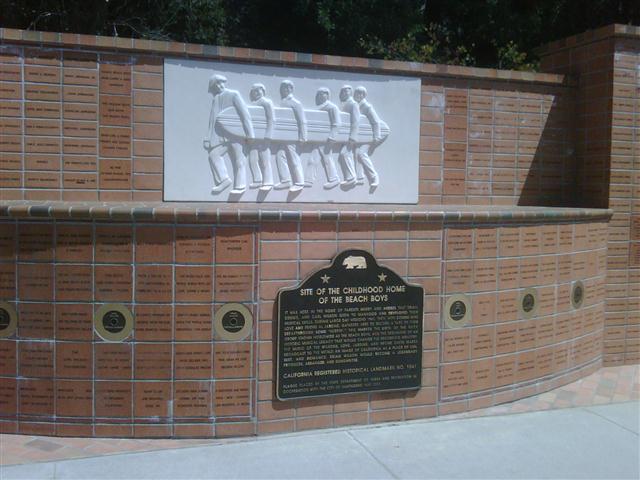
But it was there, sandwiched in a little residential block between the 105 Freeway and Hawthorne Municipal Airport, that a curious red brick mantel-like landmark (dedicated in 2005) on the corner of Kornblum Avenue and 119th Street bears homage to its most famous native musical sons.

The inscription describes that on Labor Day weekend of 1961 (that's 50 years ago this weekend!) the brothers Carl, Dennis and Brian (no, not that one, stupid Giants fan) Wilson, along with their cousin, Mike Love and friend Al Jardine, got together on this site - the location of what was once the Wilson family home - to record a demo tape of their debut song "Surfin," giving birth to  a group called The Pendletones, who eventually renamed themselves The Beach Boys.

 
The Wilson family household at 3701 W. 119th Street no longer stands there -- it was razed in the 1980s to build the Century Freeway (You could literally create another city if you put together all the homes, businesses and institutions that were cleared away to make the freeways...Militant sigh).

The group, as you all know, went on to make 36 Top 40 hits and get inducted into the Rock and Roll Hall of Fame in 1988. The Beach Boys are our Beatles, they defined a sound and style that was uniquely Los Angeles, uniquely Southern California. And they did so much more beyond the surfing boy imagery (Apparently the late Dennis Wilson was the only member of the band who actually rode the waves...).

Here's The Militant's favorite Beach Boys song of all time...Appropo? O_o


So on this Labor Day weekend, don't just do the same old same old late-summer ritual like you do every year, recognize the half century of our boys from Hawthorne -- do like Randy Newman says and crank up the Beach Boys, don't let the music stop. And if you're in the area, stop by The Beach Boys monument in Hawthorne...you can even take the (M) Green Line there.

Oh hey, remember this one? East Coast meets West Coast!!!

Wednesday, August 31, 2011

A River Ran Through It: In Search Of The Lost Rivers Of UCLA

The Militant Angeleno, as you may or may not know, is fond of retracing the lost waterways of Los Angeles. In April of 2008, he won several awards (okay, he didn't win any, but his blog sure got a lot of hits) on discovering Sacatela Creek, which ran from Los Feliz to Koreatown. A couple months later, he found Arroyo de los Jardines, which runs from Hollywood down to Mid-City, some of it still visible. He thought there weren't any more rivers to retrace...until now.

(Cue dramatic epic theme music...)

School may not be starting up for another few weeks at UCLA, but you're about to get your first Militant History 101 lesson (and you don't even have to be a registered student to learn!).

Whether you're an incoming freshman, a senior about to graduate next Spring, working on your master's or Ph.D, there's a lot you may know, but what you Bruins may not know is what lies under the very ground you walk on.

When UCLA ditched its original campus on Vermont Avenue (now Los Angeles City College) in the late 1920s for a much larger space, originally called the "Beverly Site," it left the bustle of the city for a quiet, serene meadow land near the foothills of Santa Monica Mountains.

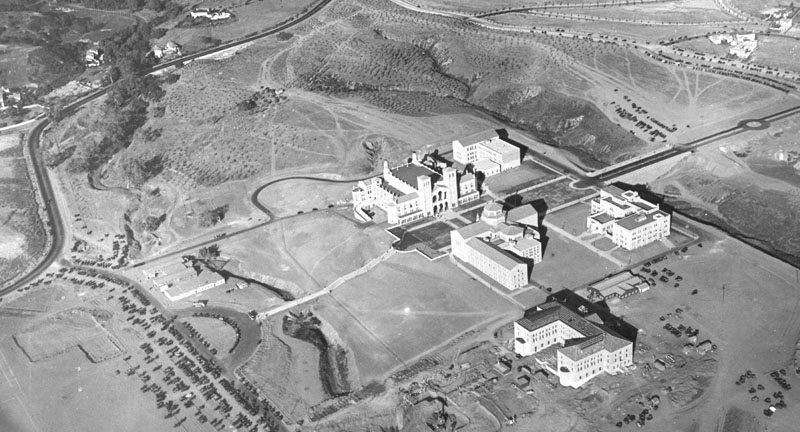
The first freshman class at UCLA arrived to a campus of all but five buildings - the landmark Royce Hall being one of them - and a terrain of streams, creeks and arroyos.

Wait, what?

Yes, rivers once ran in Bruin Land. But where did they go?

There were four waterways that ran through the UCLA campus - all north from the Santa Monica Mountains down south eventually towards Ballona Creek - just like the other two rivers that The Militant retraced. There was (from west to east) the West Arroyo, Foothill Stream, Stone Canyon Creek and East Arroyo.


View Lost Rivers of UCLA in a larger map

West Arroyo ran through where the student housing complexes now stand. Foothill Stream ran just west of Drake Stadium.

As for the East Arroyo, it was once the most prominent geological feature of the campus (seen towards the right of the above picture), a sunken ravine that somehow resembled a moat protecting the virtual castles of higher education. In fact, the main entrance to campus was once a bridge that went over the East Arroyo:


And here's what it looks like today (Royce Hall at the left is reference):

The arroyo was filled in in 1947 to make way for Dickson Court and more campus buildings, such as Schoenberg Hall.

So what happened to the bridge? Oh, it's still there. See the low wall running across the middle of the picture above? That's the bridge!


Yes, it's still recognized by the State of California as a functioning bridge, complete with weight limit restrictions (pictured left, ya rly) and periodic seismic inspections.
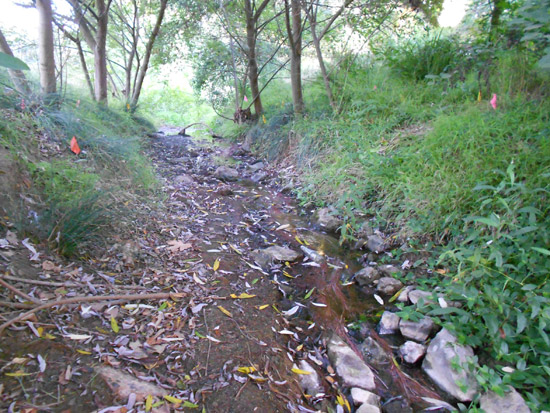
As for Stone Canyon Creek, it's still very much a creek, starting up in the Santa Monica Mountains, running down parallel to its emponymous road, making its presence in the front yards of more than a few Bel-Air homes.

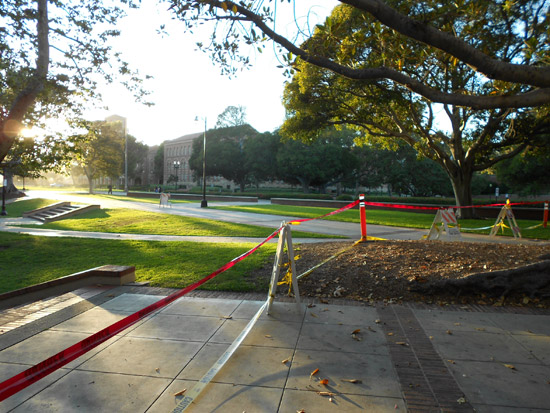
On the UCLA campus, The Militant is proud to say, the creek still runs - albeit for just a little bit. Found sandwiched between Sunset Boulevard and the Anderson School of Management and hidden behind a layer of trees, lo and behold...you can still see the last vestige of the rivers of UCLA:


For even in the Summertime, the water still flows, just as it always has been, even before the university arrived here. Come see it for yourself sometime!

And then, just like that, the waters unceremoniously enter a storm drain (pictured right), never to reflect light again, at least until it gets dumped into a concrete channel just south of Westwood en route to Ballona Creek.

Fortunately, there are proposals to "daylight" Stone Canyon Creek on the UCLA campus, although it's quite a challenge (funding notwithstanding).  A website makes a call for volunteers to help restore the creek, although it looks like it hasn't been updated since 2007.

Class dismissed. You will be quizzed next week. Professor Militan Tan-Geleno will be available after class in his office for any questions.

In the meantime, The Militant seeks his next lost river adventure!

Militant props to the L.A. Creek Freak and UCLA alum Loteria Chicana for providing a couple leads towards the research of this blog post!