Showing posts with label Pasadena. Show all posts

Thursday, May 28, 2015

The Militant's Epic Militant CicLAvia Tour 10.0!!!!!!!!!

 
Interactive Map! Click on green points to view hotspots, or click on entire map for larger view.

It's now time for the second CicLAvia of 2015, which means it's time to start posting again (He may or may not rename this blog, "Epic CicLAvia Tour Guides" eventually).

When The Militant first learned about the minuscule 3.5-mile route for the 13th-ever CicLAvia (and the 10th unique routing, hence the version number), he was kinda bummed. But after doing some Militant research, he found out that Pasadena has lots to offer in terms of history and interesting locations. The last CicLAvia tour only had 20 locations, yet was twice as long!

This is also the first-ever CicLAvia located entirely outside of the City of Los Angeles. The Militant initially decided to defer this to The Militant Pasadenan, but he recently learned that ol' MP moved to Sonoma County in 2009, and no one else has taken up the title since. So, according to Militancy Code, The Militant Angeleno would have to assume MP's duties by default (Ugh, so much responsibilities...). Which reminds The Militant that Long Beach's Beach Streets ciclovia event happens next Sunday. The Militant Long Beacher hasn't returned any of The Militant Angeleno's emails or texts. F'ing flake. Come on, man.

(As consistent with previous Epic Militant CicLAvia Tour maps, this routing starts from the east and works its way westward). Without further delay, let's go!

1. Pasadena City College
1570 E. Colorado Blvd, Pasadena
1924

What does actor Nick Nolte, director John Singleton, Worf from Star Trek, the original Superman and Jimmy Olson, math teacher con ganas Jaime Escalante, singer Kenny Loggins, all of the original members of Van Halen, the late Coach Jerry Tarkanian, the great Jackie Robinson (who later transferred to UCLA) and Lakers great Michael Cooper have in common?

They all attended Pasadena City College. This school, established in 1924 as Pasadena Junior College, later shared the campus with the original Pasadena High School from 1928 to 1960. In 1954, the college merged with nearby John Muir College and formally changed its name to its current moniker.

The college markets itself as the "#1 Associate Degree for Transfer," meaning, you probably won't stay long here anyway. But they sure have a pretty campus though.

Despite its long list of noble alumni, the school has also produced some dark characters, such as Robert F. Kennedy's assassin Sirhan Sirhan and Westboro Baptist Church founder Fred Phelps.

2. Old Highway Marker
1320 Colorado Blvd, Pasadena
1906

On the grass parkway in front of the McDonald's drive thru on Colorado and Hill stands a cryptic stone marker which reads:

(11)
220\222
F.B

It may or may not be a tombstone. Which makes it look even creepy. What do the numbers mean? What does "FB" mean? Did they predict Facebook or something?

Actually, it was the gravesite of the a laborer identified as #11, and he was the 220th of 222 people to die while constructing Colorado Boulevard. The "FB" may to may not be his initials...

...Okay, just kidding. It was actually a stone highway marker placed near there by Los Angeles County in 1906 -- before the road was paved. It turns out in those days, highway signs were made of stone instead of sheet metal. The "11" meant that it was 11 miles until the next highway marker, which was at the old Los Angeles County Courthouse (where Grand Park now stands in front of Los Angeles City Hall). The "220\222" were the block numbers as designated by the county's road surveying system. And the "F.B" stood for "Foothill Boulevard," which the street was originally named. In 1926, that route was designated as part of US Route 66. It is the oldest stone marker in Pasadena, and the sole surviving one of three such markers. The marker was originally placed 25 feet to the west -- where the driveway is, and was moved to the present location in 1994.

For some bonus added history, check out the faded lettering of the wall facing the McD's parking lot. It's from the old Foothill Motors Lincoln-Mercury dealership that existed from 1947 to the late 1980s.

Tweet a selfie with the marker during CicLAvia with the hashtag #EpicCicLAviaTour!

3. Howard Motor Company Building
1285 E. Colorado Blvd
1927

Located in what was considered Pasadena's automobile dealership row (see the Foothill Motors faded wall across the street), Conveniently located along Route 66, this Spanish Colonial Revival building with cherry churro Churrigueresque (like North Hollywood's St. Charles Borromeo church from the last CicLAvia) ornamentation was an attractive showroom for the Howard Motor Company, and later Bush-Morgan Motors from the 1930s to the 1950s. It is currently vacant (want to open a Churrigueresque Churro shop?), but was last used as an auto showroom as recently as the 1990s.

4. Crown City Bank Entrance
1176 E. Colorado Blvd, Pasadena
1906

The same year the mysterious highway marker was placed down the street, Crown City Bank opened up its main branch here on what is now the Pasadena Coin and Stamp Company. If you're into philately or numismatics, you'll probably be into what's inside. But if not, do observe the 109 year-old tile mosaic entrance. Over the years the building has also hosted a car dealership, a glass and mirror shop, a refrigerator store, and a men's clothing store. Yet the "Crown City Bank" entrance has remained untouched.

What is "Crown City" exactly? Why, it's Pasadena's official nickname.

And while you're here, drop by across the street to the Militant-Approved Book Alley bookstore! A great selection of local history titles!

5. Pashgian Bros. Oriental Rugs
993 E. Colorado Blvd, Pasadena
1903

Underneath this faded, old school-looking billboard is one of the longest-running businesses in Pasadena. Established in 1889 -- as old as the Tournament of Roses Parade -- this oriental rug store founded by John and Moses Pashgian has been a Pasadena institution for over one and a quarter centuries. Moses Pashgian was even the Grand Marshal of the 1915 Rose Parade, and the brothers are considered the founders of Pasadena's Armenian American community. The Pashgian family still makes its presence in the city. John Pashgian's son, the late Aram Pashgian, was a member of the Tournament of Roses Association, and Aram's daughter, Helen Pashgian, is a renowned visual artist whose work has been displayed at LACMA.

6. Horton & Converse Entryway/Brown & Wein Pharmacy
937 E. Green St, Pasadena
1952

You might be familiar with the Horton & Converse Pharmacy chain in the Westside. But did you know the 98 year-old Southern California-based company once had more stores in the area? Including one here in Pasadena, which was open 24 hours. Today, the Brown & Wein Pharmacy takes its place, but the original Horton & Converse design in the store's threshold still remains.

7. Burlington Arcade
380 South Lake Ave, Pasadena
1980

The first of three "arcades" you'll come across on the CicLAvia route was built in 1980 by controversial Pasadena developer Stanley S. Sirotin, who made this building a mini-replica of the 19th century skylighted mall in London, which is the reason why you'll see an old-school red British telephone box (booth) inside. The 14 stores of this building are rather unique: A chocolatier, a kimono store, a gourmet sandwich shop, among others.

Tweet a selfie in front of the red telephone booth during CicLAvia with the hashtag #EpicCicLAviaTour!

8. Bullock's Pasadena/Macy's
401 S. Lake Ave, Pasadena
1944

Chances are, if there's a CicLAvia, you're going to be passing by an iconic former Bullock's department store building. You saw them on 7th Street in Downtown Los Angeles, and you saw them on Wilshire Boulevard. This Pasadena Bullock's (now a Macy's) was designed by well known local architects Welton Becket and Walter Wurdeman in Streamline Moderne Art Deco stylee. The famed Tea Room was a local institution, and even though the building is over 70 years old, it still carries a contemporary look to it. The building was so influential, it transformed the formerly-residential South Lake Avenue into an upscale commercial shopping district, which continues on today. Do Mind The Bullock's.

9. Pie 'N Burger
913 E California Blvd, Pasadena
1963

Dude. It's Pie 'N Burger. Does it really need an introduction?

The Jonathan Gold Himself once said that if he had to move out of Los Angeles, his last meal would be here. Enough said.

That said, there's gonna be some long-ass lines here on Sunday, so you might as well come back some other time.

10. Vroman's Bookstore
695 E. Colorado Blvd, Pasadena
1894

Established during the Grover Cleveland administration (though the present location dates back to 1929), this is the oldest and largest independent bookstore in Southern California. Founded by Adam Clark Vroman at its original location on 60 E. Colorado Blvd, the store also sold photographic supplies as well as books.

In addition to an awesome bookstore, try to chillax at the beautiful landscaped courtyard int the back. 

Tweet a selfie at the Vroman's Courtyard with the hashtag #EpicCicLAviaTour!

11. Arcade Lane
696 E. Colorado Blvd, Pasadena
1927

Across the street from Vroman's, and having stood there two years before the bookstore moved into the block, is the second "arcade" building on the CicLAvia route.

This picturesque building, an award-winning design by Pasadena architects Sylvanus Marston and Garrett Van Pelt, was built as a replica of a marketplace in Budapest, Hungary. It once was the location of the second-ever Coffee Bean & Tea Leaf store. The picture on the left depicts the building in the 1930s.
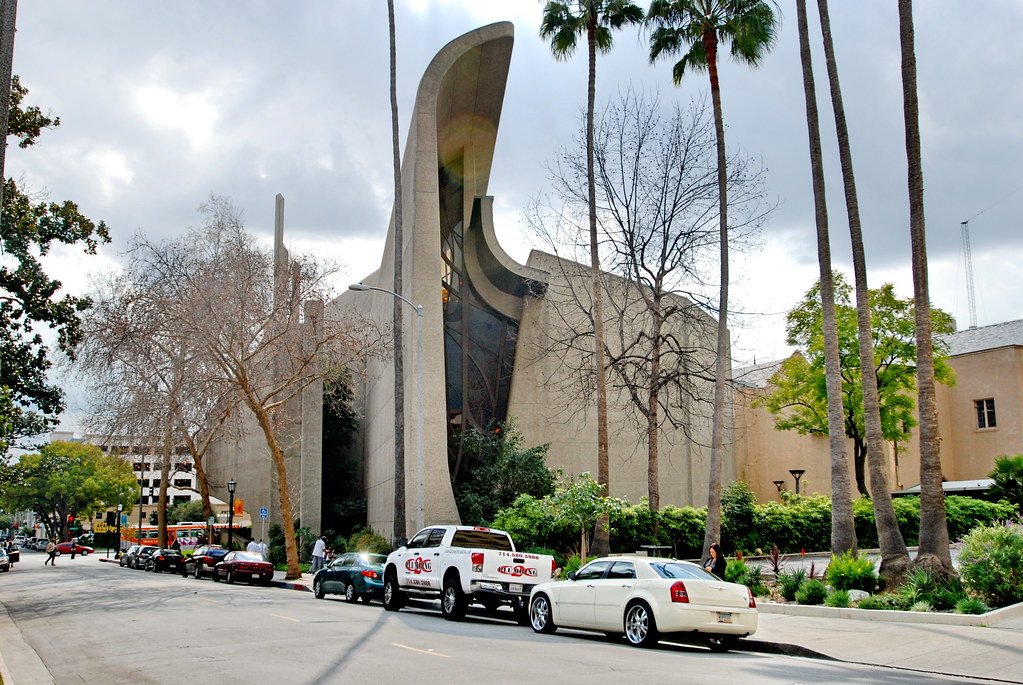
12. Pasadena Presbyterian Church
585 E. Colorado Blvd, Pasadena
1908/1976

Despite Pasadena's ethnic-kinda-sounding name (we went over its origin before), it was pretty much founded by a bunch of WASP-folk from Indiana, and the influence of Midwestern American culture still looms large, from the Tournament of Roses organization to the general vibe of the city.

From the city's founding in the 1880s to the 1920s was when the city's large Protestant churches were built along the Colorado Boulevard corridor. The Pasadena Presbyterian Church, whose congregation dates back to 1875 when it was located on Orange Grove and California street, had built two houses of worship before this one was built in 1908.

The church (as in the organization) was also heavily influential in the city's culture: It broadcasted its KPPC (hence the call letters) AM and FM radio stations from 1924 to 1971 which featured religious programming as well as more secular news, talk and music shows (including the first radio home of The Dr. Demento Show (!) in 1970).

The main sanctuary building was damaged in the 1971 Sylmar earthquake (the other original church buildings on the campus still remain), and a new one was built in 1976. It features an Aeolian-Skinner pipe organ which was rescued from the original 1908 sanctuary.

13. First United Methodist Church of Pasadena
500 E. Colorado Blvd, Pasadena
1923

This congregation dates back to the original 1872 settlers from Indiana, who originally built the church in two previous locations (the second of which was damaged in a tornado (!) in December 1891). After outgrowing its previous buildings, the church moved to its present location in 1923 and built its current English Gothic-style sanctuary, which was designed by architect Thomas P. Barber. It also includes a 1930 Skinner pipe organ.

14. Site of KROQ Broadcast Studio
117 S. Los Robles Ave, Pasadena
1976

Remember KROQ? No, not that lame ass station that's on right now, the good KROQ. As in The ROQ of the '80s? Dude...Rodney on the ROQ? Jed The Fish? The Poorman? Richard MF'in Blade?!

If you do, then...dude, you're old!

The station once broadcasted here, in Pasadena (the station still says "Pasadena/Los Angeles" due to how it's FCC license is registered). But KROQ was, like, totally Pasadena. The station itself had its origins in the old KPPC (remember, the Presbyterian Church down on Colorado?) FM, which broadcasted on the 106.7 frequency. In 1969, KPPC FM moved out of the church (literally and figuratively) due to a change in ownership and in 1973 after another ownership transfer, it became KROQ-FM - "The ROQ of Los Angeles."

KROQ moved to this Los Robles location in 1976, which coincided with the emerging sound of punk rock and new wave music bubbling out of the local underground. Deejay Rodney Bingenheimer broke many local acts such as The Runaways and The Go-Gos, as well as East Coast acts like The Ramones, Blondie and The Talking Heads. KROQ was the tastemaker of the 1980s, and many of the decade's stars came down to the Los Robles studios for interviews. A local venue called Perkin's Palace on Raymond Avenue (more on this later) also hosted many punk and new wave acts, and Pasadena became the totally happening place.

KROQ moved to Burbank in 1987, and after new wave's last hurrah in Pasadena (Depeche Mode's 101 Concert at The Rose Bowl on June 18, 1988), the city was never quite the same again.
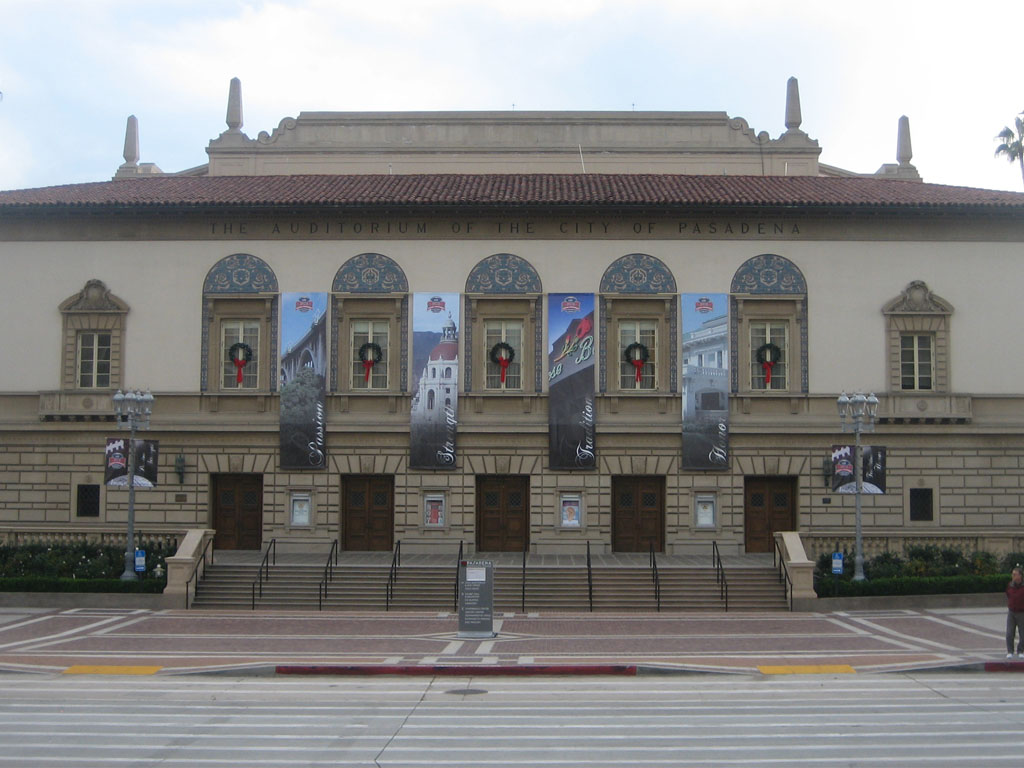
15. Pasadena Civic Auditorium
330 E. Green St, Pasadena
1931

Just south of the CicLAvia route, across from Paseo Colorado (formerly the Plaza Pasadena mall) is this stately hall designed by architects George Edwin Bergstrom, Cyril Bennett and Fitch Haskell, this 3,029-seat venue was the home of the Emmy Awards from 1977 to 1997. The 1983 NBC Motown 25 special, was taped here, which means, yes, Michael Jackson's moonwalk was performed to a worldwide audience in this here building.

16. Pasadena City Hall
100 N. Garfield Ave, Pasadena
1927

Fans of the TV show Parks & Recreation will easily recognize this building for some reason...

Built a year before Los Angeles' iconic city hall, this second-most iconic city hall building in Southern California was largely inspired by the 1915 San Francisco City Hall. In fact, the city government wanted one similar to that, so they hired SF city hall architects Arthur Brown, Jr. and John Bakewell, Jr. to design one for the Crown City, this time with Mediterranean Revival and Spanish Colonial Revival elements.
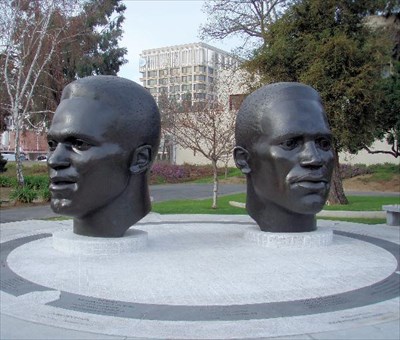
17. Jackie and Mack Robinson Memorial
Holly St. and Garfield Ave, Pasadena
1997

Legendary Brooklyn Dodger and UCLA Bruin Jackie Robinson and his brother, Olympic medalist Mack Robinson, were both raised right here in Pasadena, in a small house (no longer standing) at 121 Pepper Street, off of North Fair Oaks.

This memorial sculpture, designed by artist Ralph Helmick, features, nine-foot, 2700-pound likenesses of the Robinson brothers' heads. It was dedicated in 1997, the 50th anniversary year of Jackie Robinson breaking the color barrier.

18. Pasadena Public Library Ruins
Raymond Ave and Walnut St, Pasadena
1890

Located at the northwest corner of Pasadena's Memorial Park (It is not, The Militant repeats, not a cemetery, it's quite literally a park that contains various memorial statues and plaques to war veterans and historic individuals) is this freestanding arched structure that looks like some old rich person's tomb (again, Memorial Park is not a cemetery...).

The structure was the entrance to the original Pasadena Public Library (prior to the 1930s, the park was known as the not-macabre-at-all "Library Park"), which operated here from 1890 to 1927. It was damaged in the 1933 Long Beach Earthquake and demolished in 1954 (man, the speed of city bureaucracy...). In 1955 the city of Pasadena decided to keep the arched entrance intact and dedicate it as another memorial in this park, this time to the city's founders.

19. Raymond Theatre/Perkins Palace
129 N. Raymond Ave, Pasadena
1921

Originally built as Jensen's Raymond Theatre (if you know your Los Angeles history, it's the same Jensen's that opened the bowling alley in Echo Park and the former silent movie theatre on Melrose in East Hollywood (now the Ukrainian Culture Center - which was one of the stops in the first few Epic CicLAvia Tours), it was an early venue for vaudeville and silent movie screenings.

In the 1940s, it was sold to Crown Holding Corporation and re-named the Crown Theatre (because, as you know by now, Pasadena is "The Crown City" - and don't you forget it), showing movies until the 1960s. In the early 1970s, one of the theatre's owners was a local ophthalmologist named Dr. Nathan Roth (whose son, David Lee, was attending Pasadena City College at the time and met these guys named Michael, Alex and Eddie).

In the late '70s, the venue was owned by local businessman Mark Perkins who re-named it Perkins Palace, which became the legendary stage for local, national and international rock, pop, punk and new wave acts, from Fleetwood Mac to The Go-Gos to New Order to Oingo Boingo to, yes, Van Halen.

Today, the building remains as part of a new condo/retail complex.

20. Neon Retro Arcade
28 S. Raymond Ave, Pasadena
2015

The third "arcade" on the CicLAvia route is this one -- a video arcade, that opened earlier this year, and specializes in retro (as in 1980s and 1990s, you know, the good stuff) video games, as well as pinball machines for the older school set. If you lovingly remembered the uber-legendary Pak Mann Arcade on 1775 Colorado Blvd back in the day, this is somewhat of a consolation. Anyone wanna play some Tempest or Street Fighter?

Note: If the arcade is closed, come by after 12 noon on Sunday when it opens. After then it will, quite literally, be on like Donkey Kong.
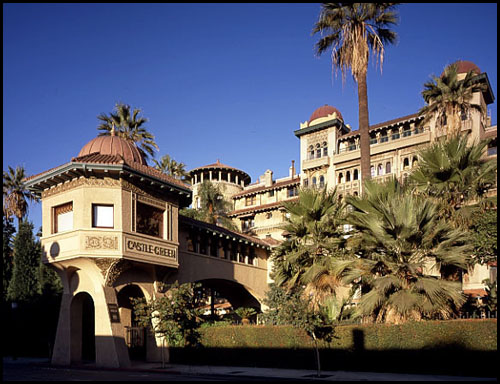
21. Hotel Green/Castle Green
99 S. Raymond Ave, Pasadena
1893

One of Pasadena's most iconic structures, this Moorish-Mediterranean Revival luxury hotel, which was designed by local architect Frederick Roehrig, was built to serve the Santa Fe Railway station across the street (more on this later). Prior to its opening, it was purchased by civil war veteran and snake oil salesman George G. Green (hence Green Street). The hotel was once home to the Tournament of Roses Association and the Valley Hunt Club, which us 99-percenters only really hear about during the Tournament of Roses Parade.
22. Stats Floral Supply
120 S. Raymond Ave, Pasadena
1962

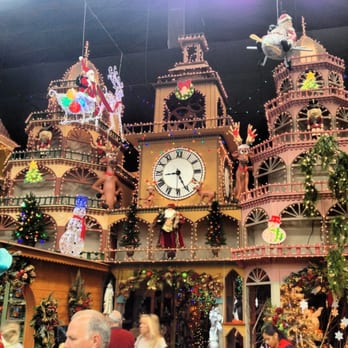
Greek immigrant Dan Stathatos, Sr. once opened a flower shop on 4th and Broadway in Downtown Los Angeles and sold violets. His sons Dan, Jr. and Jerry took over the family business after his father's death in 1941 and in 1962 opened a floral supply, craft arts and outdoor furniture store here on Raymond Avenue in Pasadena.

The real draw of this store is from September to January, where the store becomes this massive, epic Christmas Holiday wonderland: Christmas trees, snowmen, reindeer, elves, angels, nutcrackers, Santas... it's...just...so...over...the...top.

Even if you drop by this Sunday, it won't be in Christmas mode, but it's still a unique store, sort of like a Moskatel's on steroids. If Huell hasn't been here, he should have.

23. Pasadena Santa Fe Depot
230 S. Raymond Ave, Pasadena
1935

Before The Metro Gold Line opened in 2003, the Atchison, Topeka and Santa Fe Railway was the rail line that cut through town. The railroad first came to town in 1885, a line built by the Los Angeles and San Gabriel Valley Railroad, which changed hands over the years and was bought by the ATSF Railway in 1906. The line served trains that came as far as Chicago.

The Mission Revival railroad depot was built in 1935 -- four years before Union Station was built in Downtown Los Angeles, and was popular with Hollywood celebrities, who disembarked here, rather than at Union Station, due to the Pasadena station's proximity to Hollywood and the various studios in the San Fernando Valley.

In 1971, Amtrak took over passenger service from the nation's railways and used this station until 1994, when parts of the line leading to Pasadena were condemned following the Northridge Earthquake. In the late 1990s, construction of the much-anticipated light rail line from Pasadena to Downtown Los Angeles was commenced, and the original Pasadena Santa Fe depot was moved several yards to its current location, which is now adaptively reused as the La Grande Orange Cafe restaurant, located adjacent to the Del Mar Metro Gold Line station.

24. The Owl Drug Co. (J. Crew)
3 W. Colorado Blvd, Pasadena
1916

J. Crew? Huh? The Militant shops there? As if! Naw, seriously, look down at the entryway for this J. Crew in Old Town Pasadena and you'll see "The Owl Drug Co." It was a San Francisco-based national chain drugstore and soda fountain (yeah, total old school) that opened its first Pasadena location here almost a century ago. It operated until the 1940s when it was purchased by Rexall Drug Store. It changed hands over the years, weathering the neighborhood's decline and eventual revitalization towards the end of the 20th century.

25. Site of Clune's Pasadena Theatre
61 W. Colorado Blvd, Pasadena
1911

If you're into faded building signs, you're in for a treat. The north and east walls of this building still bear the weather-beaten signage for "Clune's Pasadena Theatre," a vaudeville and silent movie theatre built 104 years ago. John Philip Sousa once performed there with his orchestra,

It became part of the Fox Theatres chain in the 1920s, screening Fox, and later 20th Century Fox films until the 1950s. Today, a Crate & Barrel and a Gap store operate in the former theatre space.

Stay Militant and Happy CiclaDENA on Sunday! Don't forget to blast some Van Halen and wear your crowns!


Friday, July 26, 2013

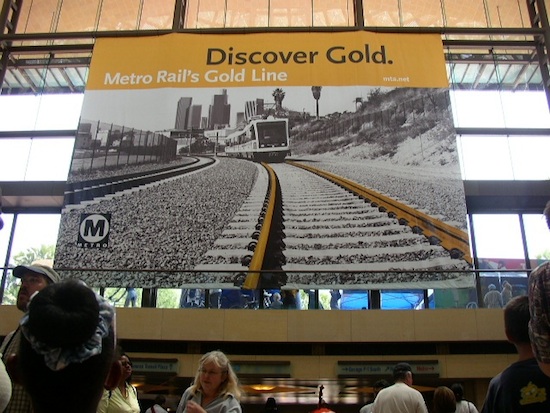
Happy 10th Birthday, Metro Gold Line!

Remember "Discover Gold?"
A decade ago today, The Metro Gold Line, Los Angeles' first light rail line in the 21st Century opened on one hot Saturday. Originally planned as an extension of the Metro Blue Line to Pasadena, it's the only direct transportation link between the Los Angeles and Pasadena downtowns (The 110 Freeway ends short of it).

The Militant, who has yet to miss an opening day for a Metro Rail line, was there, and remembered waiting in a long-ass line that snaked around the Gateway Plaza parking garage (the one some of you park in to ride the Dodger Stadium Express bus to games). It took nearly forever, but The Militant got on his train, rode all the way to the Sierra Madre Villa station, where the celebration had already ended in the parking structure there, and headed back.

Old-school Gold Line vehicles, now since replaced with the silver/gray Italian-built Ansaldobreda trains.
A few things have changed since Opening Day; the original 13.5-mile line is now nearly 20 miles long, having been extended from Union Station to East Los Angeles back in 2009. Originally an under-performing line due to its apparent slowness (something the Expo Line knows all too well), it now carries over 42,500 riders per day. Also, the orange-striped white Siemens light rail vehicles no longer run on the line, having been moved to their new tours of duty on the Green, Expo and Blue lines. And a few of the stations have changed their names: Lincoln/Cypress (originally Lincoln Heights/Cypress Park), Heritage Square (originally French Ave), Highland Park (originally Avenue 57) and South Pasadena (originally Mission).

Long-ass lines that day in the parking structure!

The future's bright for the Gold Line: In just two years it will be extended even farther into the SGV, terminating in Azusa with a station near Azusa Pacific University and Citrus College (The Militant won't miss that one fo' sho!). And by the next decade, the line will function as it was originally planned, when the two-mile Regional Connector tunnel is completed under Downtown Los Angeles. But alas, most of what the "Gold Line" is known for will no probably longer be named as such. Potential plans for the line may likely integrate the Union Station-to-Azusa section into the Blue Line, leaving the Eastside segment remaining Gold (and turning the Expo line into "Gold") in the process.

If you're feeling nostalgic for re-living the line circa 2003, take The Militant's Ultimate Gold Line Tour, which came out in 2009, and shows you places of significant interest along the old school Union Station to Sierra Madre Villa route.

Happy Birthday, Metro Gold Line! Here's to many more years, in whatever form you may or may not become!

Friday, September 2, 2011

Dining In The 'Dena: Chefs Center's Friday Food Fair

No doubt food trucks have re-defined the local food scene with their mobile munchies. But not everyone can run a food truck -- there's gas and mechanical costs to add to the overhead. One of The Militant's operatives was considering buying a truck for his food/catering business but was instantly turned off by the exhorbitant cost of purchasing the actual vehicle...Yet there is a burgeoning scene of "artisan" chefs who want to provide the same types of unique menus found in foodtruckland.

Some of them can be found at our local weekly farmer's markets. The Militant certainly has his favorites, and makes them part of his FM shopping ritual.

Another place is a unique weekly event at a unique sort of place in Pasadena. The Chefs Center of California, located on San Gabriel and Colorado, is a nonprofit social enterprise that provides facilities for start-up chefs trying to make their mark in the local food scene. Every Friday night (hey, that's like, tonight) is their outdoor Friday Food Fair and Artisanal (art is anal?) Marketplace event, which attracts an ethnically and generationally diverse crowd of mostly SGV locals who want to sample some great grub
.
The event is free, save for the price of food, which is purchased from each vendor. It's basically like a farmer's market, but with food stands only. Yes, there are about half a dozen food trucks, most of them SGV-based like the Rosemead-based Slammin' Sliders, but the real attraction here are the food vendors, who set up tables in the parking lot and hawk their wares.

The Militant checked out the scene last week (it changes slightly every week, but most of the vendors are there weekly) and sampled some Brazilian meat pastries and Yucca fries (pictured right) from Caju Catering. He couldn't get enough of their mildly-spicy sauce, which goes well with everything they serve (you can ask for refills).

Other vendors served everything from Mediterranean dishes to gourmet mac and cheese. There's also a large number of baked dessert vendors representing, like The Goodie Girls cupcakes (which will be opening up a brick-and-mortar store in Glendale by the end of the month) and Mondo's Morsels, who sells a cookie called the Midnight Bliss, consisting of chocolate and cabernet (yes, as in the wine) that blew The Militant's mind.

Though the food is described as "gourmet" and "artisanal," the prices aren't like way out there or anything. Most items go for less than $5 each. Best of all, just about all of the non-truck vendors offer free samples of their treats, so you can check 'em all out.

You can dine both outdoors and indoors, inside the Chefs Center facility, and it's a total unpretentious, laid-back local SGV kinda vibe there.

The Friday Food Fair at Chefs Center of California is on every Friday evening from 6 to 9 p.m. and lasts until mid-October (you got another month to enjoy this, so don't sleep!). Chef's Center of California is at 45 N. San Gabriel Blvd, just north of Colorado. Street parking is plentiful and free in that part of Pasadena, and, Militantly speaking, the (M) Gold Line Sierra Madre Villa station is just a mile east of there (a short bike ride or a hop on the Metro Local 181 bus).

So check it out tonight! You may or may not find The Militant there!

Wednesday, July 13, 2011

Love It And Levitt

Like many Angelenos, The Militant likes to go out and enjoy a good concert once in a while. On Sunday he had a chance to do just that by hopping on the (M) Gold Line, getting off at the Memorial Park station and walking all but a few yards to the Levitt Pavilion Pasadena. What may or may not look like an ordinary bandshell in a park is actually one of our best local treasures - its annual Summer concert series.

Did The Militant mention that the concert was FREE?!
The Levitt Pavilion has been rockin' since 2002 as one of a network of Levitt Pavilions across the country, in Connecticut, Texas, Tennessee and Pennsylvania, all dedicated to bringing free quality music events to the masses.

But us Angelenos are downright spoiled, since we have not just one, but two Levitt Pavilions in the area. As The Militant reported back in 2007, the bandshell at MacArthur Park joined the Levitt family and has been rockin' since then as our area's second Levitt Pavilion. Seriously, we're the only metropolitan area in the country to have two of them. And, like its older sister in Pasadena, it's also Metro Rail-accessible.

Though The Militant had been to The Levitt Pasadena before, covering that town's Make Music Pasadena event, this past Sunday evening was the first time The Militant caught one of their Summer concert shows. He saw a performance by a 7-member band called Freshlyground from Cape Town, South Africa. They got international attention last year by collaborating with pop singer Shakira on this song for the 2010 World Cup (no, there's no vuvuzela player in the band). The singer was a woman that probably stood about 4' 10" but she had a voice bigger than the nearby San Gabriel Mountains. The band played a mix of world music, pop and soul, that got everyone dancing.


South Africa, a place that has a similar Mediterranean climate as Los Angeles, as you may or may not know, is a country that existed for years under the government-enforced racial segregation system of apartheid, which ended in the 1990s and soon elected former political prisoner (some would call him a militant in his own right) Nelson Mandela as president. So how awesome was it to see this integrated, post-apartheid band from South Africa play in front of a few thousand Southern Californians that look like the total opposite of what apartheid stood for? And for those of you who continually say Los Angeles is a "segregated" city (And you only say that because everyone in your Podunk hometown looks alike), y'all don't know shit, seriously.


Speaking of bucking stereotypes, The Militant has always heard the transplanted ignoranti whine that "L.A. crowds are dead/jaded/etc at concerts." O RLY? The whole park was dancing around by the end of the show (pictured right). Explain that, fool! No, don't explain. Just get out of The Militant's face before he smacks you upside the head!

If you're looking for something to do during this weekend's CarmageddonChameleon, then go pack a picnic basket, leave the car at home and check out a free concert at either one of our Levitt Pavilions. Or, you can go Downtown and watch one at Grand Performances. See? Awesome free concerts...this town is full of 'em.

Tuesday, November 10, 2009

The Militant's Ultimate (M) Gold Line Tour

Yes, Angelenos, the Militant is back.

He took a brief hiatus after getting over his post-Dodger-postseason Depression (PDPD) and had a bout with what may or may not have been the Swine Flu.

The Militant is okay, both emotionally and physically, and in fact did see someone dressed in a costume resembling that of the Militant at a gas station on Halloween Night (for you "Pics-Or-It-Didn't-Happen" types, sorry, the Militant Cam didn't work quickly enough, and certainly none of you would be amused by the picture of a back of someone's car).

Anyhoo, let's get right down to business. Sometimes the Militant gets lazy, sometimes he rants, sometimes he does a little event coverage, but sometimes he does a Mega-Post(tm) - such as last year's Pulitzer Prize-winning* post on the lost Sacatela Creek. A post full of text, images and a heck of a lot of Militant Research. Well, Angelenos, the Militant is about to give you the proverbial Mother Of All Mega-Posts.

This Mega-Post(tm) contains not one, not two, nor three, four or five, but - count 'em - six years of Militant research (Of course, there was no MA blog as we know it even three years ago, but you'll just have to trust the Militant on this one.

Okay, we're inflating the word count already...As you may or may not know, the (M) Gold Line will never be the same this Sunday, as the long-awaited expansion to the Eastside (the Real Eastside, to you hipster lowlifes out there) will open to the transit-riding public.

Well, your lives - and your knowledge of Los Angeles - will never be the same after this Mega-Post(tm). The Militant is about to take you on a tour of the Pasadena-to-Los Angeles (M) Gold Line...MILITANT STYLE!

Yes, it's not just about parades, football games, concerts or pub crawls. The Gold Line is a veritable, uh, gold mine of historical and trivial facts, most of which aren't visible to the casual obvserver. It's like a Transformer, yo...More than meets the eye!

So here it is...drum roll please...a post over two years in the making...

THE MILITANT'S (M) GOLD LINE TOUR!

Being that the Militant is central Los Angeles-centric, this tour will start from Union Station and end at Sierra Madre Villa station. Got it? Now tap your TAP cards (beep), and let's goooo!

Oh wait, you gotta go to the bathroom first? OK, OK, It's down the pedestrian tunnel, then make a left. HURRY!

...Okay, we're off!


View The Militant's (M) Gold Line Tour in a larger map

1. Private Rail Car Yard
Look to your left, as the train ascends up the elevated structure. There's a private rail car yard for privately-owned (non-Amtrak) passenger cars, whose owners pay Amtrak a fee for connecting to existing passenger trains.

This yard was originally built to house the business cars of the Southern Pacific, Union Pacific and Santa Fe railroads, during the heyday of passenger rail travel.

2. Homeboy Industries / Homegirl Cafe
Due directly right as the train curves, you can literally touch the building. It's the new headquarters of the nonprofit social enterprise Homeboy Industries. The Militant has already eaten at Homegirl Cafe. Great food, great service, great cause - MILITANT APPROVED!

3. Capitol Milling Company
This family-owned flour mill operated from 1831 to 1997, before moving its operation to a much larger facility in Colton. The mill supplied flour to clients such as Ralphs, Foix French Bakery and La Brea Bakery. In 1999, the family-owned operation was purchased by industry giant Con-Agra Co.

The historic building, built even before the railroads arrived in Los Angeles, still has a horse-tethering ring, back to the days when grain was hauled by horse carriage from farms in the San Fernando Valley.

4. Zanja Madre Relics
This recovered piece of Los Angeles history appears as a pipeline-like structure made of bricks and masonry. The Zanja Madre was the early water supply/irrigation system for the early pueblo of Los Angeles, which channeled water from the then-naturally running Porciuncula (Los Angeles) river into the town.

This relic was discovered by Metro construction crews in 2005 and placed on display here.

5. Swallow's Nests
Who says there's no wildlife in the City? Look towards the side of the Broadway Viaduct (along the middle of the photo on the left) and you'll see a row of swallow's nests - constructed in the same fashion as they are in mountainside cliffs - built into the concrete!

6. (M) Gold Line Yard & Shops
This yard, the former approach to the old Southern Pacific Cornfield Yard, (now Los Angeles Historic State Park), is where the Gold Line's fleet of Siemens and Breda light rail cars are stored, cleaned and maintained daily.

7. The Old Lincoln Heights Jail
Former LAPD Police Station and City Jailhouse from 1931 to 1966, holding up to 2800 prisoners at its peak. Still owned by the City, it was abandoned due to capacity and now serves as the home of the Los Angeles Youth Athletic Club, The Bilingual Foundation for the Arts theater company, and the Aztlan Foundation which provides workshops in Latino art and culture for the community.

8. Unidentified Flying Object!
Look to your left right before the train crosses the Pasadena Freeway! There's a flying saucer here at this Lincoln Heights scrapyard!

9. Bird Zoo
If you're heading towards Pasadena, look quickly to your right, just before you reach the Southwest Museum station and behind the fence, you'll see a bunch of caged birds and animals in the backyard of this apartment complex. Exotic animals seen here include a peacock, cockatoos and a goat.

10. Casa de Adobe
Building owned by the nearby Southwest Museum for temporary exhibits and cultural events, such as the annual Lummis Day Festival.

11. Figueroa Upper Walkway
You'll have to get off at the Southwest Museum station to see it. This second-set-of-sidewalk above the street-level sidewalk is a unique sight in Los Angeles, connecting various houses and apartments with the Casa de Adobe and the entrance to the (M) Gold Line Southwest Museum Station.

12. Old L.A. Certified Farmer's Market
Hop off the Gold Line at the Highland Park station every Tuesday from 3 to 8 p.m. for this weekly Farmer's Market in Highland Park. Check out the Militant's post!

13. Quetzalcoatl Chicano Heritage Mural
This mural, painted in 1995, depicts and celebrates Chicano history and heritage. Commissioned for $50,000 and partially financed by Rage Against The Machine singer Zak de la Rocha, this mural at Ave 61 and Figueroa has been a visible landmark and point of pride for the Highland Park community.

14. Arroyo Seco Viaduct
Your train travels on this bridge, along with most of the Gold Line's right-of-way, carried freight and passenger trains of the Atchison, Topeka and Santa Fe Railway (now merged into the BNSF Railway) until 1994. The bridge was converted from single-track to double-track during the Gold Line's construction in the late 1990s.

15. Mission West Farmer's Market
Don't forget to hop off the Gold Line at the Mission Station on Thursday evenings to catch this SouthPas tradition. Check out the Militant's Post!

16. Oaklawn Pedestrian Bridge
This decorative concrete arch bridge was built in 1910 for the neighborhood's bougie residents to cross over the Santa Fe Railway tracks. More info here.

17. Potential Bikeway?
Wouldn't this be a neato location for a future bikeway? A Militant can dream...C'mon Metro, let's make it happen!

18. Art Center South Campus
The South Campus of the Art Center College of Design opened in 2004. The building was originally an aircraft testing facility built during World War II. The Militant visited this place at the end of a Pasadena Ride-Arc ride last year.

19. The First Trader Joe's
This is the oldest and longest-operating Trader Joe's supermarket in the entire chain. So for all of you with friends in Seattle or Boston or NYC who just rave about "their TJ's," show them the OG TJs and make them RECOGNIZE!

20. Historic Santa Fe Pasadena Depot
This building at the Gold Line Del Mar station says "Pasadena" on it for a reason: it was the original Pasadena railroad depot operated by the Santa Fe Railway from 1925 to 1971, and by Amtrak form 1971 to 1994, when the passenger line was rerouted and the line abandoned to make was for what was then known as the "Pasadena Blue Line." The Santa Fe "cross" logo motifs can still be found all over the station building.

The station is now adaptively reused as a restaurant as part of the Del Mar Station mixed-use development.

21. Del Mar Station Bike Parking Facility
Check it - this station has bike parking! No, not just some lame aluminum "sinewave" racks placed in some obscure, forgotten corner, but an actual room where bikes can be parked and locked!

22. Manny Ramirez's Condo(?)
Not confirmed, but according to operative reports, Dodgers Outfielder Manny Ramirez owns a condo in this mixed-use development. The Militant doesn't know which unit, nor has he had the opportunity to party like a rockstar there.

23. Colorado Blvd Subway
The original Santa Fe Railway tracks crossed Colorado, but Metro built an underpass for the light rail line for some reason. Something to do with a parade every January...

24. Ruins of the Original Pasadena Public Library
This "Memorial Park" in Pasadena is no cemetery, but it does contain the remains of the original central Public Library building, located here from 1890 to 1927, and demolished in 1954. The current Public Library opened in 1927. The city of Pasadena retained the columns in memory of the original library building, dedicated in 1955.

25. Former Pacific Electric Right-Of-Way
This landscaped median, typical of many in Southern California, once carried interurban streetcars of the Pacific Electric Railway from 1904 to 1950 in a line that originated from 6th and Main streets in Downtown Los Angeles.

26. Eaton Wash
This flood control channel captures snow runoff from the San Gabriel Mountains about a mile high above, and runs through Eaton Canyon.

27. Pasadena Sandwich Co.
Some of the biggest sammiches you've ever seen are sold at this hole-in-the-wall shop on Sierra Madre Villa Ave, just steps away from the Gold Line station.

28. Site of Hastings Ranch
This large suburban retail development was once the location of Charles Cook Hastings' 1,100-acre Mesa Alta Rancho from 1882 to 1942, boasting a vineyard and later exotic plant and animal life. After the death of Hastings' son the land was sold to become tract housing, retail and a drive-in theater during the post-war development boom.

So there you have it, 28 points of interest from the window of your Gold Line train or a short walk away. Come Sunday, the Militant will no doubt have to update this list (Google Maps needs to put some more recent images, ahem, ahem). But for those of you who do the Gold Line every day to and from work, you'll never look at your commute the same way again.

Monday, June 22, 2009

The Streets Are Not That Alive With The Sound Of Music: Make Music Pasadena Festival 2009

The Militant headed over on Sunday to the exotic land known as Pasadena as the city hosted an event called "Make Music Pasadena," a one-day music festival that made its debut last year (which the Militant regrettably missed). The festival is the local component of an event called Fete de la Musique, which started in Paris, France in 1982 on the day of the Summer solstice. The event is now held in over 300 cities worldwide.

The whole premise of Fete de la Musique is to celebrate and encourage music in a daylong event, with organized stage performance venues and impromptu sidewalk performances, all of which for free. Sounds pretty militant to this Militant's ears! So yours truly brought along Militant Operative Stingray, an operative who knows a thing or two about music, to help guide him.

After they disembarked from their Gold Line train, they walked up just yards from the station to Pasadena's Levitt Pavilion to check out a performance by Chase Allen in the Hollywood Bowl-esque bandshell. Fete or no Fete, the bandshell hosts regular performances during the summer. So far, so good, but something seemed to be missing here - some sort of, oh...je ne sais quoi.

We then headed over to the next venue, the Pasadena Central Library, a few blocks away on Walnut Street, to catch some more performances. Unfortunately, the library remained like a library normally behaved: very quiet. In fact, there was no stage nor sound equipment anywhere to be seen!

They did see some action down Garfield, which, after reaching it, turned out to be the Pasadena Chalk Festival, a totally separate event, which had a music stage of its own, but was not an integrated part of Make Music Pasadena.

Another MMP venue was found at One Colorado a few blocks to the west, tucked away in a courtyard adjacent to the movie theatres, with the dark downtempo vibe of Eliza Rickman performing.

Around the corner, we stumbled upon a MMP sign on the sidewalk and to our right was an alleyway decently crowded with folks. Another venue! This time it was the Lycee International Los Angeles elementary school band (pictured left), with little tykes playing the jazz standard "Fever," some of which sounded pretty advanced for their age! Not only that, but the alleyway, part of the Alliance Francaise center, captured more of the Fete de la Musique spirit the Militant was looking for.

Hunting around for the next venue, we found the Armory Center For The Arts, with the sounds from the Levitt Pavilion echoing in the distance. The art center hosted an indoor venue, where the Militant caught the bluegrass trio The Black Sheep (not to be confused with these guys, lol) do their thing in front of a graffiti-inspired mural (pictured right).

After finding the next venue. the Cote d'Azur spa, almost by accident (it was mis-labeled on the map to be next door to the Armory Center), where yet another parallel event was found, this time Pasadena's LiveH20 festival, which wasn't mentioned in the MMP literature but this seemed to be the venue. Needless to say, there was no music playing here, just some woman making some new-agey chants, though a few people holding guitars were found.

We did not stay long.

A couple venues, such as Old Town's Twin Palms, Redwhite+bluezz and POP Champagne and Dessert bar, did not have any performances during the Militant's and the operative's visit, so those had to be skipped.

The last venue before we hopped back on the Gold Line was Mercantile Alley, next to the Coffee Bean & Tea Leaf, where singer/pianist Theresa Flaminio was performing, out in the sun, next to a parking structure (pictured left). Guess this went more in line with the Fete spirit, which was the great thing about it, but there was something odd about the location nonetheless, with passers-by constantly walking in between the performer and the latte-sipping audience.

So Make Music Pasadena seemed to be, despite its wonderful intentions, somewhat of a dud, though after a little Militant research, it sounded like the economy was more to blame,
along with the day being Father's Day, as well as the adjacent Chalk Festival down the street (which, admittedly, seemed to have more energy to it). Still, for an event whose energy traditionally relied on the grassrootsiness of spontaneous human participation rather than organized performance venues, the Militant saw very little of it.

The Militant and the operative did spot one or two street performers, but they were probably going to be there, MMP or no MMP. And from the sound of one trumpeter situated across the street from the One Colorado entrance, listening to him struggle painfully getting a sound out of his horn didn't sound very festive at all.

Militant Operative Stingray was keenly intent on attending MMP this year to do some research on a little project he would like to pursue, which may or may not entail organizing his own Fete de la Musique event in an unspecified part of Southern California. From what he's divulged to the Militant, it sounds like he's got a plan, and the Militant wishes him the best of luck. Showing initiative - now that's music to the Militant's ears.

Saturday, August 2, 2008

Doin The 'Dena, Ride-Arc Style

On Friday night, the Militant took to the two wheels again, and, after a quick pit stop to hang out with some operatives in Silver Lake, the Militant dashed on over through Riverside Drive in Frogtown and onto Cypress Park, where he hopped on the (M) Gold Line to Old Town Pasadena.

For when he disembarked, he already caught sight of the 200 or so cyclists, including a few of the Militant's own operatives, participating in this month's Ride-Arc nocturnal, edjumakational bicycle ride, this time through our classy little satellite of Pasadena. The pack assembled in that city's Central Park and rode down Green Street, which sort-of set the tone for the night. As this ride was organized by Sci-Arc alums, architecture is the main focus of these rides, and the work of brothers Charles and Henry Greene, who were influential in designing many Pasadena architectural icons.

The ride passed by the Pasadena Playhouse/Paseo Colorado, the Pasadena City Hall, through Old Town Pasadena, the Norton Simon Museum, the Colorado Street Bridge, the Gamble House, the Rose Bowl, the bridge-like structure of the Art Center College of Design, the former Bullocks (now The Shops at South Lake), Cal Tech and finally Art Center's South Campus, with its rooftop garden. One of the Militant's operatives works in Pasadena, so he came along to learn more about his day job's town, though the ride didn't go anywhere close to his workplace.

Most impressive were the hidden gems that Pasadena had to offer: The dominating influence of craftsman-style architecture, biking through the Colorado Street (Street? Isn't it Blvd? Oh, it used to be street...) Bridge, riding around the Rose Bowl after dark, climbing the hill (and being serenaded by crickets and smelling the aroma of flora) up Lida St. towards Art Center, filing through the Cal Tech campus and passing through the interestingly traffic-calmed El Molino.

At one point on the route, while riding through Woodbury Rd. in Altadena, some of the cyclists spotted a man's body lying down on the road. Fearing the worst, the pack headed over. Apparently it wasn't a hit cyclist but a man who fell out of a window of a moving car, attempting to egg someone, or some cyclists. Whatever the case may be, 9-1-1 was contacted and as the group sped away, the wail of an ambulance could be heard. It was certainly a strange part of an otherwise fun night.

The ride ended far past the normal operating hours of the Gold Line (and it would have been a looong ride back to the compound), so the Militant ended up riding his bike to an unspecified part of NELA, where he sought refuge at his siblings' pad for the night.

Just when the Militant though he knew the entire area...along comes some new places to discover. It's never-ending, folks, and that's part of why the Militant will never move from his hometown.