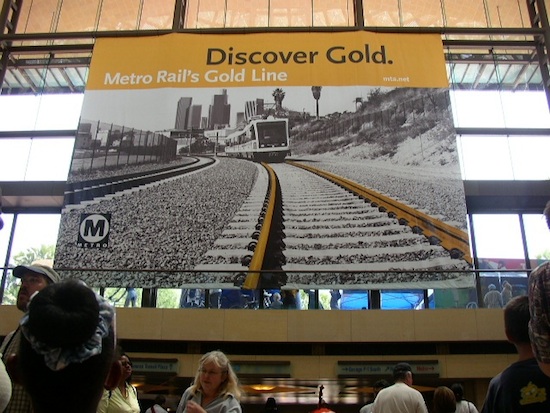
A decade ago today, The Metro Gold Line, Los Angeles' first light rail line in the 21st Century opened on one hot Saturday. Originally planned as an extension of the Metro Blue Line to Pasadena, it's the only direct transportation link between the Los Angeles and Pasadena downtowns (The 110 Freeway ends short of it).
The Militant, who has yet to miss an opening day for a Metro Rail line, was there, and remembered waiting in a long-ass line that snaked around the Gateway Plaza parking garage (the one some of you park in to ride the Dodger Stadium Express bus to games). It took nearly forever, but The Militant got on his train, rode all the way to the Sierra Madre Villa station, where the celebration had already ended in the parking structure there, and headed back.
Old-school Gold Line vehicles, now since replaced with the silver/gray Italian-built Ansaldobreda trains.
A few things have changed since Opening Day; the original 13.5-mile line is now nearly 20 miles long, having been extended from Union Station to East Los Angeles back in 2009. Originally an under-performing line due to its apparent slowness (something the Expo Line knows all too well), it now carries over 42,500 riders per day. Also, the orange-striped white Siemens light rail vehicles no longer run on the line, having been moved to their new tours of duty on the Green, Expo and Blue lines. And a few of the stations have changed their names: Lincoln/Cypress (originally Lincoln Heights/Cypress Park), Heritage Square (originally French Ave), Highland Park (originally Avenue 57) and South Pasadena (originally Mission).
Long-ass lines that day in the parking structure!
The future's bright for the Gold Line: In just two years it will be extended even farther into the SGV, terminating in Azusa with a station near Azusa Pacific University and Citrus College (The Militant won't miss that one fo' sho!). And by the next decade, the line will function as it was originally planned, when the two-mile Regional Connector tunnel is completed under Downtown Los Angeles. But alas, most of what the "Gold Line" is known for will no probably longer be named as such. Potential plans for the line may likely integrate the Union Station-to-Azusa section into the Blue Line, leaving the Eastside segment remaining Gold (and turning the Expo line into "Gold") in the process.
If you're feeling nostalgic for re-living the line circa 2003, take The Militant's Ultimate Gold Line Tour, which came out in 2009, and shows you places of significant interest along the old school Union Station to Sierra Madre Villa route.
Happy Birthday, Metro Gold Line! Here's to many more years, in whatever form you may or may not become!
Though The Militant Angeleno blog is not a history blog per se, it was intended at its founding six years ago to educate what The Militant found back then to be a largely lost and clueless blogosphere in terms of basic knowledge and appreciation of life in Los Angeles. Back then, many transplants and natives alike still clung on to inaccurate pejorative generalized assumptions of Los Angeles, which were designed on purpose to deflate the pride and morale of this city's populace in the name of self-degradation. One of them was, "L.A. [sic] Has No History."
Really now. Even a settlement founded five minutes ago has a history. There is a backstory behind the hows and whys of the existence of that settlement, and the people who founded it. Not to mention that the settlement is now no longer five minutes old, but seven minutes old.
Despite that explanation, there are still some suckas who still insist that "L.A. [sic] Has No History." So instead of inflicting bodily harm on various people, The Militant decided to assume an identity and start a blog. The rest is history. Pun may or may not be intended.
The Natural History Museum is one of Los Angeles' first major civic institutions aimed at a populace that was inevitably bound to be more than just a sleepy agrarian town. A direct product of the "City Beautiful Movement" that swept the United States around the turn of the 20th Century, the museum opened 100 years ago on November 6, 1913. Along with the Los Angeles Aqueduct, which opened the day before, these were civic benchmarks of a place that was undergoing a metamorphosis, as citrus groves and avocado orchards bordered by dirt roads were being transformed into commercial districts and neighborhoods bordered by paved streets.
More than just an old-ass building with dinosaur bones that occasionally becomes a hip venue for KCRW DJs, attaining centenarian status also meant re-asserting itself as an important and vibrant institution of learning and discovery to a city that's undergoing a new kind of metamorphosis in the 21st Century. With that, they unveiled the new "Becoming Los Angeles" permanent exhibit earlier this month. The Militant was faithfully there on Thursday to Check. It. Out.
"Becoming Los Angeles" basically explains the transformation of Los Angeles in ecological and sociopolitical aspects from Tongva nation to Spanish pueblo to Mexican rancho to Californian town to American city. The Militant realizes that it's a herculean task to condense 232 years of written history (and the few thousand years of unwritten history that precedes it) into 14,000 square feet of museum space. Though it's not perfect, it most definitely succeeds at explaining (to newbies and hardcore militant history buffs alike, and everyone in between) the hows and whys of the origins of this grand city that we live in.
The Militant will not attempt to give you a play-by-play rundown of the entire exhibit. He doesn't intend to not only because he thinks it's important that you visit this exhibit yourself and come away with your own experience of learning our city's history, but because he doesn't want to end up writing another overtly long-ass blog post that takes him into the wee-hours of the night and causes him wake up in the early afternoon, only to discover that maybe 30 people have bothered to read his volunteer dissertation (now you know why The Militant doesn't blog as much these days).
He will say that it's a largely aesthetically-pleasing , U-shaped exhibit, which is information-packed but not uncomfortably overwhelming. He will also say that even a militant Los Angeles history buff like The Militant learned a thing or two he either didn't know before, or was explained in much more coherent terms, like how cow poop was instrumental in changing the Los Angeles landscape (The Militant won't spoil it for you, if you didn't know already, then wait for the exhibit to break it down for ya). Incidentally, "poop" is the Museum's preferred synonym for feces/excrement/droppings/doo-doo/caca/shit, as its use is consistently used in the other exhibits (Dino poop, anyone?). He will also additionally say that some of the historical artifacts included here were mind-blowing in their inclusion, such as the actual table where The Freaking Treaty of Cahuenga was signed (to think that THE John C. Fremont and THE Andres Pico actually sat there...[mind blown]). He will even more also additionally say that your Los Angeles History Geekdom can accurately be measured by the amount of time in minutes (or hours) that you gaze at the Downtown Los Angeles Circa 1940 scale model and view it from various angles (and take photos of it). Mark The Militant's Word!
The Militant also stepped back and looked not just at the displays themselves, but at the people perusing them, with curiosity, delight and even various levels of expertise. It was quite a sight to see 21st Century Latinos make connections with their 19th Century counterparts, a number of which we get to be acquainted with by face and name via biography. One of the visitors commented on the picture of Eutalia Perez de Guillen Marine, who lived to the age 112(!) and said she reminded her of her own great-grandmother, and how Señora Eutalia's eyes can "look into your soul." Others were equally fascinated by the 103 year-old Rogerio Rocha (Man, what were these people eating back then, that's what The Militant wants to know!), a blacksmith of Fernandeño Indian heritage who owned his own property in the SFV but lost it to Teh White Man when American property laws went into effect in the 1850s.
And for those who know your historical figures, people like Abel Stearns, Biddy Mason and Harris Newmark, among many others, get their due props here.
As The Militant mentioned earlier, "Becoming Los Angeles" isn't perfect. Though not adversely impacting the exhibit in any major way, he feels it could be much better if the following can somehow be addressed:
- The Native American section (described specifically as "Tongva-Gabrieleño" as various tribal factions have their own variations on the name) seems kind of nominal. Maybe it's because The Militant dedicated an entire month of posts on the original native Angelenos, but you figured the people who have been here milennia longer than the Spanish, Mexicans and Americans combined should get a little more display love. We see some nice stone artifacts, but little in the way of what they looked like and what their environment was like. It would also have been awesome to see a map of Tongva villages overlaid on a modern Los Angeles like what The Militant did.
- The Pobladores display, though featuring a neato scale diorama and a full roster of the 44 founders of El Pueblo de Nuestra Señora la Reina de los Angeles del Rio Porciuncula on September 4, 1781 by name, age and gender, still seems to be missing something. Maybe it's the (lack of) adequate lighting (these are the founders, c'mon!), maybe it's the awkward positioning in the exhibit (it's placed in a corridor, painted black, possibly easy to overlook), maybe it's way the description was written, which doesn't seem to make it plainly obvious why the Pobladores were dispatched from Mission San Gabriel and why they stopped where they stopped.
- On a similar note, the Pacific Electric display, though containing some nice mementos of our former rail transit system, doesn't seem to relay to the passing eye that it's presenting the history of a transportation system -- i.e. no pictures or models of streetcars.
- More interactive displays. The interactive video presentation of the Los Angeles Aqueduct was well done, The Militant expected a little more of that with the technology we have today. Maybe a display of how the freeway system grew over the years (many Los Angeles n00bs just assume it was built all at once when it, like today's Metro Rail system, was actually planned, funded, built and opened in phases).
- While the exhibit rightfully covers the impact of the motion picture industry, including some early artifacts, though it references the film industry's east coast origins, it doesn't explain why it ended up here (supposedly to escape possible lawsuits stemming from Thomas Edison's exclusive patent of the motion picture camera, and Hollywood, once located along a railroad line, was close enough to the Mexican border where scofflaw filmmakers could escape the country in a jiffy).
- The photo gallery along the walls towards the end of the exhibit have no captions/credits. Dunno if it's not finished yet, but it would help to have explanations for the pictures (The WWII photo display of multiethnic Angelenos involved in the war, flanking a photo of San Gabriel native Gen. George S. Patton looked nice though).
The exhibit ends with a photo montage projection of historic events from the 1940s to the 2010s and a video of the Los Angeles cityscape framed by questions that lead the visitor to ponder the city's future.
Because we are also a living part of Los Angeles history.
Do The Militant a favor and visit this exhibit. Give yourself about one and a half to two hours to enjoy the whole thing. Don't rush it (The Militant sorta did towards the end but it worked out in his favor since there was a power outage at the museum on Thursday afternoon). And after you do visit it, encourage your friends and family to visit it. And especially tell your friends/relatives transplanting themselves from Out East, Flyover Country and Up North to visit it, especially within their first month in town.
Los Angeles never lacked a history. But for the longest time we lacked a common mechanism in which to learn it. It's not something the LAUSD teaches its kids (nor is it something the LAUSD wants its kids to learn, especially in this era of standardized testing and their overall systematic decimation of learning). It wasn't until websites, blogs and social media made it easier to learn the hows and whys of this grand city, and glimpse into the way our familiar streets looked like to previous generations.
Visiting the "Becoming Los Angeles" exhibit is probably one of the most important things you should be doing as an Angeleno. Though obviously not hyper-comprehensive, it's complete enough that it gives a baseline history that should form the basis of our common understanding of local history. And it stimulates our curiosities enough that if we want to learn more, we can. Militant-Approved!
Too bad it had to take 100 years to make all this happen.
It's a wonderful time to be a Dodgers fan. As of July 22, the team entered sole possession of first place in the NL West, just 22 days after being in last place. Yes, just 22 days from "suck" to "success," thanks to The Puig, Hanleywood, a more consistent rotation, a more improved pen, keeping Brandon League away from save situations and overall better health. Enjoy this one:
While The Militant was watching Sunday's game where The Boys In Blue swept the Washington Nationals, announcer Steve Lyons (yeah, we know...) made a comment about baseball's 7th Inning Stretch, how it may or may not have been originated by president William Howard Taft during the Washington Senators' Opening Day game in 1910 where the famously portly Commander-In-Chief stood up in the middle of the 7th and took a stretch to relieve the fatigue of sitting in a seat that was too small for him. The other spectators, seeing this, stood up along with the prez, and a tradition was born.
The other tidbit uttered by the unfortunately non-Vin Scully broadcasters was that the baseball anthem, "Take Me Out To The Ball Game" was first played at a baseball game in Los Angeles during a high school match in 1934.
"I find that hard to believe," quipped Lyons, fueling fire to the stereotype that Los Angeles was pretty much an empty desert until East Coast transplants arrived here, circa 1998 or so.
The story behind the song goes like this: It was written back in 1908 by Tin Pan Alley songwriters Jack Norworth (lyrics) and Albert Von Tilzer (music). Norworth was riding the subway in NYC (then brand-spanking new, only in existence for four years) when he saw an advertisement that read, "Baseball Today - Polo Grounds." The song was written with the songwriters having never been to a baseball game before (and hadn't even done so until over 20 years after the song was written).
And did you know the song as we sing it at Dodger Stadium, and at other stadia, is not the whole song? You're only singing the chorus part of the song! Here's the complete song, verses included, for y'allz:
The song was popular back in the days before records or even radio. People bought the sheet music and played and sang it themselves. It was also a popular pastime song in movie theaters - The audience sang it while the guy in the projector booth changed the film reels. But it would be some 26 years before it would be played at an actual baseball game, mainly because public address systems didn't exist until 1929.
Rick Astley's "Never Gonna Give You Up" (now known as an Internet meme) is a song that came out 26 years ago, just to give you some perspective.
Several historical accounts mention "Take Me Out..." as having been first played at a high school baseball game in Los Angeles before being played at the World Series in St. Louis later that year.
But...which high school?
It would be pretty awesomesauce if a certain high school's sports program took credit for it and literally ran the bases with it. Imagine having that distinction. Of course, Los Angeles schools don't care a thing about preserving their own histories, since teaching local history is banned in the LAUSD (assuming it was an LAUSD school). One account lists it as a "prep school" (which would likely make it a private school) and this page says it was first played "before the first game of the Los Angeles high school baseball season."
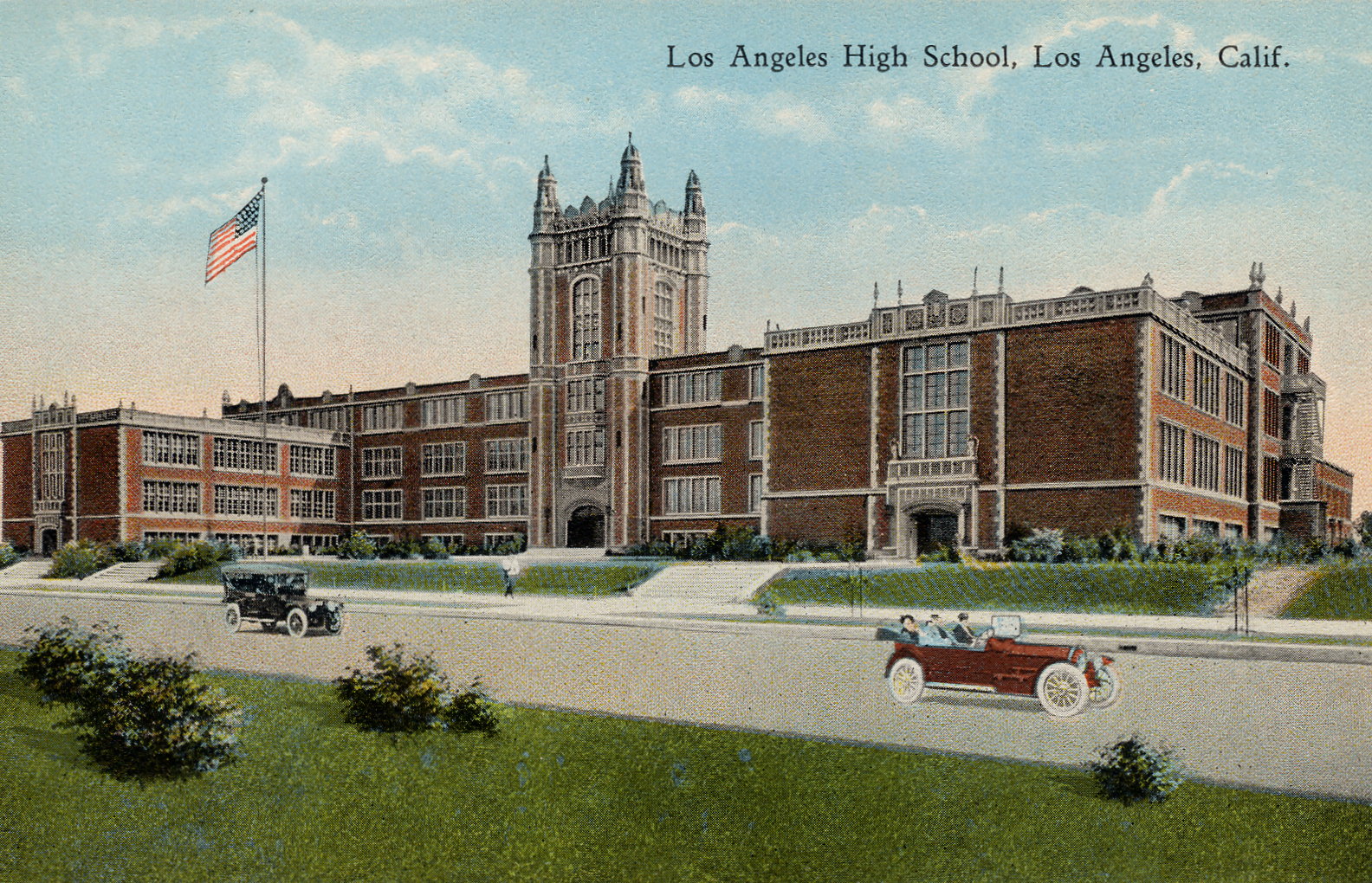
Well, there is a high school called "Los Angeles High School" which was founded in 1872 at Temple and Broadway in Downtown, moved to Fort Moore Hill in 1891 (right at pretty much the site of today's Ramon C. Cortines School of Visual and Performing Arts) and moved to its current Olympic Blvd location in 1917. It once had an ornate gothic edifice (pictured left) which was damaged in the 1971 Sylmar earthquake and destroyed by an unrelated, though mysterious, fire later that year. Today's ugly-ass penitentiaryesque '70s-era school building is what replaced a beauty of a campus.
Interestingly, Los Angeles High does boast baseball-related alumni such as former Brooklyn Dodger Mel Almada, who in 1933, became the first Mexican American to play in the major leagues as a member of the Boston Red Sox. Other players include former NY Giants catcher Harry Danning and former Yankees outfielder Bob Meusel.
But perhaps the greatest Los Angeles High alum to make an impact on baseball was not a player, but a young woman named Rosalind Weiner who was eventually elected to the Los Angeles City Council in 1953 and became the driving force in City Hall in bringing the Brooklyn Dodgers to their new home in Los Angeles.
Sounds like the stars were aligned for that one. So, unless any other school wants to take credit for it, you Los Angeles High Romans might want to steal this historical base.
"Take Me Out To The Ball Game" is a tradition of America's national pastime, performed over the years at the old Wrigley Field, at Gilmore Stadium, at the Los Angeles Memorial Coliseum, at Dodger Stadium, at Anaheim Stadium if you wanna count that, at Dedaux Field, at Jackie Robinson Stadium and at countless high school fields all over town where countless major league players once played. But one of them, whichever it is, was the originator.
If anyone out there has any solid leads on the exact high school that originated "Take Me Out To The Ballgame" in 1934, please contact The Militant [militantangeleno at gmail dot com] immediately.
When The Militant first heard that there would be another CicLAvia added between the April and October editions, he was stoked. Then when he found out the route was a simple 6-mile stretch of Wilshire, he was bummed. But then when it was revealed that the event's hours were finally extended to 9 a.m. to 4 p.m., he was stoked again.
The six-mile course was the shortest to date and the first one to not incorporate any parts of previous routes. Billed as "Iconic Wilshire Boulevard," The Militant couldn't help but read that as "Ironic Wilshire Boulevard." No, not because of all the hipsters blasting Daft Punk's Random Access Memories album on their iPod boom boxes, but because Wilshire was, for all intents and purposes, a road developed for the car. H. Gaylord Wilshire donated his land along the former Orange Street on the condition that it not have streetcars or commercial trucks run along the thoroughfare. And when developer A.W. Ross pulled a Miracle some three decades later, the stores were built to autocentric scale. So how ironic, yet how appropriate, to have the street closed to cars and open to human-powered transport.
The six-mile course wasn't actually that bad. Though it lacked the sense of adventure and accomplishment of April's Sea-cLAvia, it was short and sweet enough to enjoy multiple times over if one wished. At no point did The Militant feel the need to rush the route (whereas he always did before). There were shops, green space and historical wonders galore. There was almost something for everyone - yoga, zumba and KBBQ. And it was also quite walkable. The Militant probably walked almost two miles of the route (of course, with the large dismount areas at the ends, everyone walked 1/6 of the route).
Since two months fly by just like that, here we are...and there it went. Time flies when you're having fun, and despite the longer CicLAvia hours, the final CicLAvia of the Villaraigosa administration still went by all too quickly. Still, the two additional hours were much MUCH appreciated since The Militant was not only able to ride the entire course and back, but was able to chill out along the route. One downside though, was the lack of the 30-minute or so grace period after the official end of CicLAvia's hours, that grey area where cars aren't sure whether they should be back on the road yet, so, at least for part of the route, CicLAvia goes on extended play.
Not so this time. In fact, it was 3:55 p.m. when LAPD cruisers and City vehicles sweeped through Wilshire telling cars, in a stoic loudspeaker voice to "move to the right." So while CicLAvia might have gained two hours on paper, in reality, because there was never anyone keeping us off the route before the start time anyway, we really only gained half an hour.
How about CicLAvia follow this formula: One hour per mile, plus one, equals the appropriate length in hours of a CicLAvia event? Sunday's route was 6 miles, plus one equals the 9 a.m. to 4 p.m. span of the event. Perfect. Ergo, this just means that the 16-mile "To The Sea" route via Venice Boulevard will have to be 17 hours long next year [wide grin].
This being the first CicLAvia to experience June Gloom, Sunday's seventh iteration of CicLAvia may or may not have broken the streak of cloudless CicLAvia days, but as the afternoon wore on, the sun shone through the rest of the day. Never fails. The Despicable Me 2 blimpalso never failed to stalk us.
That aside, why don't we ask some experts what they thought of Sunday's CicLAvia? Thanks to a couple of his San Dimas-based operatives, The Militant was able to obtain a phone booth and travel back in time to gather some of the most influential white males in the history of Wilshire Boulevard! Joining us in our panel of experts (If you read the recent Epic CicLAvia Tour post, these names should be familiar to you by now...) is developer and Great Depression-era Miracle Mile founder, A.W. Ross; late 19th-century real estate magnate George Shatto and last, but certainly not least turn of the 20th century land developer, publisher and failed politician H. Gaylord Wishire.
MA: Gentlemen, thank you for being here.
George Shatto: We cannot see your face, young sir.
MA: The Militant's face is irrelevant to the topic. What did you think of Sunday's CicLAvia?
Gaylord Wishire: It was delightful to see so many bicycles on my street. They come in so many colors. Just like the people riding them. But I was much bothered by the trucks parked along the road. I specifically told the city, no trucks allowed on my street.
MA: Oh, those are food trucks, sir.
GW: Food trucks? Where are they delivering them to?
MA: They're not delivering food, they're selling food.
A.W. Ross: Food-selling trucks? Why, that's just nifty! I oughtta try that sometime on The Mile!
MA: No, don't do that, you'll mess up the space-time contin...oh never mind.
GW: Ross, was it you who erected these horrid capitalist edifices on my street?
AWR: Why, yes I did.
GW: You...swine!
AWR: Why, I oughtta pound you!
MA: Gentlemen! Gentlemen! Let's all just calm down. We're here to talk about CcLAvia. Mr. Shatto, your thoughts?
GS: What in criminy's name happened to my house? What happened to the other houses?
MA: Well, it's now a hospital. They demolished your house after you die...err...uhh...feeling awkward right now.
GS: I died? When?
MA: Die...di...dial..ed...dialed the telephone. Yes, that's it.
GS: What is the "telephone," exactly?
MA: Never mind. Hey, did you know a bowling alley was named after you?
GS: You don't say!
MA: Back on topic...Mr. Ross, what were your impressions of CicLAvia?
AWR: What happened to all the cars?
MA: Well, CicLAvia is a day where we close off the streets to cars.
AWR: Now why in tarnation's name would you ever want to do that?
MA: Well, because there's too many cars on the streets these days.
AWR: And that's a swell thing!
MA: No, because we have congestion and air pollution now.
AWR: Bah, that's just a bunch of applesauce.
GW: What does he know? That Ross is nothing but capitalist swine.
AWR: Oh dry up, Gaylord!
GW: Do you want to settle this in fisticuffs?
MA: HEY HEY GUYS! STOP! PLEASE!
GS: Is anyone interested in investing in some Santa Catalina Island property?
[Ross and Wilshire engage in a fistfight]
MA: Okay, gentlemen, thank you for participa...YO, SECURITY!
[The three panel guests were quickly escorted back into the phone booth time machine. Huh? "Station?" Who said that?]
Enjoy The Militant's Epic Militant CicLAvia Photo Gallery!
What's left of the Wilshire Grand Hotel, soon to be the freaking tall Wilshire Grand Center building.
CicLAvia has clearly gone to the birds this time.
The Militant sincerely hopes this dude's tongue was planted firmly within his cheek with this one.
Gen. Otis directs CicLAvians to the yoga class at Mac Arthur Park.
JAIME: Hey Edward James, do you think Los Angeles is a bike-friendly city now?
EDWARD JAMES: Olmos!
Stupid tall bikes were soooo April 2013. This is the newest bad-assness right now.
Homeboy kept following us the whole time.
Los Angeles County presents the highest-capacity bike rack ever made.
Wait a minute, didn't we just have a CicLAvia a couple months ago? You mean we don't have to wait until October? WOO-HOO!!!
Yes, fellow Angelenos, we have a third CicLAvia this year, albeit a short one. At six miles, it's the shortest and simplest route to date (Just Wilshire Boulevard between Grand and Fairfax avenues). Ironically, it's also the longest CicLAvia chronologically: The CicLAvia folks have finally listened to our pleas and will have CicLAvia run from 9 a.m. to 4 p.m. this Sunday! You heard right! Six miles in seven hours! It is also the first completely new route, which does not encompass any part of a previous CicLAvia route, though it crosses or closely parallels them.
Since the route is short and incredibly flat, there's talk about this being the most walkable route yet. The Militant may or may not ditch his bike and hoof it this time around! Maybe...argh. But if you want your very own preview of what Sunday's route will look like (at least from the sidewalk) check out the first four minutes of this video:
Well, we know why you're all here -- to check out interesting things compiled by the doesn't-blog-too-much-anymore Militant Angeleno (but he Tweets often...). So here goes!
1. One Wilshire Building/Wilshire Bookend Palm Trees
1966
624 S. Grand Ave, Downtown
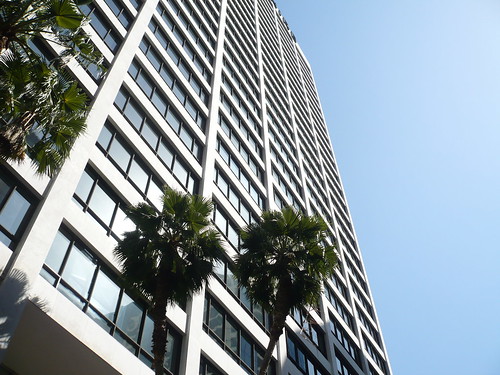
Built during the first wave of modern skyscrapers following the repeal of Los Angeles' building height limit laws, this building, designed by architectural rockstars Skidmore, Owings and Merrill (who also went on to craft Chicago's Sears Tower, among many others) stood for most of its life as the address of legal and financial institutions. After a renovation in 1992, this building is now the location of CoreSite, a major data colocation center, which carries the primary Internet connections for Los Angeles (without this building, you can't read this!)
Take note of the row of palm trees, planted here in the 1970s: They are meant to evoke the end of Wilshire Boulevard, as on the opposite end, at Santa Monica's Ocean Avenue, 16 miles from here, you will also find a row of palm trees.
2. Wilshire Grand Hotel Site
2017
Wilshire and Figueroa (SW corner), Downtown
What we see today as the Wilsh...ZOMG IT'S GONE!!!!
Oh well, up until a few months ago on that empty lot was the Wilshire Grand Hotel, formerly (in reverse chronological order) the Omni Hotel, Los Angeles Hilton, Statler Hilton and Statler Hotel.
On this site will rise Los Angeles' (and the West's -- suck on it, Transbay Tower SF!) tallest building at 73 stories and 1,100 feet (kinda sorta, there's a spire, you see...). It will also be Los Angeles' only modern skyscraper without a flat roof. It will house Wilshire Grand Hotel 2.0 and a bunch of shops and condos.
The building will also have a "sky lobby" up at the top and will be the first skyscraper anywhere to sport a mohawk.
3. L.A. Prime Matter Sculpture
1991
Wilshire and Figueroa (NW corner), Downtown
Wilshire is full of awesome-looking public art. Here's one relatively-recent sculpture right at the northwest corner of Wilshire and Figueroa. Designed by the late Venice-based artist Eric Orr, who had a penchant for utilizing elemental themes in his art, L.A. Prime Matter features twin 32-foot bronze columns that feature water sliding down its faces, and during random moments, FIRE emanates from the middle channels of the columns! The effect is total bad-ass, and its bad-assnes is magnified at night.
Hopefully participants in a bad-ass event like CicLAvia would get an opportunity to see the pyrotechnics!
4. Site of George Shatto Residence/Good Samaritan Hospital
1891
Wilshire Blvd and Lucas Ave, Downtown
Before it was named Wilshire Boulevard, it was once called Orange Street, and on the corner of Orange and Lucas was a Queen Anne-style mansion belonging to George Shatto, a real estate developer who first developed Catalina Island and the city of Avalon. If you read the Epic CicLAvia Tour 4.0 post, his name is brought up as one of the famous Angelenos buried (in a rather ornate pyramid) at Angelus Rosedale Cemetery.
But check this out! Take a look at the picture above, and pay close attention to the masonry wall going uphill that fronts Lucas Avenue. Now, on CicLAvia Sunday, look at the exact same spot, on the northwest corner of the intersection. The house is gone, but the original wall still remains!
Good Samaritan Hospital, which was founded in 1885 and moved to the current site in 1911, is also the birthplace of many native Angelenos, including incoming mayor Eric Garcetti.
5. Los Angeles Teachers (a.k.a. 'Stand And Deliver') Mural
1997
Wilshire and Alvarado, Westlake
Art imitates life imitating art imitating life in this mural by popular Salvadoreño American muralist Hector Ponce depicting actor Edward James Olmos, who portrayed Garfield High School math teacher Jaime Escalante in the 1988 movie Stand and Deliver, standing next to the real-life Escalante, and delivering a mural that's part-Hollywood, part-Los Angeles, part-Latino pride, part Eastside pride and if the Internet were as accessible back in 1988 as it is today, would make one epic photo meme. And it's painted behind the 1926 Westlake Theatre, which is slated for renovation into a community-baed performance arts venue sometime soon. Celebrate the 25th anniversary of Stand and Deliver by having the ganas to stop by.
6. Gen. Harrison Gray Otis Statue
1920
Wilshire Blvd and Park View Ave, MacArthur Park
Gen. Otis is perhaps the most visible statue at the park, which predates MacArthur's WWII service. This general served in the Spanish-American and Philippine-American wars, and also fought as a Union soldier in the Civil War. But in Los Angeles, he is most known for being the founder, owner and publisher of the Los Angeles Times.
So why is he here? His Wilshire Blvd mansion, called The Bivouac, was located across the street, was later donated to Los Angeles County and became the original campus of Otis Art Institute. It's thought that his statue is pointing to the site of the Elks Lodge, but he's probably just pointing to his old house.
7. Bryson Apartment Building
1913
2701 Wilshire Blvd, MacArthur Park
This 10-story Beaux Arts apartment building, built 100 years ago, was the 20th century precursor to today's fancy modern 21-century high-rise residential developments. Built by developer Hugh W. Bryson, it was built in a part of Los Angeles that was known at the time as "the west side" (let's not open that can of worms right now, okay?). It was one of Los Angeles' most luxurious apartment buildings, and had a large neon sign at the roof (characteristic of these kinds of developments back then). Several Raymond Chandler books reference The Bryson. The 110,000 square-foot building is also part of the National Register of Historic Places and a Los Angeles Historic-Cultural Monument.
8. LaFayette Park
1899
Wilshire Blvd and LaFayette Park Place, LaFayette Park
Clara Shatto, the widow of George Shatto (remember him?) donated 35 acres of her land to the City of Los Angeles in 1899, which was once oil wells and tar pits. Her late husband wanted it turned into a city park, and so it became Sunset Park, which existed for 19 years before the locals wanted it renamed to honor the 18th-century Frenchman who was a hero in both the American and French revolutions. Gotta give LaFayette park some props for living so long in the shadow of its more famous neighbor, MacArthur (Westlake) Park.
9. Bullocks Wilshire/Southwestern Law School
1929
3050 Wilshire Blvd
Perhaps one of the most iconic examples of Art-Deco architecture in Los Angeles, this former Bullocks Department Store was designed with a tower to resemble a New York-style skyscraper in then-unabashedly low-rise Los Angeles. It was the epitome of shopping in style in its heyday, with its own rear parking lot and other auto-centric amenities. It ultimately fell victim to the 1992 Los Angeles Riots and was closed down the next year. In 1994, the nearby Southwestern School of Law bought the building and incorporated it into its campus, restoring much of the Roaring 1920s Art Deco aesthetics. 10. Shatto Place
c. 1880s
Wilshire Blvd and Shatto Pl, Koreatown
Gee, we can't get seem to get away from that George Shatto guy, can we? George and Clara owned a plot of land here on this street, which was once home to some of the most beautiful mansions in Los Angeles at the time. Although Clara sold the land in 1904, George stipulated that all properties on the street maintain the character of the exquisite homes there, which was challenged several times until the late 1920s, when the homes started to be demolished in favor of more modern commercial development.
11. "The Vermont" Highrise Apartment Development
2014
Wilshire Blvd and Vermont Ave., Koreatown
What's with the construction? It's a 30- and 25- story highrise mixed-use apartment development called "The Vermont" by J.H. Snyder Co. which is slated to open next year. It's Metro-accessible, but who the hell can afford the rents for this place?
12. Consulate Row
Various locations along Wilshire Blvd between Vermont and Crenshaw
Some 62 countries have consular offices in the Los Angeles area and 41 of them have addresses on Wilshire Boulevard. Proximity to various foreign financial institutions on Wilshire, as well as nearby Hancock Park, where many consul-generals have traditionally resided, are the main reasons for such a high concentration of consulates on this stretch of Wilshire. The consulate offices for Bangladesh, Bolivia, El Salvador, Ethiopia, Guatemala, Honduras, Indonesia, South Korea, Nicaragua, Peru, The Philippines, Sri Lanka and Taiwan are all located on Wilshire between Vermont and Crenshaw. Many of them display their national flags in front of their respective office buildings. How many can you spot during CicLAvia?
13. Gaylord Apartments
1924
3355 Wilshire Blvd
Though the building's prominent neon sign has been source of many a snicker by immature junior high school kids, this building represents some serious history. It was named after Wilshire Boulevard's namesake, Henry Gaylord Wilshire, who was known as a wealthy real estate developer and outspoken socialist (Does that make sense?), who donated a 35-acre strip of barley fields to the City of Los Angeles on the condition that it would be free from railroads or trucking.
The building itself is a 13-story Italian Renaissance-style apartment building that actor John Barrymore (a.k.a. Drew's grandpa) and then-presidential candidate Richard Nixon once called home.
14. Brown Derby Site
1926
3427 and 3377 Wilshire Blvd
The now-defunct "The Brown Derby" local chain of restaurants were synonymous with Hollywood glitz and glamour. The Wilshire Boulevard location was the first of four (the others were in Hollywood, Beverly Hills and Los Feliz). In close proximity to The Ambassador Hotel and its Cocoanut Grove swing/jazz club, this was the original hipster joint back in the day, only back then the hipsters were actually cool and looked good. In 1937 the building was moved across the street and closed in 1975. In 1980, a shopping center was built on the site and the iconic dome structure was incorporated into the shopping center that exists today. It's situated on the third floor, above The Boiling Crab seafood restaurant. It's something to ponder on while you wait 90 minutes for your table.
Note that the pictures for #13 and #14 connect vertically - that's the Gaylord Apartments behind the Brown Derby!
15. Robert F. Kennedy Inspiration Park/Ambassador Hotel Site
2010
Wilshire Blvd between Catalina Street and Mariposa Avenue
The Militant wrote a post in 2010 about this unique public space dedicated to Sen. Robert F. Kennedy, who was assassinated just yards away at the Ambassador Hotel, which was demolished in 2005 and where the LAUSD's sprawling and costly RFK Community Schools campus now stands. There's Kennedy quotes on public art installations and benches for you to chill on. There's also speakers playing recordings of some of the jazz music that was performed at the hotel's famed Cocoanut Grove swing and jazz club.
16. Wiltern Theatre/Pellissier Building
1931
Wilshire Blvd and Western Avenue (duh...), Koreatown
The 12-story structure, designed by Stiles O. Clements, is Los Angeles' emerald-green temple to all that is Art Deco. Originally operating as the "Warner Theatre" (Specifically the Western Avenue location of Warner Bros. chain of movie theaters; The Warner Theatre in San Pedro is another example), The Wiltern (named so since 1935) has seen many cycles of decay and rebirth, most recently in the 1980s, when preservationists renovated the theatre to a performing arts venue. The contemporary Wiltern Theatre has been operating since 1985.
17. The Last House On Wilshire
1918
4016 Wilshire Blvd, Hancock Park
Wilshire Boulevard was once a prestigious address for many a prominent Angeleno, from General Otis to, yep, George Shatto (don't worry, this is probably the last Shatto reference in this post). But after the 1920s, Wilshire became undeniably commercial and even the most dignified free-standing household succumbed to the wrecking ball.
Except this one, standing (quite nicely) on 4016 Wilshire, just yards west of Wilton Place. Built in 1918, this six bedroom, three bathroom, 3300 square-foot single-family home is literally the last of its kind on Wilshire. The earliest recorded owner, John and Katherine Neeland (circa 1921), of Canada, sold it in 1925 to Elmer & Clara Neville. The Neville family trust still owns the house to this day. If you owned the last house on the street, you'd hang on to it, right?
18. Rimpau Blvd/Rancho Las Cienegas
1823-1920s
South of Wilshire Blvd between Norton Avenue and La Cienega Boulevard, Hancock Park
You may or may not notice that all of the streets south of Wilshire from Norton Avenue to just past the Fairfax Avenue terminus of the CicLAvia route run in a diagonal fashion, akin to the way Downtown Los Angeles streets run. Why? This was once part of the old Rancho Las Cienegas Spanish land grant, which was given in 1823 to Francisco Avila, once mayor of Spanish-era Los Angeles. In 1866, the land was divided among his four children, one of whom was his daughter Francisca, who married a German dude named Theodore Rimpau...Does that name sound familiar? Yep, it's the namesake of Rimpau Blvd. The last remaining rancho land was eventually sold and subdivided by Theodore and Francisca's sons in the 1920s.
19. E. Clem Wilson Building (aka Samsung Building)
1929
Wilshire Blvd and La Brea Ave, Miracle Mile
At 191 feet, it was once the tallest commercial building in Los Angeles (honoring the height-limit restrictions at the time). Built during the first wave of commercial migration from Downtown Los Angeles, this structure originally housed legal and medical offices belonging to Jewish professionals, and was part of the genesis of the Jewish community in this area (centered on Fairfax Avenue). The building once featured a large mast on top to serve dirigible blimps(!) but is most famous for the massive 4-sided neon advertisements installed on the crown in the 1960s: First, Mutual of Omaha Life Insurance, then Asahi Beer and now Samsung Electronics.
20. The Los Angeles "Hair District"
c. 1970s
Wilshire Blvd between Cloverdale and Burnside avenues.
The Militant wrote about this interesting little business corridor five years ago, noting an unusually high concentration of wig, weave and human hair retailers along this part of Wilshire.
21. The Desmond's Department Store Building
1928
5500 Wilshire Blvd
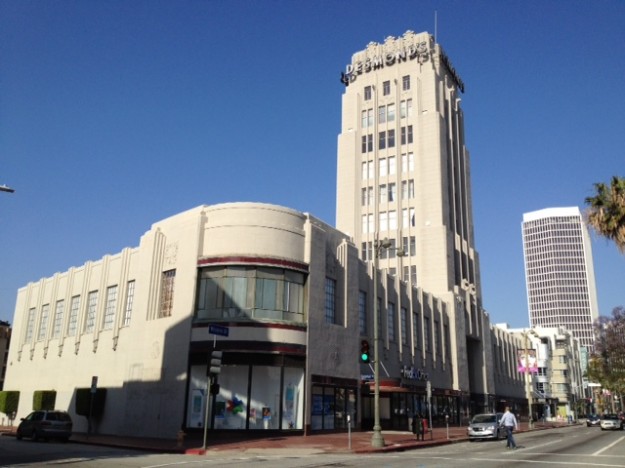
This is the building that started it all, the archetype that led to many miracles on this mile of Wilshire Boulevard. The Wilshire location of Desmond's Department Store was the first high-end department store on Wilshire, and the retail development anywhere to sport a rear parking lot, and a main entrance that faced the back, rather than the street, as well as large circular display windows to attract motorists.
The 10-story building will soon be adaptively-reused into 175 (luxury, The Militant can assume...) apartments which will open sometime next year.
22. A.W. Ross Monument
1956
5700 Wilshire Blvd (Wilshire Blvd and Curson Ave)
"A. W. Ross, founder and developer of the Miracle Mile. Vision to see, wisdom to know, courage to do."
The story goes: Real estate developer A.W. Ross bought an 18-acre stretch of property along Wilshire Blvd in 1921 for $54,000 and in less than a decade's time, turned that stretch of dirt road, oil fields and farmland into Los Angeles' bougiest stretch of retail, which boomed -- of all times -- during The Great Depression. You can call that a miracle.
Ross was considered an innovator in his day; he brought large-scale, ritzy retail developments to his district, all with rear parking lots, and all made to be visible at 30 miles per hour. Left-turn lanes and synchronized traffic signals were credited to Ross. Streamline Moderne and Art Deco architecture flourished thanks to Ross' development.
In 1956, this bronze bust was placed on this landscaped traffic island to honor the man who brought the "town" out of Downtown and stretched it out like Laffy Taffy.
But little else is known about A.W. Ross (no, he was not affiliated with the Ross Dress For Less stores). Where did he come from? What was his real estate dealings before the his purchase of Wilshire? What did "A.W." stand for, anyway? 23. Some Hairy Elephants In Some Oily Lake
16,000 B.C.
5801 Wilshire Blvd, Miracle Mile
You may or may not know about this place, built in 1976, and if you don't, there's really no hope for you.
24. May Company Building/LACMA
1939
6067 Wilshire Blvd, Miracle Mile
Many people know the May Company Building - today part of the LACMA campus, and tomorrow the new home of the Academy of Motion Picture Arts and Sciences Museum - as a Streamline Moderne department store. But did you know it was instrumental in moving Los Angeles' Jewish community from The Eastside and Downtown to Fairfax Avenue?
It all began in 1881 when Asher Hamburger, a well-respected Jewish merchant, opened his People's Store on Main Street in Downtown. The business grew and moved in 1911 to a much larger building on 8th and Broadway and was then known as A. Hamburger and Sons Co until 1923, when the company merged with the Missouri-baed May Company. The new operation, formally known as May Company California, was largely run by the Hamburger family and enjoyed much support and patronage by the local Jewish community.
The opening of the aforementioned E. Clem Wilson Building attracted Jewish professionals farther west. In 1935, there were four synagogues along the Fairfax corridor. In the years following the 1939 opening of May Company's new flagship store on Wilshire and Fairfax, the Jewish population boomed, the number of synagogues tripled by 1945. Post-War growth continued the population boom along Fairfax.
About a month ago, there was a certain unspecified food festival that took place in a location that was not located East Of The Los Angeles River that had the audacity to use the word "Eastside" in its name. Now, if you've been reading This Here Blog for a long time, you May Or May Not Know Damn Well Know that certain geographically-clueless gentrifying forces have co-opted the "Eastside" name with no regard to the people who live on the East bank of the Los Angeles River who have taken pride in their regional identity for decades longer than the faux-Eastsiders have even been here. And of course, The Militant has had his own well-publicized say in all of that.
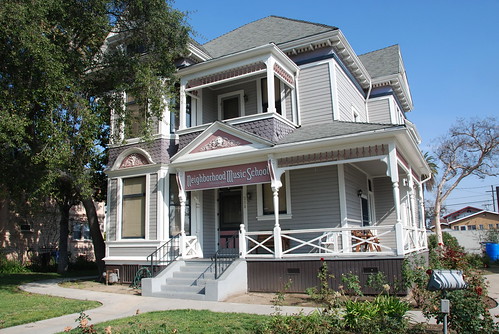
But here's some good news, this Saturday, June 1, get to go to a REAL Eastside festival, which takes place in Boyle Heights, and see what The Real Actual Authentic Puro Eastside is all about (the wannabe Eastsiders just call it "Chololand" or don't even acknowledge it exists). It's the 2nd Annual Eastside Community Festival, which takes place at the campus of the Neighborhood Music School, a 99-year old Eastside educational arts institution. Have authentic, inexpensive Eastside-made food, have a chat with REAL Eastsiders and learn about the organizations that work hard to build real, hipster-free community activities, such as PUENTE Learning Center, Alma Family Services, the East Los Angeles Community Corporation, our mobility amigos at Streetsblog Los Angeles (who DO know where The Eastside is), and more. But the biggest whammy of them all is the participation of the world-famous Eastside phenomenon Caine's Arcade, which will set up some games and certainly sell some Fun Passes for the day. Dude, Caine's Freaking Arcade! No faux-Eastside event can claim THAT!
So come one, come all, it's FREE, and not only that, but it's transit-accessible! Take the Metro Gold Line to the Mariachi Plaza station, and walk three blocks south on Boyle Ave. Or better yet, ride your bikes down 1st Street and head down Boyle! There May Or May Not be bike parking, but you'll find a way. Besides, it's been a long-ass time since The Militant has plugged an event, much more written a blog post! See you or not see you there!
Two and a half years since the advent of Los Angeles' own ciclovia event, we have the longest CicLAvia route to date at a length of 16 miles, from El Pueblo to la playa, and going as far west as it can go, to the iconic Angeleno seaside playground known as Venice Beach, just yards from the famed boardwalk. The planners call it "CicLAvia to the Sea." The Militant will skip the redundant syllables and come up with his own portmanteau: Sea-cLAvia.
The Militant was there, and has yet to miss a CicLAvia (and plans never to do so, unless they make this a daily event), so he got on his chromoly steed and rode westward.
Had it really been that long since his the last CicLAvia in October - half a year ago? CicLAvia season has now begun, and Angelenos have officially sprung back into life.
We haven't seen THIS since last October...
True to CicLAvia fashion, there was nary a cloud in the sky (except at the beach, which burned off eventually), the temperature somewhere between 74 and 80 degrees, zero arrests (compared to 171 out in Coachella) and hundreds of thousands of smiling faces.
The severely undercounted estimate of 100,000 participants (which is a hard figure to quantify with any precision whatsoever) had to have been surpassed, as the past 3 or 4 have already broken the 100K mark. The Militant's estimate is some 225,000 people for CicLAvia VI.
Westbound CicLAvians outnumber the eastbound ones on Venice Blvd.
Because the event lasts an all-too-short five hours -- a major pet peeve of The Militant since CicLAvia began -- He skipped the Downtown-to-Westlake segment and headed for the goods.
He passed by several of his listed points of interest in his Epic Militant CicLAvia Tour 4,0 post, and even had some nice chats with fellow riders, even educating one on where the Expo Line was headed to in three years (he knew there was construction in Santa Monica, but for some reason didn't put two and two together...). He saw a family bang on percussion instruments from their balcony on Venice Blvd to the delight of cyclists, Brazilian capoeira on Venice, Hare Krishnas singing, DJs spinning, and even rode along with the mayor, as well as a likely future mayor.
Bikes backed up on Venice at Sawtelle. There's something about being close to the 405 that creates congestion.
The biggest complaint shared by most was the traffic bottlenecks west of Culver City. Yep, even without cars, the Westside still has the worst traffic in town, and CicLAvia was proof. Most of it had to do with the fact that the eastbound lanes of most of Venice Blvd were still open to normal auto traffic, while both directions of the CicLAvia flow had to share the westbound lanes.
But CicLAvia being a work in progress, expect to not experience that next time we have see a Sea-cLAvia route.
The Metro Expo Line, of which its current western terminus in Culver City was one of three directly located along the route was put to the test on Sunday, not just ferrying CicLAvians and their bikes, but transporting literature fans to and from the Los Angeles Times Festival of Books at USC. A number of operatives have also reported to The Militant that trains were still handling CicLAvians even several hours after the streets had let cars back in.
And of course, there's the whole time issue. Again folks, an eight-hour CicLavia. It's totally possible.
The next CicLavia route on June 23rd will be along Wilshire Blvd, expected to run from Grand Avenue in DTLA to Fairfax Avenue, just outside of LACMA. If that indeed will be the route, it will be 6 miles long -- the shortest route ever (CicLAvia started at 7 miles). They should continue the route either north along Fairfax to Sunset Blvd (imagine passing by Farmer's Market, Canter's and Oki-Dog), or head south along Fairfax through Little Ethiopia and onto La Cienega to the Expo Line station for a way to transport people in and out of the area. We'll also get a third this year on October 6, which may or may not be the classic CicLAvia route seen in the first three runs.
Speaking of future CicLAvias, rumor has it from operative reports that there will likely be four CicLAvias next year, working towards 5-6 scheduled through the year, perhaps every other month (leaving out December and January as the off-season). Yes sir, may we have another?
More pics of course!
Homies for Historic Homes, at the Casas Alicia Restoration Project on Alvarado: "DON'T MESS WITH THESE PROPERTIES! HOMIES "R" WORKING ON THEM!! XV3HI!"
The Old Venice Civic Center turned quite festive on Sunday.
Capoeira on Venice Blvd! Little Brasil comes alive for CicLAvia!
CicLAvia with the current mayor...
...And CicLAvia with the next mayor (Face it, we all know he's gonna win).