Showing posts with label Hollywood. Show all posts

Friday, August 19, 2022

The Militant's Epic Militant CicLAvia Tour XL!!


Interactive Map! Click on green points to view hotspots, or click here for larger view.

The second of four CicLAvias in 2022 and the 40th (XL) iteration of Los Angeles' showcase open streets event takes is upon us this Sunday, August 21! This 6.5-mile route is the second time around for this so-called "Meet The Hollywoods" east-west route from West Hollywood to central Hollywood (i.e. Hollywood Hollywood) to East Hollywood (the first one being in August 2019). Only this time, there's a short extension going from Vermont Avenue in the 2019 route farther east to Virgil-Hillhurst avenues.

Since starting this Epic CicLAvia Tour guide, The Militant made a slight design tweak, enlarging the photos (the other reason for the "XL" designation) so they are more mobile-friendly. This also makes things less-complicated from The Militant's end, so, win-win!

Lastly, The Militant would like to thank a few of you who kicked in some support for The Militant's time and endeavors this month, namely:

Collection Studios
Patrick Murray
Ted Rogers
Darla Doxstater
Johannes Haanraadts
Mark Jones

Your support is greatly appreciated and The Militant raises his fist to ya! So here goes the CicLAvia guide for this Sunday. As always, Go Dodgers and see you or not see you on the streets!


1. Vista Theatre
1923
4473 Sunset Dr, Los Feliz.

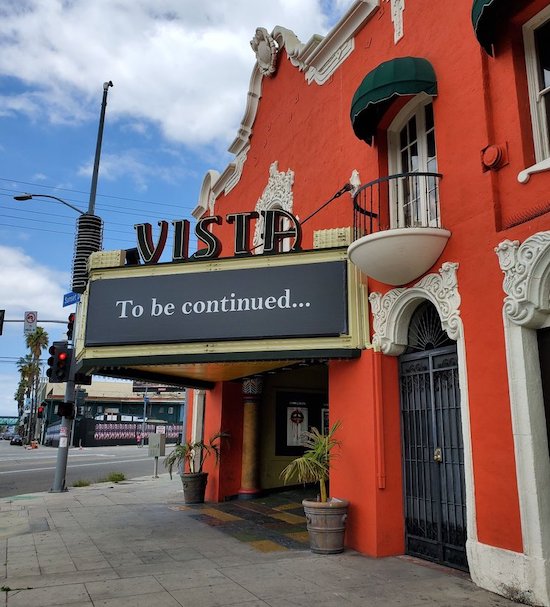
Originally known as "Bard's East Hollywood Playhouse" showing live Vaudeville shows, this Spanish-Revival-on-the-outside-Egyptian-on-the-inside single-screen cinema designed by Lewis A. Smith has rolled reels from silent movies, to 2nd-and 3rd-run screenings, to pr0n, to first-run blockbusters. In 2021, film director Quentin Tarantino was turned on by the feet feat of refurbishing this nearly century-old neighborhood cinema gem and is in the process of reopening it with an adjacent arcade and bar in time for its 100th anniversary. HIDDEN EASTER EGG: Look for the monogrammed letter "B" (for "Bard's") emblazoned atop the window above the marquee!

2. The Crazy-Ass 6-Way Intersection
1900
Sunset Boulevard - Sunset Drive, Virgil and Hillhurst avenues and Hollywood Boulevard, East Hollywood

One of the most confusing intersections for motorists, pedestrians and cyclists alike is the six-way intersection consisting of the east-west thoroughfare of Sunset Boulevard and Sunset Drive, the north-south alignment of Virgil and Hillhurst avenues, and the diagonal eastern end of Hollywood Boulevard continuing on towards the southeast as Sunset. The story began in 1900 when a railroad was built to link the burgeoning dusty cow town of Los Angeles with the outlying town of Hollywood, financed by dudes like H.J. Whitley (the dude who founded Hollywood) and Col. Griffith J. Griffith (If that reference isn't a walk in the Park, you still might have Observed that name before...). In 1904, most of that railroad right-of-way was converted into a parallel road named Sunset Boulevard, cutting through mostly agricultural land. In 1910, the town of Hollywood was annexed into the City of Los Angeles and its main drag, Prospect Avenue, was re-named Hollywood Boulevard, which included the diagonal link between Prospect and Sunset. With the diagonal road/streetcar line juxtaposed against the standard Jeffersonain street grid, you have a six-way intersection, complicated further by the fact that it forms the terminus of four of those streets (east end of Hollywood Blvd, south end of Hillhurst Avenue, west end of Sunset Drive and north end of Virgil Avenue). So there you go.


3. Vermont Triangle

1911
Hollywood Blvd, Vermont Ave & Prospect Ave, East Hollywood

A year after the town of Hollywood voted to be annexed by Los Angeles in 1910, the Pacific Electric Railway extended its tracks from Sunset Boulevard to Hollywood Blvd. This triangular space, formed by Hollywood, Vermont and Prospect Avenue (the former moniker of Hollywood Blvd that retains its name eastward of the triangle), became a popular Red Car stop until service here ended in 1954. It maintained its use as a transportation facility, becoming not only a bus stop, but also a taxi layover zone. It became a de facto green space up until the early 21st century, where it turned into a popular locale for homeless encampments, despite the city's efforts to landscape it into a beautified public space.

1921
4800 Hollywood Blvd, East Hollywood

The former residence of oil heiress, proto-feminist, patron of the arts and cultural influencer Aline Barnsdall (pronounced "barns-doll," not "barns-dale"), it was built in 1921 and designed by none other than Frank Lloyd MF'ing Wright. Named after Barnsdall's favorite flower (which forms a design motif around the building), it was borne from much bickering and head-clashing between the architect and client due to the home not being built to her tastes and cost overruns. In 1926 she up and left, sort of, donating the house and most of the property sitting on Olive Hill to the City of Los Angeles for artistic and recreational purposes. Although, she did live in a now-demolished residence on the west side of the park for the last two decades of her life. In July 2019, Hollyhock House was designated as a UNESCO World Heritage Site - the first such in Los Angeles.


5. Mosque Shopping Center/Calmos Gas Station

1923
4982 Hollywood Blvd, East Hollywood

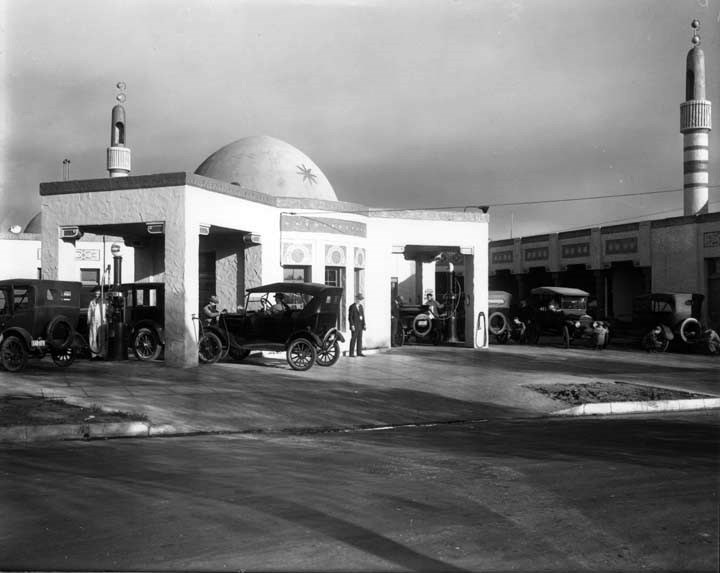
This unassuming L-shaped shopping center on Hollywood and Alexandria sports a pair of towering minarets on top of its roof. Was it a mosque at one time? Was this home of an Islamic community in the past? Actually, no. they're the last vestiges of Calmos Auto Service Center, a gas station built in 1923 that became part of Union Oil's 76 chain. Its architecture reflects the whole Arab/Egyptian aesthetic fetish/appropriation thing back in the '20s, a decade which was marked by the 1921 Rudolph Valentino film, "The Sheik" and the 1922 discovery of King Tut's tomb. As seen in the historic 1924 photo, the dome of the "mosque" was a now-demolished structure that housed the area for the gas pumps.


1615 N. Alexandria Ave., Little Armenia

This K-12 Armenian private school, affiliated with the St. Garabed  Armenian Apostolic Church across the street, is one of the biggest cultural anchors in Little Armenia. Named after its founders, not only is it the alma mater of 3/4ths of the rock band System Of A Down, but its relatively-new library building was designed to resemble Noah's Ark, as it was believed the ark landed in Mt. Ararat, the highest mountain in ancient Armenia and an iconic cultural landmark for the country.


7. Thai Spirit House
1992
5321 Hollywood Blvd, Thai Town


Just to the right of the driveway of the Thailand Plaza shopping center, across from the Buddha shrine, is one of the most tucked-away curiosities in the Hollywood area. Known by the uninitiated as a "doll house," this miniature Siam-style abode serves as a cultural function to the nearby Silom market and the former Jinda Thai restaurant on the premises: Known as a "spirit house," it is built away from a business to ward away evil or mischievous spirits by leading them to an alternate location (plus water/fruit offerings) so their bad juju doesn't affect you.


8. Thai Town Gateway Statues

2007
5448 Hollywood Blvd, Thai Town

This pair of bronze statues on pedestals towering over Hollywood Boulevard function as the gateway of Thai Town. First installed in 2007 and the subject of The Militant's first ever blog post, it depicts a figure known as an apsonsi, a half-angel, half-lion creature from Thai mythology, chosen for its attributes as a protector. The statues were made in Thailand and flown from Bangkok, which, like Los Angeles, is also known as "The City of Angels." Another pair of statues were installed west of Normandie Avenue in 2012.


9. Mayer Building
1928
5504 Hollywood Blvd, East Hollywood

This four-story, Art Deco edifice, also known as the Hollywood Western Building, was designed by S. Charles Lee, who also happened to design many a structure featured in The Militant's Epic CicLAvia Tour guides. Named after its developer Louis B. Mayer (as in Metro Goldwyn Mayer) it served as the first home of the Motion Picture Academy of America (a.k.a. The Ratings People) and Central Casting. More recently, it serves as the local field office of U.S. Congressman Adam Schiff. Be on the look out for one of them trolley wire support rings, still embedded into the side of the building!


10. Hollywood Pantages Theatre
1930
Hollywood Blvd, Hollywood

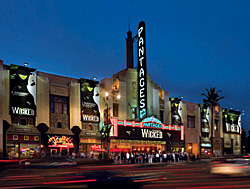
Opened in 1930, this was actually the second theatre in Los Angeles bearing the Pantages name (the first one, still standing on 7th and Hill streets, opened a decade earlier and was renamed the Warner Theatre in 1929). This was also the last theater built bearing the name of vaudeville promoter Alexander Pantages, who ran a chain of 84 theaters across North America back in the day. The iconic Art Deco venue designed by B. Marcus Priteca (who also drew up the DTLA Pantages, as well as other theaters) actually functioned as a cinema for most of its history until 1977 when it ran the Broadway musical Bubbling Brown Sugar and the rest is Jazz Hands history. But did you know that the building constructed nearly 90 years ago is actually incomplete? It was originally supposed to stand 12 stories tall with offices. There have been recent proposals to complete the structure.


11. Hollywood Brown Derby Site/Metro Bike Hub
1929-1985/2017
1628 N. Vine St, Hollywood

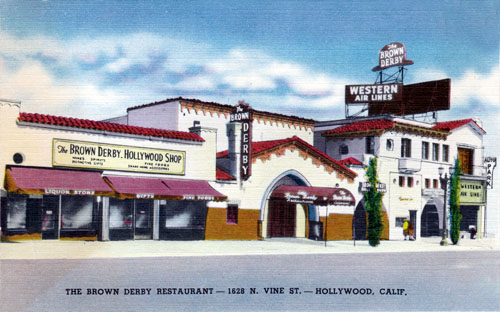
Did you know that Metro's Hollywood Bike Hub facility, which opened in 2017, stands on the very site of the Hollywood Brown Derby restaurant? This was the second location of the legendary local restaurant chain, which began on Wilshire Boulevard. Back in the Hollywood Heyday of the first half of the 20th century, it was like the lunch and dining hotspot for famous film stars and industry moguls. But perhaps the biggest star associated with the Hollywood Brown Derby was the Cobb Salad, invented here circa 1937. Named after Brown Derby co-owner Robert Cobb, it was an improvised mish-mash of leftover salad ingredients, either made for theater mogul Sid Grauman or by Cobb himself as a late-night meal (depending on which version of the legend). The restaurant closed down in 1985 and the iconic Mediterranean-style structure was burned in a fire two years later. It was finally demolished in the mid-1990s after the Northridge Earthquake.


12. Capitol Records Building/Hollywood Jazz Mural
1956
1750 N. Vine St, Hollywood

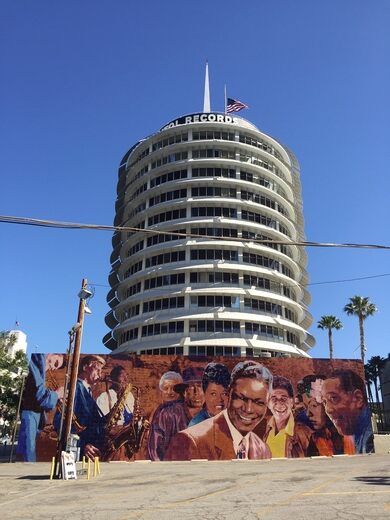
You may or may not already know that the Capitol Records building is: a) The world's first circular office building (designed by Louis Naidorf of Welton Becket associates -- the same architectural firm that designed the Dorothy Chandler Pavilion; b) Designed like a stack of records; and c) The FAA warning light atop its spire spells "HOLLYWOOD" in Morse Code. What you probably didn't know was that Capitol Records, founded in 1942, was the first major record label headquartered in the West Coast, and that the building was largely financed by the profits made from its premier artist at the time, Nat King Cole. Also, this is one of two skyscrapers in Los Angeles with a spire, the second being the Wilshire Grand Center. And speaking of Nat King Cole, Capitol's classic crooner is depicted front and center in the 88 foot-wide mural facing the building's south parking lot, "Hollywood Jazz, 1948-1972" by African American muralist (and Lynwood native) Richard Wyatt, Jr. painted in 1990 and restored in 2011. If you're into the Walk of Fame stars, all four members of The Beatles, as well as Tejana singer Selena, have their pavement honors in front of the building.
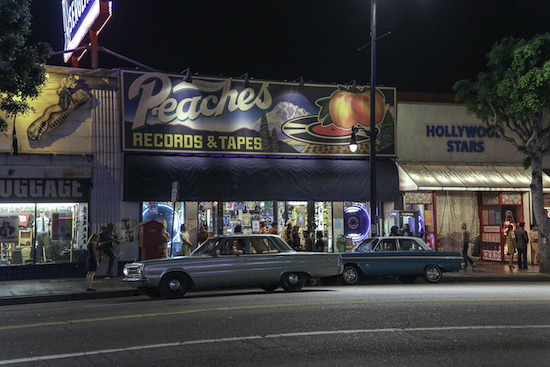

13. 'Once Upon A Time in Hollywood' Filming Locations
2018
Hollywood Blvd between Vine Street and Cherokee Avenue

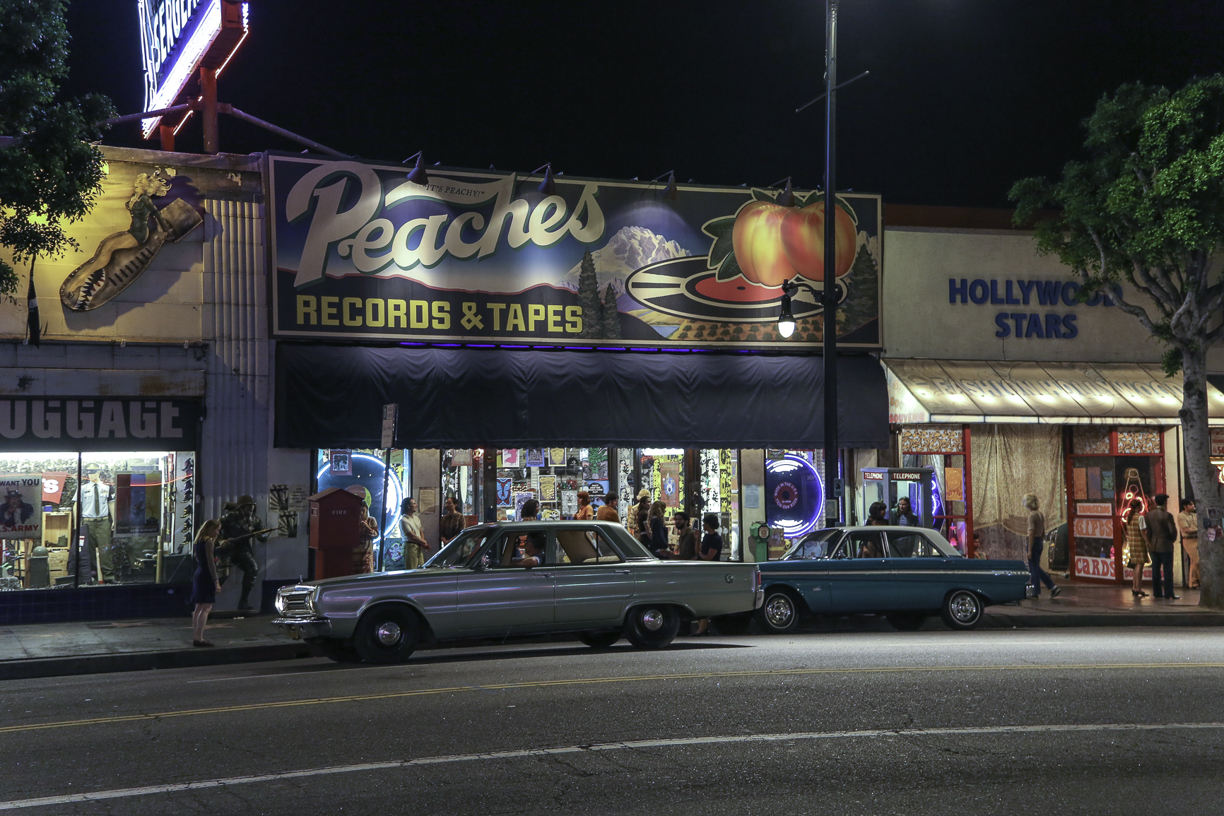
Location scenes from the 2019 Quentin Tarantino film, "Once Upon A Time In Hollywood" were filmed in summer and winter 2018 on The Boulevard between Vine Street and Cherokee Avenue, which itself became an actor, dressed in late-1960s period signs, ads and aesthetic. The 1923 Guaranty Building on 6331 Hollywood Blvd (now the L.Ron Hubbard Museum) got a retro-look as a Bank of America branch. And up Ivar Street, Joseph's Cafe (1775 Ivar) stood in for the iconic West Hollywood nightclub Pandora's Box.


14. Janes House (Oldest House in Hollywood)

1903
6541 Hollywood Blvd, Hollywood

At the far end of this collection of restaurants and bars stands the oldest extant house in Hollywood -- a Queen Anne/Dutch Colonial Revival abode built in 1903 developed by none other than H.J. Whitley himself (as in the dude who founded Hollywood in 1886). It was owned by members of the Janes family from Illinois for some 80 years and also functioned as a small private school (attended by the children of celebrities) until the mid-1920s. In 1985, the house was moved several yards north to its current location and the Hollywood-facing part of the property was developed. Today it functions as a 1920s-themed speakeasy bar called No Vacancy at Hotel Juniper.

15. Grauman's Egyptian Theatre
1922
6706 Hollywood Blvd, Hollywood

Built in 1922 by cinema mogul Sid Grauman, this was his first venue in Hollywood after opening the Million Dollar Theatre in Downtown Los Angeles. Designed by the team of Gabriel Meyer and Philip Holler (who also designed The Egyptian's younger and more famous sister down the street, The Grauman's Chinese Theatre), it was inspired by the popular "Egypt-mania" sweeping the world following the 1922 discovery of King Tut's tomb. From the 1970s to the 1990s it ran under the Mann Theatres chain (The Militant saw "Return of the Jedi" here during opening weekend in 1983), and was sold to American Cinematheque in 1996, re-opening two years later after a major renovation. In May 2020, it was purchased by Netflix, but American Cinematheque still continues to program screening events there. 

16. Hollywood High School
1903
1521 N. Highland Ave, Hollywood

Originally founded in 1903 as a two-room school a few blocks north above a Masonic Lodge the same year the town of Hollywood was in incorporated, the campus moved to its current location a year later. In the 1920s, its mascot, The Sheik, was named after the hit 1921 Rudolph Valentino movie of the same name. Since then it has boasted a large number of famous alumni, such as Los Angeles Times publisher Norman Chandler (Class of 1917), actress Carole Lombard (1923),  "Looney Tunes" animator Chuck Jones (1930), actress Lana Turner (1936), "People's Court" judge Joseph Wapner (1937), actor Mickey Rooney (1938), actress Judy Garland (1940), Secretary of State Warren Christopher (1940),  actor James Garner (1944), actress/comedian Carol Burnett (1951), actor/singer Ricky Nelson (1958), actor John Ritter (1966), actor Laurence Fishburne (1980), actress Sarah Jessica Parker (1983) and R&B singer Brandy (1996). A large mural outside the school's auditorium depicts famous alums as well as other celebrities.

17. Highland Avenue
1900
Highland Avenue, Hollywood

Highland Avenue was not named after the Scottish Highlands, nor any other geography or topography, but in memory of a local woman named Highland Price. Her best friend and neighbor, Mary Penman Moll, who lived where the Hollywood Roosevelt Hotel now stands, donated a strip of property to be built as a road. She named it in memory of Price, who passed away at the time and was the first person interred at Hollywood (now Hollywood Forever) Cemetery in 1900. The street became an important north-south thoroughfare, especially one connecting directly with the San Fernando Valley via the Cahuenga Pass. From 1911 to 1952, it carried the Pacific Electric Railway lines between Los Angeles and the SFV.


18. Formosa Cafe/PE Red Car 913
1925
7156 Santa Monica Blvd, West Hollywood

This iconic restaurant, bar and Hollywood hangout (just across the street from the Samuel Goldwyn Studio) opened in 1925 by former boxer Jimmy Bernstein, who used an old Pacific Electric Red Car. The adjoining building was built in 1939. In the 1940s, Hong Kong-born chef Lem Quon was hired to cook at the Formosa and later became Bernstein's business partner, taking over ownership after his death in 1976. Quon died in 1993, with family members taking over ownership afterward. Threatened with demolition several times, the Formosa persevered. It was featured in the 1990s movies "L.A. Confidential" and "Swingers." In the 2010s decade, after various remodeling and re-remodeling, it was purchased by the 1933 Group in 2017 and re-opened this year with the Red Car (#913, in full view on Formosa Avenue) re-painted and the establishment restored to its Golden Era charm.


9. Plummer Park

1937
7377 Santa Monica Blvd, West Hollywood

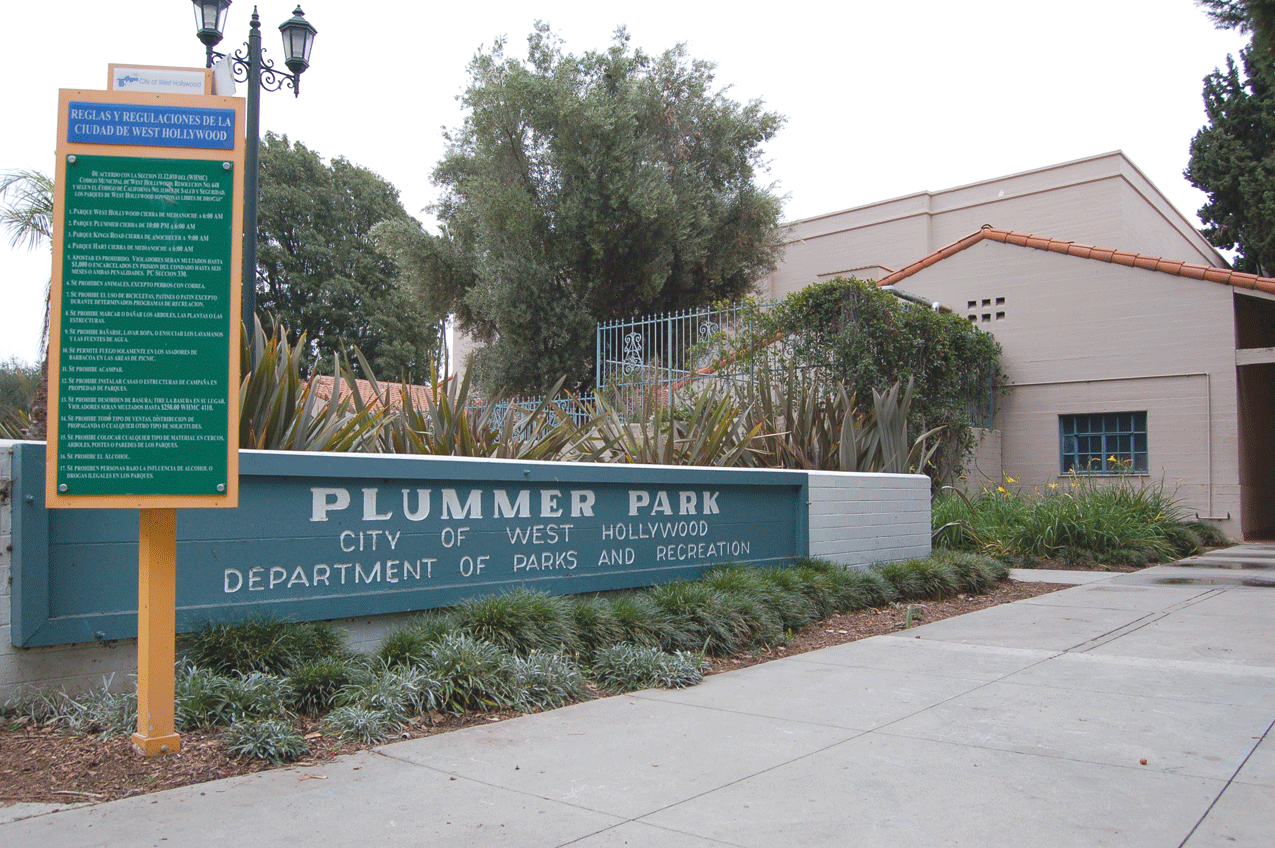
In 1874, Anglo-Mexican couple Capt. John and Maria Cecila Plummer purchased a ranch formerly part of Rancho La Brea (bounded by present-day Santa Monica Blvd, La Brea Ave, Fountain Ave & Gardner St) to raise their sons Juan and Eugenio and grow vegetables to sell to residents of nearby Los Angeles. The Plummers were good friends with the Leonis family, who had a ranch of their own way over the hill in present-day Calabasas. After John and Maria died, the ranch was divided and plots sold off, with Los Angeles County purchasing a large portion in 1937 to use as a public park, with new facilities being built as part of FDR's Works Progress Administration projects. Eugenio lived in the 1877 family house until his death in 1943. The Plummer House was the oldest house in Hollywood until it was moved in 1983 to the grounds of the Leonis Adobe in Calabasas, whereby the 1903 Janes House (See #12) took the crown as the oldest Hollywood home.

20. Crescent Heights Triangle/Quint Cutoff
1900
Santa Monica Blvd & Crescent Heights Blvd, West Hollywood

Have you ever wondered why there's a "triangle" at the corner of Santa Monica and Crescent Heights boulevards? It's a remaining vestige of a half-mile railroad line known as the Quint Cutoff built in 1900 connecting a rock quarry west of Laurel Canyon with the railroad tracks along Santa Monica Boulevard. The "triangle" section is known in railroad terms as a "wye," which enables a locomotive to reverse direction without the use of a turntable. Another "wye" was built at the opposite end of the line where it meets Sunset Boulevard. The Pacific Electric Railway briefly took over this railroad line in 1911 until it was dismantled shortly after that year, but the
alignment of the "wye" tracks on both ends were built into the modern street grid.

21. Sal Guarriello Veterans' Memorial
2003
Santa Monica Blvd & Holloway Dr

Salvatore "Sal" Guarriello was an Italian American WeHo resident who was best known as serving on the West Hollywood City Council from 1990 to 2009, and served as mayor four times during that tenure. During World War II, he served in the U.S. Army as a combat medic in Italy and established the West Hollywood Veterans' Memorial in Holloway Park in 2003. After his death in 2009, the City of West Hollywood re-dedicated their civic veterans' monument as the Sal Guarriello Veterans' Memorial in honor of its most respected veteran and civic official.


22. Site of La Cienega Lanes/Flippers Roller Boogie Palace
1946-1981
8491 Santa Monica Blvd, West Hollywood

What stands as a CVS Pharmacy with a concave facade was a popular youth recreational venue for various generations. In 1946, TV host Art Linkletter established Art Linkletter's La Cienega Lanes bowling alley, becoming a popular place to roll strikes during the golden era of bowling in the post-World War II era. From 1979 to 1981, the alley became Flippers Roller Boogie Palace, a popular roller skating rink and music venue during the influential post-disco new wave/punk era of Los Angeles. Local bands like The Plimsouls, Berlin and the Go-Gos, as well as up-and-coming popular acts like The Talking Heads and Prince performed there. In 1984, the building became the Esprit clothing flagship store.


23. Tail O' The Pup
1946/2022
8512 Santa Monica Blvd, West Hollywood

Don't call it a comeback! In a town known for Dodger Dogs, Pink's, Bacon-wrapped street cart dogs, and the birthplace of the Wienershnitzel chain, this hot dog icon of hot dog icons has come to re-claim its place. Originally opened in 1946, nearly a mile south at 311 N. La Cienega Blvd, this mimetic novelty hot dog stand, designed by Milton J. Black, found its way over the years into films, TV shows, commercials, music videos and as a celebrity hang. In the 1980s, TOTP moved a few yards to 329 N. La Cienega Blvd, where it remained until 2005. The stand had an Angels Flight-like afterlife existing in storage, eventually being donated to the Valley Relics Museum in 2017. A year later, the 1933 Group (who also owns the Formosa Cafe - see #19 on this list) purchased it with plans for a serious reopening, and lo and behold, TOTP re-materialized (with an extensive menu, separate kitchen building and indoor/outdoor eating areas) in July, 2022. BONUS: This site was also the location of The Doors' recording studio, where they recorded their 'L.A. Woman' album in 1970.

24. Site of Pacific Electric Sherman Yard/Pacific Design Center
1896-1954; 1975
8687 Melrose Ave, West Hollywood

West Hollywood was originally known as Sherman, named after Moses Hazeltine Sherman, land developer and railroad executive (Yes, the SFV's Sherman Way and Hazeltine Ave were named after him) who co-founded the Los Angeles Pacific Railway, linking Santa Monica with Los Angeles. The area on the former Rancho La Brea land that sat midway between the two cities was chosen as the site of a railroad yard, and a settlement named after Sherman developed around it. In 1925, the town on unincorporated Los Angeles County land chose to re-name itself "West Hollywood" to closer associate with Tinseltown. Because it was on County land, and thus patrolled by the Sheriff's Department, it began to attract gay and lesbian residents during the Prohibition Era due to the Los Angeles Police Department's frequent raids of gay and lesbian establishments in Los Angeles city (whereas the Sheriff's Department was much more tolerant). The Los Angeles Pacific Railway became part of the Pacific Electric Railway starting in 1911, and the yard became the main facility for its Western District, until the last Red Car in the area rolled in 1954. Southern Pacific freight trains took over the tracks on Santa Monica Boulevard, though not as frequently, and in 1974, the yard was demolished to make room for the sprawling Pacific Design Center, which opened the year later. The PDC was designed by the late Argentinian architect Cesar Pelli, who also designed Downtown Los Angeles' 777 Tower.


25. Norma Triangle

Santa Monica Blvd/Doheny Dr/Sunset Bl-Holloway Dr, West Hollywood

Our CicLAvia tour begins with one triangle, and ends with another: The right-triangle formed by Doheny Drive, Sunset Boulevard/Holloway Drive and Santa Monica Boulevard features one of West Hollywood's biggest residential and commercial districts. Norma Triangle was named not after actress Norma Talmadge, but after the wife or child of a Los Angeles Pacific Railroad executive during the area's days as Sherman, as many streets were named at the time. Featuring the famed Sunset Strip on its north side, and the LGBT-oriented "Boys Town" nightclub district on the south, the area also includes the former residence and studio of architect Lloyd Wright (son of Hollyhock House designer (See #2) Frank Lloyd MF'ing Wright, and who also assisted designing Barnsdall residence himself - see how things tie together on these CicLAvia guides?) on 858 N. Doheny Drive.

Happy CicLAvia on Sunday! Don't forget to share this guide with a friend!


Friday, August 16, 2019

The Militant's Epic Militant CicLAvia Tour XXXII!!


Click for larger map!

The fourth of six CicLAvias in 2019 and the 32nd iteration of Los Angeles' showcase open streets event takes place this Sunday, 8/18. Though unfortunately not in the San Fernando Valley, as the date would otherwise dictate, but on the other side of The Hill, with a 6-mile course linking the ethnically diverse East Hollywood with the star-studded central Hollywood and the prideful and design-conscious West Hollywood. Dubbed by CicLAvia's organizers as "Meet The Hollywoods" (Can they try to find better names of events without using the word "meet" or "meets"? The Militant is willing to help them out in that department - seriously -- email him), The organizers challenge CicLAvians to re-discover neighborhoods they may or may not already know. The Militant, too, wants people to re-discover the communities along every CicLAvia route: There have been 31 unique routes during the entire history of CicLAvia so far (the first two events had the same course), and The Militant Angeleno has tirelessly [takes, long deep breath] taken time out of his militant and extramilitant life to share with you his intimate knowledge of secret and unique points of interest.

If you're familiar with The Militant's Epic CicLAvia Tour guides, you'll know that a lot of the points of interest are connected with another in some way, and this one is no exception. Our CicLAvia tour begins in a triangle formed by local streets, and as you will see, you'll see that pattern repeats itself all the way to the opposite end of the route!

So here goes the CicLAvia guide for this Sunday. As always, see you or not see you on the streets!


1. Vermont Triangle
1911
Hollywood Blvd, Vermont Ave & Prospect Ave, East Hollywood

A year after the town of Hollywood voted to be annexed by Los Angeles in 1910, the Pacific Electric Railway extended its tracks from Sunset Boulevard to Hollywood Blvd. This triangular space, formed by Hollywood, Vermont and Prospect Avenue (the former moniker of Hollywood Blvd that retains its name eastward of the triangle), became a popular Red Car stop until service here ended in 1954. It maintained its use as a transportation facility, becoming not only a bus stop, but also a taxi layover zone. It became a de facto green space up until the early 21st century, where it turned into a popular locale for homeless encampments, despite the city's efforts to landscape it into a beautified public space.

2. Hollyhock House
1921
4800 Hollywood Blvd, East Hollywood

The former residence of oil heiress, proto-feminist, patron of the arts and cultural influencer Aline Barnsdall (pronounced "barns-doll," not "barns-dale"), it was built in 1921 and designed by none other than Frank Lloyd MF'ing Wright. Named after Barnsdall's favorite flower (which forms a design motif around the building), it was borne from much bickering and head-clashing between the architect and client due to the home not being built to her tastes and cost overruns. In 1926 she up and left, sort of, donating the house and most of the property sitting on Olive Hill to the City of Los Angeles for artistic and recreational purposes. Although, she did live in a now-demolished residence on the west side of the park for the last two decades of her life. Last month, Hollyhock House was designated as a UNESCO World Heritage Site - the first such in Los Angeles.

3. Mosque Shopping Center/Calmos Gas Station
1923
4982 Hollywood Blvd, East Hollywood

This unassuming L-shaped shopping center on Hollywood and Alexandria sports a pair of towering minarets on top of its roof. Was it a mosque at one time? Was this home of an Islamic community in the past? Actually, no. they're the last vestiges of Calmos Auto Service Center, a gas station built in 1923 that became part of Union Oil's 76 chain. Its architecture reflects the whole Arab/Egyptian aesthetic fetish/appropriation thing back in the '20s, a decade which was marked by the 1921 Rudolph Valentino film, "The Sheik" and the 1922 discovery of King Tut's tomb. As seen in the historic 1924 photo, the dome of the "mosque" was a now-demolished structure that housed the area for the gas pumps.


1969
1615 N. Alexandria Ave., Little Armenia

This K-12 Armenian private school, affiliated with the St. Garabed  Armenian Apostolic Church across the street, is one of the biggest cultural anchors in Little Armenia. Named after its founders, not only is it the alma mater of 3/4ths of the rock band System Of A Down, but its relatively-new library building was designed to resemble Noah's Ark, as it was believed the ark landed in Mt. Ararat, the highest mountain in ancient Armenia and an iconic cultural landmark for the country. The school will be celebrating its 50th anniversary this week on Tuesday, August 20.

5. Thai Spirit House
1992
5321 Hollywood Blvd, Thai Town

Just to the right of the driveway of the Thailand Plaza shopping center, across from the Buddha shrine, is one of the most tucked-away curiosities in the Hollywood area. Known by the uninitiated as a "doll house," this miniature Siam-style abode serves as a cultural function to the nearby Silom market and the former Thai restaurant on the premises: Known as a "spirit house," it is built away from a business to ward away evil or mischievous spirits by leading them to an alternate location (plus water/fruit offerings) so their bad juju doesn't affect you.

6. Thai Town Gateway Statues
2007
5448 Hollywood Blvd, Thai Town

This pair of bronze statues on pedestals towering over Hollywood Boulevard function as the gateway of Thai Town. First installed in 2007 and the subject of The Militant's first ever blog post, it depicts a figure known as an apsonsi, a half-angel, half-lion creature from Thai mythology, chosen for its attributes as a protector. The statues were made in Thailand and flown from Bangkok, which, like Los Angeles, is also known as "The City of Angels."
Another pair of statues were installed near Normandie Avenue in 2012.

7. Mayer Building
1928
5504 Hollywood Blvd, East Hollywood

This four-story, Art Deco edifice, also known as the Hollywood Western Building, was designed by S. Charles Lee, who also happened to design many a structure featured in The Militant's Epic CicLAvia Tour guides. Named after its developer Louis B. Mayer (as in Metro Goldwyn Mayer) it served as the first home of the Motion Picture Academy of America (a.k.a. The Ratings People) and Central Casting. More recently, it serves as the local field office of U.S. Congressman Adam Schiff. Be on the look out for one of them trolley wire support rings, still embedded into the side of the building!

8. Hollywood Pantages Theatre
1930
Hollywood Blvd, Hollywood

Opened in 1930, this was actually the second theatre in Los Angeles bearing the Pantages name (the first one, still standing on 7th and Hill streets, opened a decade earlier and was renamed the Warner Theatre in 1929). This was also the last theater built bearing the name of vaudeville promoter Alexander Pantages, who ran a chain of 84 theaters across North America back in the day. The iconic Art Deco venue designed by B. Marcus Priteca (who also drew up the DTLA Pantages, as well as other theaters) actually functioned as a cinema for most of its history until 1977 when it ran the Broadway musical Bubbling Brown Sugar and the rest is Jazz Hands history. But did you know that the building constructed nearly 90 years ago is actually incomplete? It was originally supposed to stand 12 stories tall with offices. There have been recent proposals to complete the structure.

9. Hollywood Brown Derby Site/Metro Bike Hub
1929-1985/2017
1628 N. Vine St, Hollywood

Did you know that Metro's Hollywood Bike Hub facility, which opened in 2017, stands on the very site of the Hollywood Brown Derby restaurant? This was the second location of the legendary local restaurant chain, which began on Wilshire Boulevard. Back in the Hollywood Heyday of the first half of the 20th century, it was like the lunch and dining hotspot for famous film stars and industry moguls. But perhaps the biggest star associated with the Hollywood Brown Derby was the Cobb Salad, invented here circa 1937. Named after Brown Derby co-owner Robert Cobb, it was an improvised mish-mash of leftover salad ingredients, either made for theater mogul Sid Grauman or by Cobb himself as a late-night meal (depending on which version of the legend). The restaurant closed down in 1985 and the iconic Mediterranean-style structure was burned in a fire two years later. It was finally demolished in the mid-1990s after the Northridge Earthquake.

10. Capitol Records Building/Hollywood Jazz Mural
1956
1750 N. Vine St, Hollywood

You may or may not already know that the Capitol Records building is: a) The world's first circular office building (designed by Louis Naidorf of Welton Becket associates -- the same architectural firm that designed the Dorothy Chandler Pavilion; b) Designed like a stack of records; and c) The FAA warning light atop its spire spells "HOLLYWOOD" in Morse Code. What you probably didn't know was that Capitol Records, founded in 1942, was the first major record label headquartered in the West Coast, and that the building was largely financed by the profits made from its premier artist at the time, Nat King Cole. Also, this is one of two skyscrapers in Los Angeles with a spire, the second being the Wilshire Grand Center. And speaking of Nat King Cole, Capitol's classic crooner is depicted front and center in the 88 foot-wide mural facing the building's south parking lot, "Hollywood Jazz, 1948-1972" by African American muralist (and Lynwood native) Richard Wyatt, Jr. painted in 1990 and restored in 2011. If you're into the Walk of Fame stars, all four members of The Beatles, as well as Tejana singer Selena, have their pavement honors in front of the building.

11. 'Once Upon A Time in Hollywood' Filming Locations
2018
Hollywood Blvd between Vine Street and Cherokee Avenue

Location scenes from the 2019 Quentin Tarantino film, "Once Upon A Time In Hollywood" were filmed in summer and winter 2018 on The Boulevard between Vine Street and Cherokee Avenue, which itself became an actor, dressed in late-1960s period signs, ads and aesthetic. The 1923 Guaranty Building on 6331 Hollywood Blvd (now the L.Ron Hubbard Museum) got a retro-look as a Bank of America branch. And up Ivar Street, Joseph's Cafe (1775 Ivar) stood in for the iconic West Hollywood nightclub Pandora's Box.

12. Janes House (Oldest House in Hollywood)
1903
6541 Hollywood Blvd, Hollywood

At the far end of this collection of restaurants and bars stands the oldest extant house in Hollywood -- a Queen Anne/Dutch Colonial Revival abode built in 1903 developed by none other than H.J. Whitley himself (as in the dude who founded Hollywood in 1886). It was owned by members of the Janes family from Illinois for some 80 years and also functioned as a small private school (attended by the children of celebrities) until the mid-1920s. In 1985, the house was moved several yards north to its current location and the Hollywood-facing part of the property was developed. Today it functions as a 1920s-themed speakeasy bar called No Vacancy at Hotel Juniper.

13. Grauman's Egyptian Theatre
1922
6706 Hollywood Blvd, Hollywood

Built in 1922 by cinema mogul Sid Grauman, this was his first venue in Hollywood after opening the Million Dollar Theatre in Downtown Los Angeles. Designed by the team of Gabriel Meyer and Philip Holler (who also designed The Egyptian's younger and more famous sister down the street, The Grauman's Chinese Theatre), it was inspired by the popular "Egypt-mania" sweeping the world following the 1922 discovery of King Tut's tomb. From the 1970s to the 1990s it ran under the Mann Theatres chain (The Militant saw "Return of the Jedi" here during opening weekend in 1983), and was sold to American Cinematheque in 1996, re-opening two years later after a major renovation. It may or may not be purchased by Netflix.

14. Hollywood High School
1903
1521 N. Highland Ave, Hollywood

Originally founded in 1903 as a two-room school a few blocks north above a Masonic Lodge the same year the town of Hollywood was in incorporated, the campus moved to its current location a year later. In the 1920s, its mascot, The Sheik, was named after the hit 1921 Rudolph Valentino movie of the same name. Since then it has boasted a large number of famous alumni, such as Los Angeles Times publisher Norman Chandler (Class of 1917), actress Carole Lombard (1923),  "Looney Tunes" animator Chuck Jones (1930), actress Lana Turner (1936), "People's Court" judge Joseph Wapner (1937), actor Mickey Rooney (1938), actress Judy Garland (1940), Secretary of State Warren Christopher (1940),  actor James Garner (1944), actress/comedian Carol Burnett (1951), actor/singer Ricky Nelson (1958), actor John Ritter (1966), actor Laurence Fishburne (1980), actress Sarah Jessica Parker (1983) and R&B singer Brandy (1996). A large mural outside the school's auditorium depicts famous alums as well as other celebrities.

15. Highland Avenue
1900
Highland Avenue, Hollywood

Highland Avenue was not named after the Scottish Highlands, nor any other geography or topography, but in memory of a local woman named Highland Price. Her best friend and neighbor, Mary Penman Moll, who lived where the Hollywood Roosevelt Hotel now stands, donated a strip of property to be built as a road. She named it in memory of Price, who passed away at the time and was the first person interred at Hollywood (now Hollywood Forever) Cemetery in 1900. The street became an important north-south thoroughfare, especially one connecting directly with the San Fernando Valley via the Cahuenga Pass. From 1911 to 1952, it carried the Pacific Electric Railway lines between Los Angeles and the SFV.


16. Formosa Cafe/PE Red Car 913
1925
7156 Santa Monica Blvd, West Hollywood

This iconic restaurant, bar and Hollywood hangout (just across the street from the Samuel Goldwyn Studio) opened in 1925 by former boxer Jimmy Bernstein, who used an old Pacific Electric Red Car. The adjoining building was built in 1939. In the 1940s, Hong Kong-born chef Lem Quon was hired to cook at the Formosa and later became Bernstein's business partner, taking over ownership after his death in 1976. Quon died in 1993, with family members taking over ownership afterward. Threatened with demolition several times, the Formosa persevered. It was featured in the 1990s movies "L.A. Confidential" and "Swingers." In the 2010s decade, after various remodeling and re-remodeling, it was purchased by the 1933 Group in 2017 and re-opened this year with the Red Car (#913, in full view on Formosa Avenue) re-painted and the establishment restored to its Golden Era charm.

17. Crescent Heights Triangle/Quint Cutoff
1900
Santa Monica Blvd & Crescent Heights Blvd, West Hollywood

Have you ever wondered why there's a "triangle" at the corner of Santa Monica and Crescent Heights boulevards? It's a remaining vestige of a half-mile railroad line known as the Quint Cutoff built in 1900 connecting a rock quarry west of Laurel Canyon with the railroad tracks along Santa Monica Boulevard. The "triangle" section is known in railroad terms as a "wye," which enables a locomotive to reverse direction without the use of a turntable. Another "wye" was built at the opposite end of the line where it meets Sunset Boulevard. The Pacific Electric Railway briefly took over this railroad line in 1911 until it was dismantled shortly after that year, but the alignment of the "wye" tracks on both ends were built into the modern street grid.

18. Plummer Park
1937
7377 Santa Monica Blvd, West Hollywood

In 1874, Anglo-Mexican couple Capt. John and Maria Cecila Plummer purchased a ranch formerly part of Rancho La Brea (bounded by present-day Santa Monica Blvd, La Brea Ave, Fountain Ave & Gardner St) to raise their sons Juan and Eugenio and grow vegetables to sell to residents of nearby Los Angeles. The Plummers were good friends with the Leonis family, who had a ranch of their own way over the hill in present-day Calabasas. After John and Maria died, the ranch was divided and plots sold off, with Los Angeles County purchasing a large portion in 1937 to use as a public park, with new facilities being built as part of FDR's Works Progress Administration projects. Eugenio lived in the 1877 family house until his death in 1943. The Plummer House was the oldest house in Hollywood until it was moved in 1983 to the grounds of the Leonis Adobe in Calabasas, whereby the 1903 Janes House (See #12) took the crown as the oldest Hollywood home.

19. Sal Guarriello Veterans' Memorial
2003
Santa Monica Blvd & Holloway Dr

Salvatore "Sal" Guarriello was an Italian American WeHo resident who was best known as serving on the West Hollywood City Council from 1990 to 2009, and served as mayor four times during that tenure. During World War II, he served in the U.S. Army as a combat medic in Italy and established the West Hollywood Veterans' Memorial in Holloway Park in 2003. After his death in 2009, the City of West Hollywood re-dedicated their civic veterans' monument as the Sal Guarriello Veterans' Memorial in honor of its most respected veteran and civic official.

20. Site of La Cienega Lanes/Flippers Roller Boogie Palace
1946-1981
8491 Santa Monica Blvd, West Hollywood

What stands as a CVS Pharmacy with a concave facade was a popular youth recreational venue for various generations. In 1946, TV host Art Linkletter established Art Linkletter's La Cienega Lanes bowling alley, becoming a popular place to roll strikes during the golden era of bowling in the post-World War II era. From 1979 to 1981, the alley became Flippers Roller Boogie Palace, a popular roller skating rink and music venue during the influential post-disco new wave/punk era of Los Angeles. Local bands like The Plimsouls, Berlin and the Go-Gos, as well as up-and-coming popular acts like The Talking Heads and Prince performed there. In 1984, the building became the Esprit clothing flagship store.

21. Site of Pacific Electric Sherman Yard/Pacific Design Center
1896-1954; 1975

West Hollywood was originally known as Sherman, named after Moses Hazeltine Sherman, land developer and railroad executive (Yes, the SFV's Sherman Way and Hazeltine Ave were named after him) who co-founded the Los Angeles Pacific Railway, linking Santa Monica with Los Angeles. The area on the former Rancho La Brea land that sat midway between the two cities was chosen as the site of a railroad yard, and a settlement named after Sherman developed around it. In 1925, the town on unincorporated Los Angeles County land chose to re-name itself "West Hollywood" to closer associate with Tinseltown. Because it was on County land, and thus patrolled by the Sheriff's Department, it began to attract gay and lesbian residents during the Prohibition Era due to the Los Angeles Police Department's frequent raids of gay and lesbian establishments in Los Angeles city (whereas the Sheriff's Department was much more tolerant). The Los Angeles Pacific Railway became part of the Pacific Electric Railway starting in 1911, and the yard became the main facility for its Western District, until the last Red Car in the area rolled in 1954. Southern Pacific freight trains took over the tracks on Santa Monica Boulevard, though not as frequently, and in 1974, the yard was demolished to make room for the sprawling Pacific Design Center, which opened the year later. The PDC was designed by Argentinian architect Cesar Pelli, who passed away one month ago.

22. Norma Triangle
Santa Monica Blvd/Doheny Dr/Sunset Bl-Holloway Dr, West Hollywood

Our CicLAvia tour begins with one triangle, and ends with another: The right-triangle formed by Doheny Drive, Sunset Boulevard/Holloway Drive and Santa Monica Boulevard features one of West Hollywood's biggest residential and commercial districts. Norma Triangle was named not after actress Norma Talmadge, but after the wife or child of a Los Angeles Pacific Railroad executive during the area's days as Sherman, as many streets were named at the time. Featuring the famed Sunset Strip on its north side, and the LGBT-oriented "Boys Town" nightclub district on the south, the area also includes the former residence and studio of architect Lloyd Wright (son of Hollyhock House designer (See #2) Frank Lloyd MF'ing Wright, and who also assisted designing Barnsdall residence himself - see how things tie together on these CicLAvia guides?) on 858 N. Doheny Drive.

Happy CicLAvia on Sunday! Don't forget to share this guide with a friend!

Thursday, September 27, 2018

The Militant's Epic Militant CicLAvia Tour XXVII!! (Full Version)


Click here for bigger version of this map!


The route of this 27th iteration of CicLAvia, "Celebrate LA," which happens to be an extension of the current "Iconic Wilshire Boulevard" route (truncated lately due to Metro Purple Line subway construction) will offer something different for the 8 year-old open streets tradition: An 8-mile street celebration centered around music to commemorate the 100th anniversary of the Los Angeles Philharmonic Orchestra. In keeping with the theme, this Epic CicLAvia Tour guide will not only feature some music-related points of interest along the route, but will also feature all four of the LAPhil's indoor home concert venues (all of them located on or just around the corner from Grand Avenue, BTW).

The Militant will also be doing something different: He is conducting an Epic CicLAvia Tour in person for the very first time. Collaborating with Ted Rogers of the cycling advocacy site Biking in L.A., The Militant will come out of the shadows and be your personal tour guide for the CicLAvia route! Ya really!

Needless to say, The Militant is totally stoked (and admittedly a little nervous, but hey...) about appearing in person for ya'llz!

This is also the largest Epic CicLAvia Tour guide to date! Why? Why not! It's just that epic!

Also, you will notice that some of the points of interest on this particular Epic CicLAvia Tour are missing some numbers. That is actually intentional - there are 10 points of interest on the route that have been left off of this published version. But they will be covered on the Epic CicLAvia Tour Live! guided bike tour on Sunday. Which means, if you want the whole Epic CicLAvia Tour experience, you'll just have to join us (An updated version of this tour guide with the 10 missing points of interest will be published next week)!

Remember, to join the tour, and get full details on where exactly we will meet (it will be somewhere near Grand Avenue and 2nd Street), RSVP by shooting an email to militantangeleno [at] gmail [dot] com!

So here goes, see you or not see you on the streets on Sunday!

[Note: This blog post may or may not contain some formatting errors. This is out of The Militant's control and is the fault of Blogspot.com's sorry-assed user interface. So deal with it!]

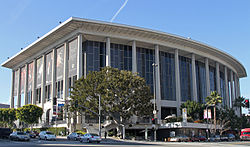
1. Dorothy Chandler Pavilion (LAPhil's 3rd Home)
1964
135 N. Grand Ave, Downtown

The third home of the Los Angeles Philharmonic Orchestra from 1964 to 2002, it was originally the primary component of The Music Center, Los Angeles County's complex of arts  venues, also including the Ahmanson Theatre and the Mark Taper Forum. Named after its primary donor, the wife of Los Angeles Times publisher Norman Chandler, who was also the daughter of the founder of the Buffums' department store chain (in existence from 1904 to 1991), Mrs. Chandler (1901-1997) was a major supporter of the arts in Los Angeles. The venue, designed by Welton Becket, lives on as the exclusive home of the Los Angeles Opera.

2. Walt Disney Concert Hall
(LAPhil's 4th Home)
2003
111 S. Grand Ave, Downtown

The fourth and current home of the Los Angeles Philharmonic Orchestra opened in October, 2003. The iconic stainless steel structure was designed by Frank Gehry (like duh, you didn't already know that already). The project began in 1987 when Lilian Disney, widow of Walt Disney, donated $50 million for the construction of a new concert hall addition to the Music Center.

3. AT&T Madison Complex Switching Center
1925
420 S. Grand Ave, Downtown
This important building complex in Los Angeles' telecommunications history began life in 1907 when the Home Telephone company built a telephone and telegraph switching office to handle 10,000 lines for the city.  The first of the existing buildings was built in 1925 (facing Olive Street) to handle switching functions for the 213 area code.  Subsequent buildings were added to the complex in 1945 and 1961, which is the 17-story structure with the iconic microwave tower which functioned in the 1960s-1990s to handle important signal transmissions. Today, the complex, which also handles state-of-the-art fiber optic cable transmssions and data co-location, is one of the largest telecommunications central offices in the US, and handles over 1.3 million phone lines for local, national and long-distance calls. Do note the public art sculpture on Grand Ave comprised of old telephone equipment.


4. Site of Philharmonic Auditorium
(LAPhil's 2nd Home)
1906-1985
427 W. 5th St, Downtown

Built in 1906 as the Temple Auditorium, it was a mixed-use theatre/Baptist church designed by Charles F. Whittlesey, at the time the largest theatre building west of Chicago. It was also known as Clune's Theatre. In 1920 the Los Angeles Philharmonic Orchestra moved in for its second season (thereby renaming the building "Philharmonic Auditorium"), where it remained until the opening of the Dorothy Chandler Pavilion in 1964. It was demolished in 1985 where it became a surface parking lot until recently, where it is currently being developed as the Park Fifth mixed-use project.

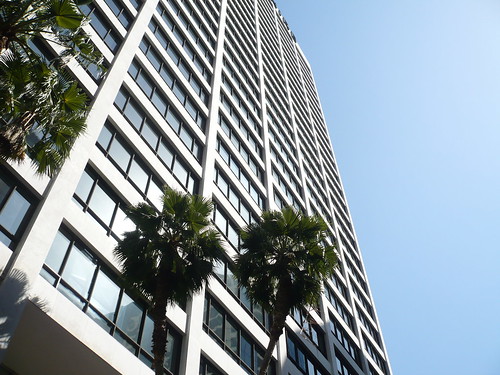
5. One Wilshire Building/Wilshire Bookend Palm Trees
1966
624 S. Grand Ave, Downtown

Built during the first wave of modern skyscrapers following the repeal of Los Angeles' building height limit laws, this building, designed by architectural rockstars Skidmore, Owings and Merrill (who also went on to craft Chicago's Sears Tower, among many others) stood for most of its life as the address of legal and financial institutions. After a renovation in 1992, this building is now the location of CoreSite, a major data colocation center, which carries the primary Internet connections for Los Angeles (without this building, you can't read this!)

Take note of the row of palm trees, planted here in the 1970s: They are meant to evoke the end of Wilshire Boulevard, as on the opposite end, at Santa Monica's Ocean Avenue, 16 miles from here, you will also find a row of palm trees.

6. Trinity Auditorium (LAPhil's 1st Home)
1914
855 S Grand Ave, Downtown Los Angeles

This nine-story Beaux-Arts building designed by Harry C. Deckbar was the first home of the Los Angeles Philharmonic Orchestra during its debut  season in 1919. The building originally functioned as a mixed-use Methodist Episcopal church and hotel complex and was once owned by USC during the 1980s-1990s. It is currently being renovated into a hotel again.


7. L.A. Prime Matter Sculpture
1991
Wilshire and Figueroa (NW corner), Downtown

Wilshire is full of awesome-looking public art. Here's one relatively-recent sculpture, recently renovated, right at the northwest corner of Wilshire and Figueroa. Designed by the late Venice-based artist Eric Orr, who had a penchant for utilizing elemental themes in his art, L.A. Prime Matter features twin 32-foot bronze columns that feature water sliding down its faces, and during random moments, FIRE emanates from the middle channels of the columns every hour on the hour! The effect is total bad-ass, and its bad-assnes is magnified at night.


8. Wilshire Grand Center
2017
900 Wilshire Blvd, Downtown

On this site rises the new Wilshire Grand Center, Los Angeles' (and the West's -- suck on it, Transbay Tower SF!) tallest building at 73 stories and 1,100 feet (kinda sorta, there's a spire, you see...). Opened on June 23, it is the city's only modern skyscraper without a flat roof, the only Los Angeles building since Hollywood's Capitol Records tower in 1956 to feature a spire, the first skyscraper anywhere to sport a mohawk, and it also has its own irreverent Twitter account. ;)

Owned by Korean Air (hence the red and blue taeguk LED logo), the tower houses the 900-room Hotel Intercontinentalwith its 70th-floor Sky Lobby and the unique Spire 73 skybar, with wonderful views of the south and west (the sunset vista from here is not to be missed).

The building's construction site was the location of "The Big Pour" - which lasted from February 15 -16, 2014, where 21,200 cubic yards (81 million pounds) of concrete for the tower's foundation were continuously poured - earning it a Guinness World Record for that feat.

Before the skyscaper, the site was home of the Wilshire Grand Hotel, formerly (in reverse chronological order) the Omni Hotel, Los Angeles Hilton, Statler Hilton and Statler Hotel.

9. Site of George Shatto Residence/Good Samaritan Hospital
1891
Wilshire Blvd and Lucas Ave, Downtown

Before it was named Wilshire Boulevard, it was once called Orange Street, and on the corner of Orange and Lucas was a Queen Anne-style mansion belonging to George Shatto, a real estate developer who first developed Catalina Island and the city of Avalon. If you read the Epic CicLAvia Tour 4.0 post, his name is brought up as one of the famous Angelenos buried (in a rather ornate pyramid) at Angelus Rosedale Cemetery.

But check this out! Take a look at the picture above, and pay close attention to the masonry wall going uphill that fronts Lucas Avenue. Now, on CicLAvia Sunday, look at the exact same spot, on the northwest corner of the intersection. The house is gone, but the original wall still remains!

Good Samaritan Hospital, which was founded in 1885 and moved to the current site in 1911, is also the birthplace of many native Angelenos, including mayor Eric Garcetti.

10. S. Charles Lee Office and Residence
1903/1935
1648 Wilshire Blvd, Westlake.

Architect S. Charles Lee was famous for designing some of Los Angeles' ornate theaters along Broadway, including the Los Angeles Theatre and the Tower Theatre (a.k.a. The Apple Mac Tower Pro Theatre). He moved his family to a two-story Victorian house on Wilshire and in 1935 built his Regency Moderne-style office right in front of it, a unique live-work space arrangement of its time.

11. Los Angeles Teachers (a.k.a. 'Stand And Deliver') Mural
1997
Wilshire and Alvarado, Westlake

Art imitates life imitating art imitating life in this mural by popular Salvadoreño American muralist Hector Ponce depicting actor Edward James Olmos, who portrayed Garfield High School math teacher Jaime Escalante in the 1988 movie Stand and Deliverstanding next to the real-life Escalante, and delivering a mural that's part-Hollywood, part-Los Angeles, part-Latino pride, part Eastside pride and if the Internet were as accessible back in 1988 as it is today, would make one epic photo meme. And it's painted behind the 1926 Westlake Theatre, which is slated for renovation into a community-based performance arts venue sometime soon.

12. Gen. Harrison Gray Otis Statue
1920
Wilshire Blvd and Park View Ave, Westlake

Gen. Otis is perhaps the most visible statue at the park, which predates MacArthur's WWII service. This general served in the Spanish-American and Philippine-American wars, and also fought as a Union soldier in the Civil War. But in Los Angeles, he is most known for being the founder, owner and publisher of the Los Angeles Times. So why is he here? His Wilshire Blvd mansion, called The Bivouac, was located across the street, was later donated to Los Angeles County and became the original campus of Otis Art Institute. It's thought that his statue is pointing to the site of the Elks Lodge, but he's probably just pointing to his old house. BTW, Gen. Otis was the grandfather of Dorothy Chandler's husband, Norman.

13. Bryson Apartment Building
1913
2701 Wilshire Blvd, Westlake

This 10-story Beaux Arts apartment building, built 100 years ago, was the 20th century precursor to today's fancy modern 21-century high-rise residential developments. Built by developer Hugh W. Bryson and designed by Noonan & Kysor, it was built in a part of Los Angeles that was known at the time as "the west side" (let's not open that can of worms right now, okay?). It was one of Los Angeles' most luxurious apartment buildings, and had a large neon sign at the roof (characteristic of these kinds of developments back then). Several Raymond Chandler books reference The Bryson. The 110,000 square-foot building is also part of the National Register of Historic Places and a Los Angeles Historic-Cultural Monument.

14. Lafayette Park
1899
Wilshire Blvd and LaFayette Park Place, Westlake

Clara Shatto, the widow of 19th-century real estate developer George Shatto donated 35 acres of her land to the City of Los Angeles in 1899, which was once oil wells and tar pits. Her late husband wanted it turned into a city park, and so it became Sunset Park, which existed for 19 years before the locals wanted it renamed to honor the 18th-century Frenchman who was a hero in both the American and French revolutions. Gotta give LaFayette park some props for living so long in the shadow of its more famous neighbor, MacArthur (Westlake) Park.

15. Bullocks Wilshire/Southwestern Law School
1929
3050 Wilshire Blvd

Perhaps one of the most iconic examples of Art-Deco architecture in Los Angeles, this former Bullocks Department Store was designed with a tower to resemble a New York-style skyscraper in then-unabashedly low-rise Los Angeles. It was the epitome of shopping in style in its heyday, with its own rear parking lot and other auto-centric amenities. It ultimately fell victim to the 1992 Los Angeles Riots and was closed down the next year. In 1994, the nearby Southwestern School of Law bought the building and incorporated it into its campus, restoring much of the Roaring 1920s Art Deco aesthetics.

16. Consulate Row
Various locations along Wilshire Blvd between Vermont and Crenshaw

Some 62 countries have consular offices in the Los Angeles area and 41 of them have addresses on Wilshire Boulevard. Proximity to various foreign financial institutions on Wilshire, as well as nearby Hancock Park, where many consul-generals have traditionally resided, are the main reasons for such a high concentration of consulates on this stretch of Wilshire. The consulate offices for Bangladesh, Bolivia, El Salvador, Ethiopia, Guatemala, Honduras, Indonesia, South Korea, Nicaragua, Peru, The Philippines, Sri Lanka and Taiwan are all located on Wilshire between Vermont and Crenshaw. Many of them display their national flags in front of their respective office buildings. How many can you spot during CicLAvia?

17. Gaylord Apartments
1924
3355 Wilshire Blvd

Though the building's prominent neon sign has been source of many a snicker by immature junior high school kids, this building represents some serious history. It was named after Wilshire Boulevard's namesake, Henry Gaylord Wilshire, who was known as a wealthy real estate developer and outspoken socialist (Does that make sense?), who donated a 35-acre strip of barley fields to the City of Los Angeles on the condition that it would be free from railroads or trucking. The building itself is a 13-story Italian Renaissance-style apartment building that actor John Barrymore (a.k.a. Drew's grandpa) and then-presidential candidate Richard Nixon once called home.

18. Wilshire Brown Derby Site
1926
3427 and 3377 Wilshire Blvd

The now-defunct "The Brown Derby" local chain of restaurants were synonymous with Hollywood glitz and glamour. The Wilshire Boulevard location was the first of four (the others were in Hollywood, Beverly Hills and Los Feliz). In close proximity to The Ambassador Hotel and its  Cocoanut Grove swing/jazz club, this was the original hipster joint back in the day, only back then the hipsters were actually cool and looked good. In 1937 the building was moved across the street and closed in 1975. In 1980, a shopping center was built on the site and the iconic dome structure was incorporated into the shopping center that exists today. It's situated on the third floor, above The Boiling Crab seafood restaurant. It's something to ponder on while you wait 90 minutes for your table.

Note that the pictures for #17 and #18 connect vertically - that's the Gaylord Apartments behind the Brown Derby!

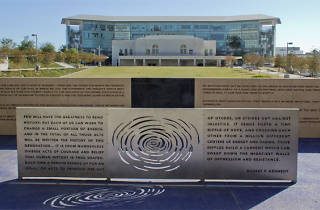
19. Robert F. Kennedy Inspiration Park/Ambassador Hotel Site
2010
Wilshire Blvd between Catalina Street and Mariposa Avenue

The Militant wrote a post in 2010 about this unique public space dedicated to Sen. Robert F. Kennedy, who was assassinated just yards away at the Ambassador Hotel, which was demolished in 2005 and where the LAUSD's sprawling and costly  RFK Community Schools campus now stands. There's Kennedy quotes on public art installations and benches for you to chill on. There's also speakers playing recordings of some of the jazz music that was performed at the hotel's famed Cocoanut Grove swing and jazz club.

20. Wiltern Theatre/Pellissier Building
1931
Wilshire Blvd and Western Avenue (duh...), Koreatown

The 12-story structure, designed by Stiles O. Clements, is Los Angeles' emerald-green temple to all that is Art Deco. Originally operating as the "Warner Theatre" (Specifically the Western Avenue location of Warner Bros. chain of movie theaters; The Warner Theatre in San Pedro is another example), The Wiltern (named so since 1935) has seen many cycles of decay and rebirth, most recently in the 1980s, when preservationists renovated the theatre to a performing arts venue. The contemporary Wiltern Theatre has been operating since 1985.

21. MaDang Courtyard Mall
2010
621 S. Western Ave, Koreatown

The heart of K-town is essentially the revived district once known as Wilshire Center,  a mid-rise commercial district which emerged in the mid-1960s, filling in the commercial real estate gap between Downtown and Miracle Mile. By the late 1980s, the district had fallen into disarray, with many businesses closing down or moving out, culminating around the time of the 1992 Riots (the iconic Bullocks Wilshire closed down in 1993). With the old guard having moved out, it allowed opportunities for the then-scattered Korean business community, fueled by an abundant supply of investment money from South Korea, to move into the vacant retail and office spaces and expand Koreatown into the large district that exists today. Enter MaDang Courtyard, which opened in 2010. This dense, triple-story urban mall represents not only the modern Koreatown, but a more of a visual semblance of Seoul, as opposed to the re-purposed commercial spaces of the old Wilshire Center. Anchored by the CGV Cinemasmultiplex, which screens current Hollywood features, Korean films and Korean-subtitled versions of mainstream blockbusters, you can't get more K-town than that (for a non-food establishment). But speaking of food establishment, there's also a Hansol Noodle location here, a Paris Baguette (despite the francophone name, it's a South Korean bakery cafe chain), a Lemon Tree kids' play cafe and Japanese imports Daiso (picture a Nippon version of the 99 Cents Only store) and pastry chain Beard Papa's. It's like a trip across the Pacific (minus the jet-lag).


AND NOW, A BREAK AT THE HALFWAY MARK...

The CicLAvia route visits Western Avenue for the very first time. But this isn't the first car-free, open street event that's popular with cyclists. In fact, they've been doing it 122 years ago...
 This photo, taken in 1896, shows a group bicycle ride up an unpaved Western Avenue (back then called County Road), back in the agricultural days. What comes around, goes around!

22. Selig Building
1931
269 S. Western Ave, Koreatown

This single-story black and gold terra cotta Art Deco storefront building (like total LAFC style, yo!) designed by Arthur Harvey was originally the Alvin C. Selig men's formalware store when it opened in the 1930s and later became a Crocker National Bank branch and video store. Today, the newly-renovated building is subdivided into separate retail spaces, which includes The Dolly Llama Waffle Master restaurant.

23. St. Charles Apartments Wall Advertisements

1925
240 S. Western Ave, Koreatown

Several generations of painted wall advertisements can be seen on the southern-facing wall of the 1925 St. Charles apartment building, including a faded 1920s-era Sparkletts Water ad, a 1970s Coca-Cola ad and a more contemporary ad for a Korean lighting fixture store.

24. US Post Office - Nat King Cole Station
1987 (Dedicated 2002)
265 S. Western Ave, Koreatown.

Formerly the United States Postal Service's Oakwood Station, it was dedicated to singer Nat King Cole in 2002, who lived nearby on Murfield Rd. and 4th Street in Hancock Park from 1948 to his death in 1965. The facility is slated to move to a new location nearby as the current building will be demolished for redevelopment.

25. Original Home of See's Candies
1921
135 N. Western Ave., Koreatown

Canadian immigrant Charles See, along with his wife Florence, their children and his mother Mary, moved to Los Angeles where they opened a candy shop at this location in November, 1921 using Mary's recipes from when she helped run her late husband's hotel in southern Ontario. The operation soon blossomed into multiple stores, even booming during the Great Depression, and can be found in 17 states. The candies are made here in California, at its factories on La Cienega Blvd and in South San Francisco. The original See's Candies location is currently a Tom N Tom's (a.k.a. Korean Starbucks) coffee shop.

26. Postmodern KFC
1990
340 N Western Ave., Koreatown.

Designed by Elyse Grinstein and Jeffrey Daniels (both who previously worked for Frank Gehry's architectural firm), the two-story building is a postmodern representation of not just a bucket of chicken, but a chicken itself. It is also one of the few KFC franchises to still bear the full "Kentucky Fried Chicken" name signage.

27. Janss Investment Co. Uptown Branch Bldg.
1928
500 N. Western Ave., Koreatown

This unique Byzantine domed building was designed by Percy Parke Lewis (can't lose?), who also designed the Art Deco Village Theatre in Westwood, was built as the Janss Investment Company's Uptown Branch office (this was once "Uptown"? Well Uptown Funk gonna give it to ya). Today it's repurposed as the Korea Sah Buddhist temple.

28. Hollywood Melrose Hotel
1927
5162 Melrose Ave, Hollywood.

This three-story building was designed by S. Charles Lee (remember him?) and opened in 1927 as the Hollywood Melrose Hotel. It later became rental units known as the Melrose Arms and Monte Cristo Island Apartments. In 1992 it made the National Register of Historic Places and was returned to an inn in 2010, re-branded as the Hollywood Historic Hotel which is now run by the Armenian family that owns the Edmon’s Unique Furniture and Stone Gallery business on the ground floor.


29. Jack London House
1923
5152 La Vista Ct, Hollywood.

This may or may not be the former residence of famous writer Jack London, who has a bas-relief memorial sculpture on the outside wall of this unique, quirky 3-story residence in an alley named La Vista Court. Actually no, it was built seven years after London's death, but it was designed by London's friend, sculptor Finn Hakkon Frolich. This well-researched blog post details the history and mythology of the house that writer Jack London may or may not have lived in.

30. Raleigh Studios
1914
5300 Melrose Ave, Hollywood

Standing in the shadow of its much more famous neighbor across the street, this independent motion picture facility was founded in 1914 as the Fiction Players company studios, and later on as Clune Studios (Yes, the same William H. Clune that owned what later became Philharmonic Auditorium) in 1915. This studio facility was later associated with stars like Douglas Fairbanks and Charlie Chaplin. It was the filming location of classic TV shows like "The Adventures of Superman" and "Gunsmoke" (1950s); "Dallas," and Madonna's "Like A Prayer" music video (1980s) and Nirvana's "Heart-Shaped Box" video (1990s).

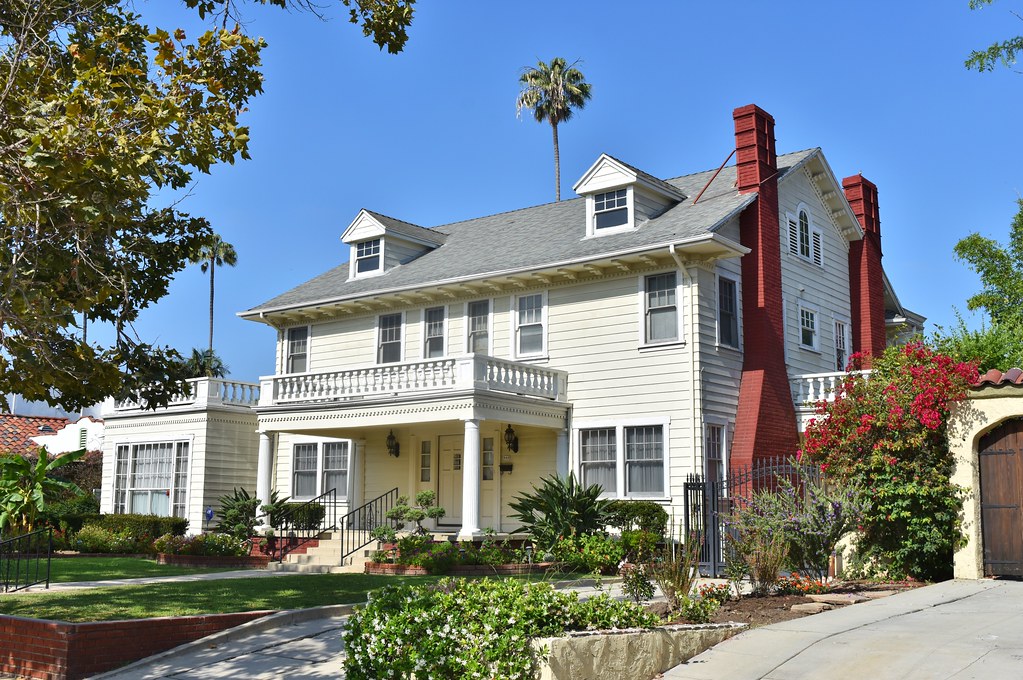
31. Happy Days House
1923
565 N. Cahuenga Blvd, Hancock Park.

"Aaaaaayyyyyyy!!!" This Colonial-style house on 565 N. Cahuenga Blvd stood in for the Cunningham Residence in the hit ABC TV series, "Happy Days" from 1974 to 1984, where it was "565 Clinton Drive" in Milwaukee, Wisconsin (Interesting, since Clinton Street is the closest intersection). Though mostly used in establishing shots, the actual sitcom was filmed a half mile to the east at Paramount Studios.


32. Arroyo de los JardinesWest of Rossmore Avenue, north of Beverly Boulevard, Hancock Park
 
One of few remaining exposed active creeks in the Ballona Watershed, this "Creek of the Gardens," as it is named in Spanish runs through the center of the Wilshire Country Club's golf course. The Hollywood area was full of various creeks that ran southward from the Hollywood Hills in the days before urbanization, which led to the area being an attractive place for agriculture. South of Beverly, the creek goes underground and surfaces again in various places before ending up at Ballona Creek, where its flow washes out to the Pacific Ocean in Marina Del Rey. The Militant talked more about this creek in a 2008 blog post.

33. El Royale Apartments
1929
450 N. Rossmore Ave, Hancock Park

This Spanish/French/Roccoco Renaissance luxury apartment building in Hancock Park,  built during the Depression era for $1.25 million, was designed by Douglass Lee (also the architect of Chateau Marmont in West Hollywood), has been home to many a celebrity since, including
Clark Gable and Loretta Young, as well are more contemporary stars like Uma Thurman, Ben Stiller and Cameron Diaz. It was also Huell Howser's urban residence (when he wasn't hanging out in his desert volcano home) from 1980 to 2012.

34. Site of Gold Star Recording Studios
1950-1984
6252 Santa Monica Blvd, Hollywood

Since this CicLAvia is focused on music with various musical performances along the route, this site was home of Gold Star Recording Studios, which lasted from the 1950s to the early 1980s. In the 1960s, it was most associated with (pre-murderer era) producer Phil Spector, who recorded The Beach Boys' hit "Good Vibrations" here, as well as parts of their legendary Pet Sounds album.  The studio was used by countless artists such as Ritchie Valens, Herb Alpert, Sonny and Cher, The Monkees, The Go-Gos, The Chipmunks, John Lennon, The Who and Jimi Hendrix. The Militant covered this spot back in 2008.

35. Wild Card Boxing Gym
1995
1123 N. Vine St, Hollywood

Founded and still operated by legendary boxing trainer Freddie Roach, this facility has been the choice training spot for amateur and professional boxers for the past two decades. Boxers such as Mike Tyson, Oscar De La Hoya, Manny Pacquiao, Miguel Cotto and Julio Cesar Chavez, among many, have trained in this 2nd-floor gym perched above a nondescript minimall. And oh yeah, this places smells like nasty-ass humid BO. The Militant was here back in 2007.

36. Site of Hollywood Ranch Market
1929-1981
1240 Vine St, Hollywood

Opened as the Mandarin Market in 1929 (pre-dating its more famous and celebrated cousin down at 3rd and Fairfax), the Hollywood Ranch Market was one of Hollywood's biggest retail attractions, featuring a 24-hour (yes, Hollywood had late night establishments even back then) indoor marketplace (the large neon sign featured the words, "We Never Close") selling fresh produce, groceries, and offering services such as check cashing and shoe shining. It was also featured in many movies and television shows back in the day. Unfortunately, the market burned down in a fire in 1981 and was replaced with the Office Depot-anchored shopping center that stands today.

37. Pickford Center/Mutual-Don Lee Studios
1948
1313 N. Vine St, Hollywood

Functioning today as the Academy of Motion Picture Arts and Science's Pickford Center for Motion Picture Study, this is the oldest building in Hollywood built for television production. It opened in
1948 as the headquarters of the old Mutual-Don Lee (that's Lee as in Mt. Lee, home of the Hollywood Sign) broadcast network, which birthed an early TV station, KTSL (for Thomas S. Lee, Don's son). In 1950, CBS took over the operation and years later it was the home of KHJ (now KCAL) Channel 9. In 1964, public TV station KCET began broadcasting here until it moved 3 1/2 miles east to Los Feliz in 1970. ABC took over the facility until the 1990s, when AIDS Project L.A. located its offices at the former studio. The Academy has used the old Don Lee studios since 2002.

38. Site of NBC Studios
1938-1962
1500 N. Vine St, Hollywood

Before The Peacock Network was associated with "Beautiful Downtown Burbank," it called the northeast corner of Sunset Boulevard and Vine Street its (West Coast) home. It began life as Radio City West (after NYC's Radio City), and the broadcast facility became influential in the industry, prompting rivals ABC and CBS to locate their western headquarters in close proximity. Local affiliate KNBC channel 4 was born here in 1949 (then known as KNBH, later becoming KRCA in 1954). It took on the KNBC call sign when the operation moved out to The 'Burb[ank] in 1962. The iconic Streamline Moderne studio building was torn down and replaced with a Home Savings and Loan bank branch (now operating today as  Chase Bank). The Sunset & Vine retail/residential complex across the street gave an architectural nod to the NBC building with Streamline Moderne touches).

39. Hollywood Brown Derby Site/Metro Bike Hub
1929-1985/2017
1628 N. Vine St, Hollywood

Did you know that Metro's Hollywood Bike Hub facility, which opened last year, stands on the very site of the Hollywood Brown Derby restaurant? This was the second location of the legendary local restaurant chain.(See Point #18) Back in the Hollywood Heyday of the first half of the 20th century, it was like the lunch and dining hotspot for famous film stars and industry moguls. But perhaps the biggest star associated with the Hollywood Brown Derby was the Cobb Salad, invented here circa 1937. Named after Brown Derby co-owner Robert Cobb, it was an improvised mish-mash of leftover salad ingredients, either made for theater mogul Sid Graumann or by Cobb himself as a late-night meal (depending on which version of the legend). The restaurant closed down in 1985 and the iconic Mediterranean-style structure was burned in a fire two years later. It was finally demolished in the mid-1990s after the Northridge Earthquake.

40. Hollywood Pantages Theatre
1930
6233 Hollywood Blvd, Hollywood

Opened in 1930, this was actually the second theatre in Los Angeles bearing the Pantages name (the first one, still standing on 7th and Hill streets, opened a decade earlier and was renamed the Warner Theatre in 1929). This was also the last theatre built bearing the name of vaudeville promoter Alexander Pantages, who ran a chain of 84 theaters across North America back in the day. The iconic Art Deco venue designed by B. Marcus Priteca (who also drew up the DTLA Pantages, as well as other theaters) actually functioned as a cinema for most of its history until 1977 when it ran the Broadway musical Bubbling Brown Sugar and the rest is Jazz Hands history. But did you know that the building constructed nearly 90 years ago is actually incomplete? It was originally supposed to stand 12 stories tall with offices. There have been recent proposals to complete the structure.

41. Hollywood and Vine
1887
Hollywood Blvd and Vine St (duh), Hollywood

Originally part of Hollywood pioneers Horace and Ida Wilcox's ranch (Ida was the one who dubbed the former Cahuenga Valley (named after the Tongva village known as Cahug-na) the name "Hollywood"), two dirt roads were cut through it: the east-west Prospect Avenue and Weyse Avenue running north-south. In 1903, a Methodist church was built on the southeast corner, soon followed by a number of businesses. When Hollywood was annexed to Los Angeles in 1910, Prospect and Weyse went all showbiz by changing its name to Hollywood Boulevard and Vine Street and a decade later, the corner became world famous due to being a hub of radio and movie-related businesses. The Pacific Electric Railway's Western and Franlin Ave. Line even terminated here during that period from 1908 to 1940. Today it is arguably the World's Most Famous Intersection (seriously, try to name a more famous corner), and in July of 2018, a diagonal "scramble" pedestrian intersection was installed by the City.

42. Capitol Records Building/Hollywood Jazz Mural
1956/1990
1750 N. Vine St, Hollywood

You may or may not already know that the Capitol Records building is: a) The world's first circular office building (designed by Louis Naidorf of Welton Becket associates -- the same architectural firm that designed the Dorothy Chandler Pavilion (Point #1), at the opposite end of the CicLAvia tour (How's that for full circle [pumps fist]?)); b) Designed like a stack of records; and c) The FAA warning light atop its spire spells "HOLLYWOOD" in Morse Code. What you probably didn't know was that Capitol Records, founded in 1942, was the first major record label headquartered in the West Coast, and that the building was largely financed by the profits made from its premier artist at the time, Nat King Cole (See Point #24). Also, to make yet another connection to another point on this CicLAvia tour, this is one of two skyscrapers in Los Angeles with a spire, the second being the Wilshire Grand Center (Point #8). Dude, is everything like interconnected or what?! And speaking of Nat King Cole, Capitol's classic crooner is depicted front and center in the 88 foot-wide mural facing the building's south parking lot, "Hollywood Jazz, 1948-1972" by African American muralist (and Lynwood native) Richard Wyatt, Jr. painted in 1990 and restored in 2011.