Thursday, May 28, 2015

The Militant's Epic Militant CicLAvia Tour 10.0!!!!!!!!!

 
Interactive Map! Click on green points to view hotspots, or click on entire map for larger view.

It's now time for the second CicLAvia of 2015, which means it's time to start posting again (He may or may not rename this blog, "Epic CicLAvia Tour Guides" eventually).

When The Militant first learned about the minuscule 3.5-mile route for the 13th-ever CicLAvia (and the 10th unique routing, hence the version number), he was kinda bummed. But after doing some Militant research, he found out that Pasadena has lots to offer in terms of history and interesting locations. The last CicLAvia tour only had 20 locations, yet was twice as long!

This is also the first-ever CicLAvia located entirely outside of the City of Los Angeles. The Militant initially decided to defer this to The Militant Pasadenan, but he recently learned that ol' MP moved to Sonoma County in 2009, and no one else has taken up the title since. So, according to Militancy Code, The Militant Angeleno would have to assume MP's duties by default (Ugh, so much responsibilities...). Which reminds The Militant that Long Beach's Beach Streets ciclovia event happens next Sunday. The Militant Long Beacher hasn't returned any of The Militant Angeleno's emails or texts. F'ing flake. Come on, man.

(As consistent with previous Epic Militant CicLAvia Tour maps, this routing starts from the east and works its way westward). Without further delay, let's go!

1. Pasadena City College
1570 E. Colorado Blvd, Pasadena
1924

What does actor Nick Nolte, director John Singleton, Worf from Star Trek, the original Superman and Jimmy Olson, math teacher con ganas Jaime Escalante, singer Kenny Loggins, all of the original members of Van Halen, the late Coach Jerry Tarkanian, the great Jackie Robinson (who later transferred to UCLA) and Lakers great Michael Cooper have in common?

They all attended Pasadena City College. This school, established in 1924 as Pasadena Junior College, later shared the campus with the original Pasadena High School from 1928 to 1960. In 1954, the college merged with nearby John Muir College and formally changed its name to its current moniker.

The college markets itself as the "#1 Associate Degree for Transfer," meaning, you probably won't stay long here anyway. But they sure have a pretty campus though.

Despite its long list of noble alumni, the school has also produced some dark characters, such as Robert F. Kennedy's assassin Sirhan Sirhan and Westboro Baptist Church founder Fred Phelps.

2. Old Highway Marker
1320 Colorado Blvd, Pasadena
1906

On the grass parkway in front of the McDonald's drive thru on Colorado and Hill stands a cryptic stone marker which reads:

(11)
220\222
F.B

It may or may not be a tombstone. Which makes it look even creepy. What do the numbers mean? What does "FB" mean? Did they predict Facebook or something?

Actually, it was the gravesite of the a laborer identified as #11, and he was the 220th of 222 people to die while constructing Colorado Boulevard. The "FB" may to may not be his initials...

...Okay, just kidding. It was actually a stone highway marker placed near there by Los Angeles County in 1906 -- before the road was paved. It turns out in those days, highway signs were made of stone instead of sheet metal. The "11" meant that it was 11 miles until the next highway marker, which was at the old Los Angeles County Courthouse (where Grand Park now stands in front of Los Angeles City Hall). The "220\222" were the block numbers as designated by the county's road surveying system. And the "F.B" stood for "Foothill Boulevard," which the street was originally named. In 1926, that route was designated as part of US Route 66. It is the oldest stone marker in Pasadena, and the sole surviving one of three such markers. The marker was originally placed 25 feet to the west -- where the driveway is, and was moved to the present location in 1994.

For some bonus added history, check out the faded lettering of the wall facing the McD's parking lot. It's from the old Foothill Motors Lincoln-Mercury dealership that existed from 1947 to the late 1980s.

Tweet a selfie with the marker during CicLAvia with the hashtag #EpicCicLAviaTour!

3. Howard Motor Company Building
1285 E. Colorado Blvd
1927

Located in what was considered Pasadena's automobile dealership row (see the Foothill Motors faded wall across the street), Conveniently located along Route 66, this Spanish Colonial Revival building with cherry churro Churrigueresque (like North Hollywood's St. Charles Borromeo church from the last CicLAvia) ornamentation was an attractive showroom for the Howard Motor Company, and later Bush-Morgan Motors from the 1930s to the 1950s. It is currently vacant (want to open a Churrigueresque Churro shop?), but was last used as an auto showroom as recently as the 1990s.

4. Crown City Bank Entrance
1176 E. Colorado Blvd, Pasadena
1906

The same year the mysterious highway marker was placed down the street, Crown City Bank opened up its main branch here on what is now the Pasadena Coin and Stamp Company. If you're into philately or numismatics, you'll probably be into what's inside. But if not, do observe the 109 year-old tile mosaic entrance. Over the years the building has also hosted a car dealership, a glass and mirror shop, a refrigerator store, and a men's clothing store. Yet the "Crown City Bank" entrance has remained untouched.

What is "Crown City" exactly? Why, it's Pasadena's official nickname.

And while you're here, drop by across the street to the Militant-Approved Book Alley bookstore! A great selection of local history titles!

5. Pashgian Bros. Oriental Rugs
993 E. Colorado Blvd, Pasadena
1903

Underneath this faded, old school-looking billboard is one of the longest-running businesses in Pasadena. Established in 1889 -- as old as the Tournament of Roses Parade -- this oriental rug store founded by John and Moses Pashgian has been a Pasadena institution for over one and a quarter centuries. Moses Pashgian was even the Grand Marshal of the 1915 Rose Parade, and the brothers are considered the founders of Pasadena's Armenian American community. The Pashgian family still makes its presence in the city. John Pashgian's son, the late Aram Pashgian, was a member of the Tournament of Roses Association, and Aram's daughter, Helen Pashgian, is a renowned visual artist whose work has been displayed at LACMA.

6. Horton & Converse Entryway/Brown & Wein Pharmacy
937 E. Green St, Pasadena
1952

You might be familiar with the Horton & Converse Pharmacy chain in the Westside. But did you know the 98 year-old Southern California-based company once had more stores in the area? Including one here in Pasadena, which was open 24 hours. Today, the Brown & Wein Pharmacy takes its place, but the original Horton & Converse design in the store's threshold still remains.

7. Burlington Arcade
380 South Lake Ave, Pasadena
1980

The first of three "arcades" you'll come across on the CicLAvia route was built in 1980 by controversial Pasadena developer Stanley S. Sirotin, who made this building a mini-replica of the 19th century skylighted mall in London, which is the reason why you'll see an old-school red British telephone box (booth) inside. The 14 stores of this building are rather unique: A chocolatier, a kimono store, a gourmet sandwich shop, among others.

Tweet a selfie in front of the red telephone booth during CicLAvia with the hashtag #EpicCicLAviaTour!

8. Bullock's Pasadena/Macy's
401 S. Lake Ave, Pasadena
1944

Chances are, if there's a CicLAvia, you're going to be passing by an iconic former Bullock's department store building. You saw them on 7th Street in Downtown Los Angeles, and you saw them on Wilshire Boulevard. This Pasadena Bullock's (now a Macy's) was designed by well known local architects Welton Becket and Walter Wurdeman in Streamline Moderne Art Deco stylee. The famed Tea Room was a local institution, and even though the building is over 70 years old, it still carries a contemporary look to it. The building was so influential, it transformed the formerly-residential South Lake Avenue into an upscale commercial shopping district, which continues on today. Do Mind The Bullock's.

9. Pie 'N Burger
913 E California Blvd, Pasadena
1963

Dude. It's Pie 'N Burger. Does it really need an introduction?

The Jonathan Gold Himself once said that if he had to move out of Los Angeles, his last meal would be here. Enough said.

That said, there's gonna be some long-ass lines here on Sunday, so you might as well come back some other time.

10. Vroman's Bookstore
695 E. Colorado Blvd, Pasadena
1894

Established during the Grover Cleveland administration (though the present location dates back to 1929), this is the oldest and largest independent bookstore in Southern California. Founded by Adam Clark Vroman at its original location on 60 E. Colorado Blvd, the store also sold photographic supplies as well as books.

In addition to an awesome bookstore, try to chillax at the beautiful landscaped courtyard int the back. 

Tweet a selfie at the Vroman's Courtyard with the hashtag #EpicCicLAviaTour!

11. Arcade Lane
696 E. Colorado Blvd, Pasadena
1927

Across the street from Vroman's, and having stood there two years before the bookstore moved into the block, is the second "arcade" building on the CicLAvia route.

This picturesque building, an award-winning design by Pasadena architects Sylvanus Marston and Garrett Van Pelt, was built as a replica of a marketplace in Budapest, Hungary. It once was the location of the second-ever Coffee Bean & Tea Leaf store. The picture on the left depicts the building in the 1930s.
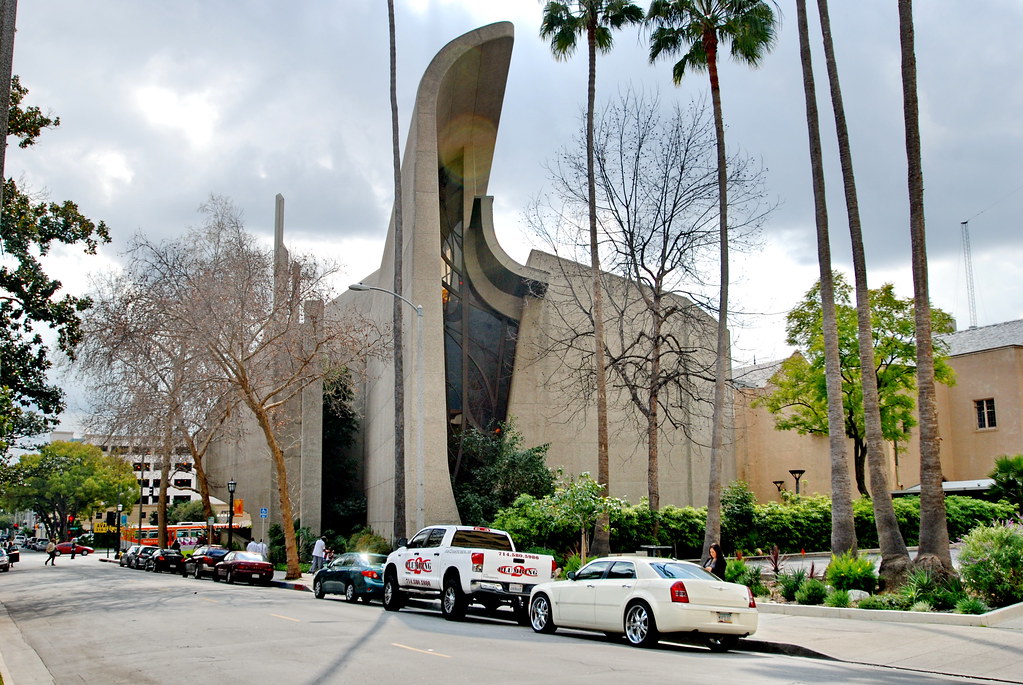
12. Pasadena Presbyterian Church
585 E. Colorado Blvd, Pasadena
1908/1976

Despite Pasadena's ethnic-kinda-sounding name (we went over its origin before), it was pretty much founded by a bunch of WASP-folk from Indiana, and the influence of Midwestern American culture still looms large, from the Tournament of Roses organization to the general vibe of the city.

From the city's founding in the 1880s to the 1920s was when the city's large Protestant churches were built along the Colorado Boulevard corridor. The Pasadena Presbyterian Church, whose congregation dates back to 1875 when it was located on Orange Grove and California street, had built two houses of worship before this one was built in 1908.

The church (as in the organization) was also heavily influential in the city's culture: It broadcasted its KPPC (hence the call letters) AM and FM radio stations from 1924 to 1971 which featured religious programming as well as more secular news, talk and music shows (including the first radio home of The Dr. Demento Show (!) in 1970).

The main sanctuary building was damaged in the 1971 Sylmar earthquake (the other original church buildings on the campus still remain), and a new one was built in 1976. It features an Aeolian-Skinner pipe organ which was rescued from the original 1908 sanctuary.

13. First United Methodist Church of Pasadena
500 E. Colorado Blvd, Pasadena
1923

This congregation dates back to the original 1872 settlers from Indiana, who originally built the church in two previous locations (the second of which was damaged in a tornado (!) in December 1891). After outgrowing its previous buildings, the church moved to its present location in 1923 and built its current English Gothic-style sanctuary, which was designed by architect Thomas P. Barber. It also includes a 1930 Skinner pipe organ.

14. Site of KROQ Broadcast Studio
117 S. Los Robles Ave, Pasadena
1976

Remember KROQ? No, not that lame ass station that's on right now, the good KROQ. As in The ROQ of the '80s? Dude...Rodney on the ROQ? Jed The Fish? The Poorman? Richard MF'in Blade?!

If you do, then...dude, you're old!

The station once broadcasted here, in Pasadena (the station still says "Pasadena/Los Angeles" due to how it's FCC license is registered). But KROQ was, like, totally Pasadena. The station itself had its origins in the old KPPC (remember, the Presbyterian Church down on Colorado?) FM, which broadcasted on the 106.7 frequency. In 1969, KPPC FM moved out of the church (literally and figuratively) due to a change in ownership and in 1973 after another ownership transfer, it became KROQ-FM - "The ROQ of Los Angeles."

KROQ moved to this Los Robles location in 1976, which coincided with the emerging sound of punk rock and new wave music bubbling out of the local underground. Deejay Rodney Bingenheimer broke many local acts such as The Runaways and The Go-Gos, as well as East Coast acts like The Ramones, Blondie and The Talking Heads. KROQ was the tastemaker of the 1980s, and many of the decade's stars came down to the Los Robles studios for interviews. A local venue called Perkin's Palace on Raymond Avenue (more on this later) also hosted many punk and new wave acts, and Pasadena became the totally happening place.

KROQ moved to Burbank in 1987, and after new wave's last hurrah in Pasadena (Depeche Mode's 101 Concert at The Rose Bowl on June 18, 1988), the city was never quite the same again.
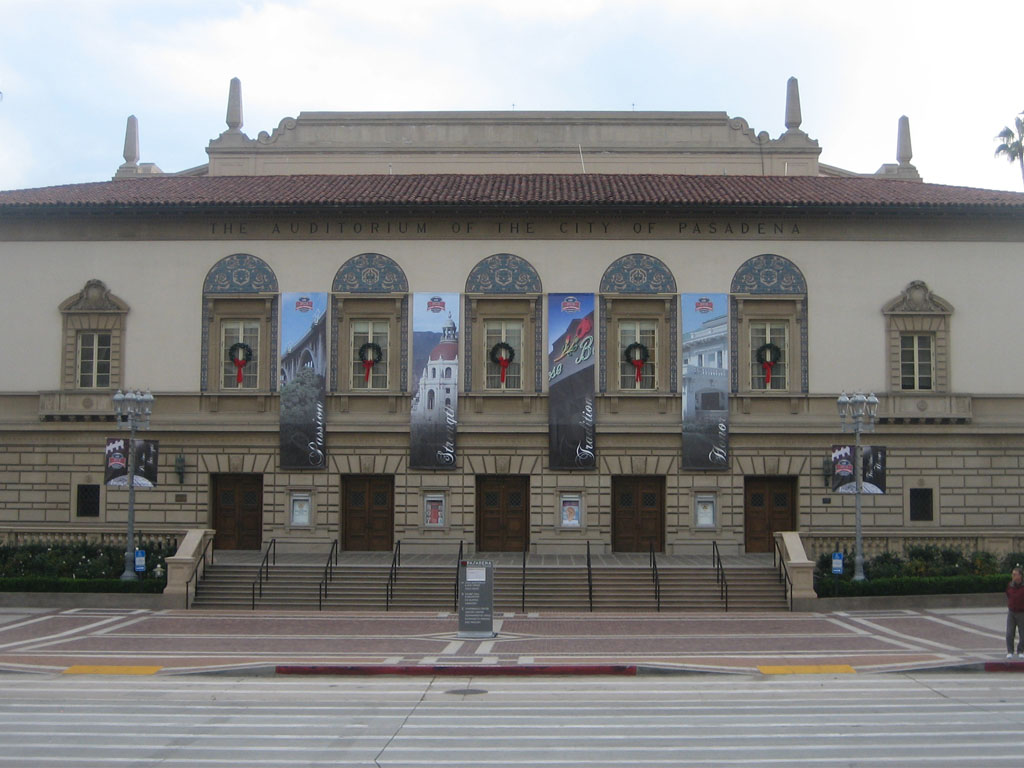
15. Pasadena Civic Auditorium
330 E. Green St, Pasadena
1931

Just south of the CicLAvia route, across from Paseo Colorado (formerly the Plaza Pasadena mall) is this stately hall designed by architects George Edwin Bergstrom, Cyril Bennett and Fitch Haskell, this 3,029-seat venue was the home of the Emmy Awards from 1977 to 1997. The 1983 NBC Motown 25 special, was taped here, which means, yes, Michael Jackson's moonwalk was performed to a worldwide audience in this here building.

16. Pasadena City Hall
100 N. Garfield Ave, Pasadena
1927

Fans of the TV show Parks & Recreation will easily recognize this building for some reason...

Built a year before Los Angeles' iconic city hall, this second-most iconic city hall building in Southern California was largely inspired by the 1915 San Francisco City Hall. In fact, the city government wanted one similar to that, so they hired SF city hall architects Arthur Brown, Jr. and John Bakewell, Jr. to design one for the Crown City, this time with Mediterranean Revival and Spanish Colonial Revival elements.
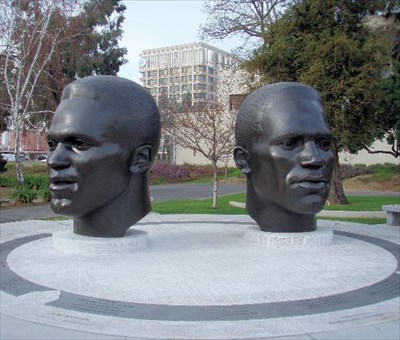
17. Jackie and Mack Robinson Memorial
Holly St. and Garfield Ave, Pasadena
1997

Legendary Brooklyn Dodger and UCLA Bruin Jackie Robinson and his brother, Olympic medalist Mack Robinson, were both raised right here in Pasadena, in a small house (no longer standing) at 121 Pepper Street, off of North Fair Oaks.

This memorial sculpture, designed by artist Ralph Helmick, features, nine-foot, 2700-pound likenesses of the Robinson brothers' heads. It was dedicated in 1997, the 50th anniversary year of Jackie Robinson breaking the color barrier.

18. Pasadena Public Library Ruins
Raymond Ave and Walnut St, Pasadena
1890

Located at the northwest corner of Pasadena's Memorial Park (It is not, The Militant repeats, not a cemetery, it's quite literally a park that contains various memorial statues and plaques to war veterans and historic individuals) is this freestanding arched structure that looks like some old rich person's tomb (again, Memorial Park is not a cemetery...).

The structure was the entrance to the original Pasadena Public Library (prior to the 1930s, the park was known as the not-macabre-at-all "Library Park"), which operated here from 1890 to 1927. It was damaged in the 1933 Long Beach Earthquake and demolished in 1954 (man, the speed of city bureaucracy...). In 1955 the city of Pasadena decided to keep the arched entrance intact and dedicate it as another memorial in this park, this time to the city's founders.

19. Raymond Theatre/Perkins Palace
129 N. Raymond Ave, Pasadena
1921

Originally built as Jensen's Raymond Theatre (if you know your Los Angeles history, it's the same Jensen's that opened the bowling alley in Echo Park and the former silent movie theatre on Melrose in East Hollywood (now the Ukrainian Culture Center - which was one of the stops in the first few Epic CicLAvia Tours), it was an early venue for vaudeville and silent movie screenings.

In the 1940s, it was sold to Crown Holding Corporation and re-named the Crown Theatre (because, as you know by now, Pasadena is "The Crown City" - and don't you forget it), showing movies until the 1960s. In the early 1970s, one of the theatre's owners was a local ophthalmologist named Dr. Nathan Roth (whose son, David Lee, was attending Pasadena City College at the time and met these guys named Michael, Alex and Eddie).

In the late '70s, the venue was owned by local businessman Mark Perkins who re-named it Perkins Palace, which became the legendary stage for local, national and international rock, pop, punk and new wave acts, from Fleetwood Mac to The Go-Gos to New Order to Oingo Boingo to, yes, Van Halen.

Today, the building remains as part of a new condo/retail complex.

20. Neon Retro Arcade
28 S. Raymond Ave, Pasadena
2015

The third "arcade" on the CicLAvia route is this one -- a video arcade, that opened earlier this year, and specializes in retro (as in 1980s and 1990s, you know, the good stuff) video games, as well as pinball machines for the older school set. If you lovingly remembered the uber-legendary Pak Mann Arcade on 1775 Colorado Blvd back in the day, this is somewhat of a consolation. Anyone wanna play some Tempest or Street Fighter?

Note: If the arcade is closed, come by after 12 noon on Sunday when it opens. After then it will, quite literally, be on like Donkey Kong.
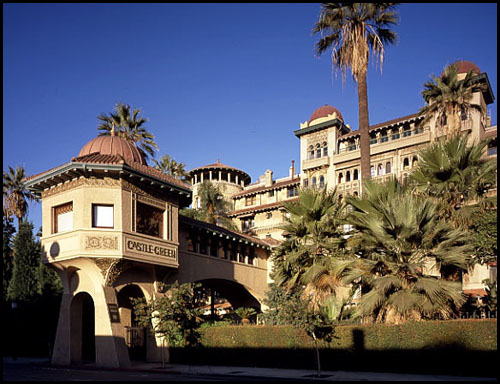
21. Hotel Green/Castle Green
99 S. Raymond Ave, Pasadena
1893

One of Pasadena's most iconic structures, this Moorish-Mediterranean Revival luxury hotel, which was designed by local architect Frederick Roehrig, was built to serve the Santa Fe Railway station across the street (more on this later). Prior to its opening, it was purchased by civil war veteran and snake oil salesman George G. Green (hence Green Street). The hotel was once home to the Tournament of Roses Association and the Valley Hunt Club, which us 99-percenters only really hear about during the Tournament of Roses Parade.
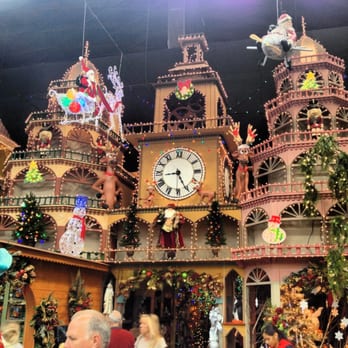
22. Stats Floral Supply
120 S. Raymond Ave, Pasadena
1962

Greek immigrant Dan Stathatos, Sr. once opened a flower shop on 4th and Broadway in Downtown Los Angeles and sold violets. His sons Dan, Jr. and Jerry took over the family business after his father's death in 1941 and in 1962 opened a floral supply, craft arts and outdoor furniture store here on Raymond Avenue in Pasadena.

The real draw of this store is from September to January, where the store becomes this massive, epic Christmas Holiday wonderland: Christmas trees, snowmen, reindeer, elves, angels, nutcrackers, Santas... it's...just...so...over...the...top.

Even if you drop by this Sunday, it won't be in Christmas mode, but it's still a unique store, sort of like a Moskatel's on steroids. If Huell hasn't been here, he should have.

23. Pasadena Santa Fe Depot
230 S. Raymond Ave, Pasadena
1935

Before The Metro Gold Line opened in 2003, the Atchison, Topeka and Santa Fe Railway was the rail line that cut through town. The railroad first came to town in 1885, a line built by the Los Angeles and San Gabriel Valley Railroad, which changed hands over the years and was bought by the ATSF Railway in 1906. The line served trains that came as far as Chicago.

The Mission Revival railroad depot was built in 1935 -- four years before Union Station was built in Downtown Los Angeles, and was popular with Hollywood celebrities, who disembarked here, rather than at Union Station, due to the Pasadena station's proximity to Hollywood and the various studios in the San Fernando Valley.

In 1971, Amtrak took over passenger service from the nation's railways and used this station until 1994, when parts of the line leading to Pasadena were condemned following the Northridge Earthquake. In the late 1990s, construction of the much-anticipated light rail line from Pasadena to Downtown Los Angeles was commenced, and the original Pasadena Santa Fe depot was moved several yards to its current location, which is now adaptively reused as the La Grande Orange Cafe restaurant, located adjacent to the Del Mar Metro Gold Line station.

24. The Owl Drug Co. (J. Crew)
3 W. Colorado Blvd, Pasadena
1916

J. Crew? Huh? The Militant shops there? As if! Naw, seriously, look down at the entryway for this J. Crew in Old Town Pasadena and you'll see "The Owl Drug Co." It was a San Francisco-based national chain drugstore and soda fountain (yeah, total old school) that opened its first Pasadena location here almost a century ago. It operated until the 1940s when it was purchased by Rexall Drug Store. It changed hands over the years, weathering the neighborhood's decline and eventual revitalization towards the end of the 20th century.

25. Site of Clune's Pasadena Theatre
61 W. Colorado Blvd, Pasadena
1911

If you're into faded building signs, you're in for a treat. The north and east walls of this building still bear the weather-beaten signage for "Clune's Pasadena Theatre," a vaudeville and silent movie theatre built 104 years ago. John Philip Sousa once performed there with his orchestra,

It became part of the Fox Theatres chain in the 1920s, screening Fox, and later 20th Century Fox films until the 1950s. Today, a Crate & Barrel and a Gap store operate in the former theatre space.

Stay Militant and Happy CiclaDENA on Sunday! Don't forget to blast some Van Halen and wear your crowns!


Tuesday, March 17, 2015

The Militant's Epic Militant CicLAvia Tour 9.0!!!!!!!!!

Interactive Map! Click on green points to view hotspots, or click on entire map for larger view.

Wow, its it really CicLAvia time again? It was just three and a half months since the last one, and The Militant can still remember that like it was yesterday. Now it's 2015 and we're in for -- count em -- four CicLAvia events this year: The Valley (March 22); Pasadena (May 31); Culver City/Venice (August 9) and the classic Heart of Los Angeles route (TBD October).

For The Militant, this not only means fun for an entire Sunday, but a lot of Militant Research and hard work preparing another one of his Epic Militant CicLAvia Tour guide posts. With three all-new tour guides to research and compose this year, he's got his work cut out for him,

This time around, we get to explore the 818 for the very first time in car-free mode, going along the Lankershim and Ventura boulevard corridors, with the Metro Red Line Universal City/Studio City (ugh, redundant and slashy) station's park-and-ride lot as a junction point and an activity hub.

Now, The Militant did not grow up in the Valley per se, but he did have countless experiences in the SFV, and when it came to composing this guide, he just sat down, looked at a map, and pointed out some places that either meant something historically or personally. Eventually, he came up with 20 of them. It only took one on-site route visit to confirm things, and without any further a due, The Militant Angeleno presents you his Militant guide to the XIIth CicLAvia, or the 9th unique routing. ENJOY!

(As consistent with previous Epic Militant CicLAvia Tour maps, this routing starts from the east and works its way westward).


1. Historic Lankershim Depot
1893
5351 Lankershim Blvd, North Hollywood

Metro Orange Line riders might wonder exactly what is this mysterious wooden building shrouded behind a fence and banners. Alas, it's one of the oldest surviving buildings in the San Fernando Valley. Built in 1893 as the Toluca Depot by the Southern Pacific Railroad along what was then the railway line from San Francisco to Los Angeles, it fielded both passengers and freight -- namely San Fernando Valley produce, such as peaches and oranges -- for a number of years. In 1911, the building was moved 50 feet to make room for the new Pacific Electric Railway, and the station served both the Southern Pacific and Pacific Electric until the last Red Car ran in 1952. Six years later, the Southern Pacific passenger trains stopped using the tracks and the station was repurposed as a lumber company's loading dock for freight cars. The line was abandoned in 1993, but soon after the new Los Angeles county Metropolitan Transportation Authority (a.k.a. MTA, now Metro), purchased the property as part of a construction staging area for the North Hollywood subway station. When the station opened in 2000, the transit agency announced a commitment to eventually restore the station, already a Los Angeles City Historic-Cultural Monument. Last October, Metro completed a $3.6 million renovation of the building, and even repainted it with the original colors the Southern Pacific built it with. The exact use of the station has yet to be decided, but it may or may not become a multi-use cafe, community space and Metro Customer Service Center.

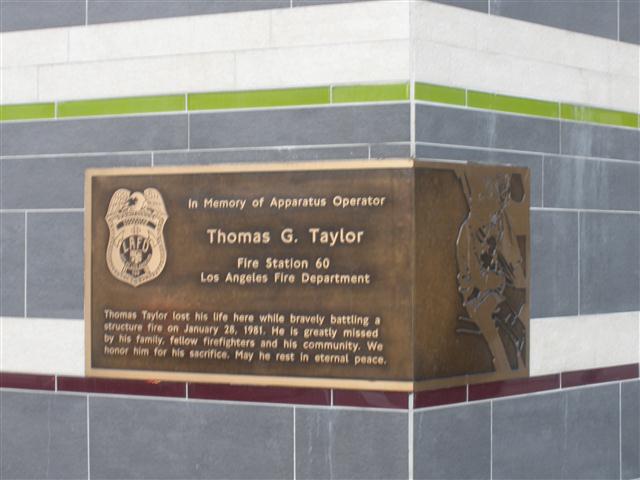
2. Firefighter Thomas G. Taylor Monument
2001
5300 Lankershim Blvd, North Hollywood

In the early morning hours of January 28, 1981, a fire broke out at what was then Cugee's Coffee Shop. While members of Los Angeles Fire Department Truck No. 60 were cutting a hole in the roof of the building, it collapsed, killing Apparatus Operator Thomas G. Taylor, a seven-year veteran of the LAFD.

The fire was later discovered to be an arson fire, planned by the restaurant's owners to collect insurance, and paid Van Nuys barber Mario Catanio $2,500 to burn their restaurant down. The owners were each given 10-year prison sentences but Catanio was sentenced to 25 years to life. He was denied parole in 2012.

When the current building was erected in 2001, a bronze memorial plaque for Taylor was placed on the corner of the building where Lankershim intersects with Weddington St. It was covered by The Militant in a blog post on North Hollywood in 2010.


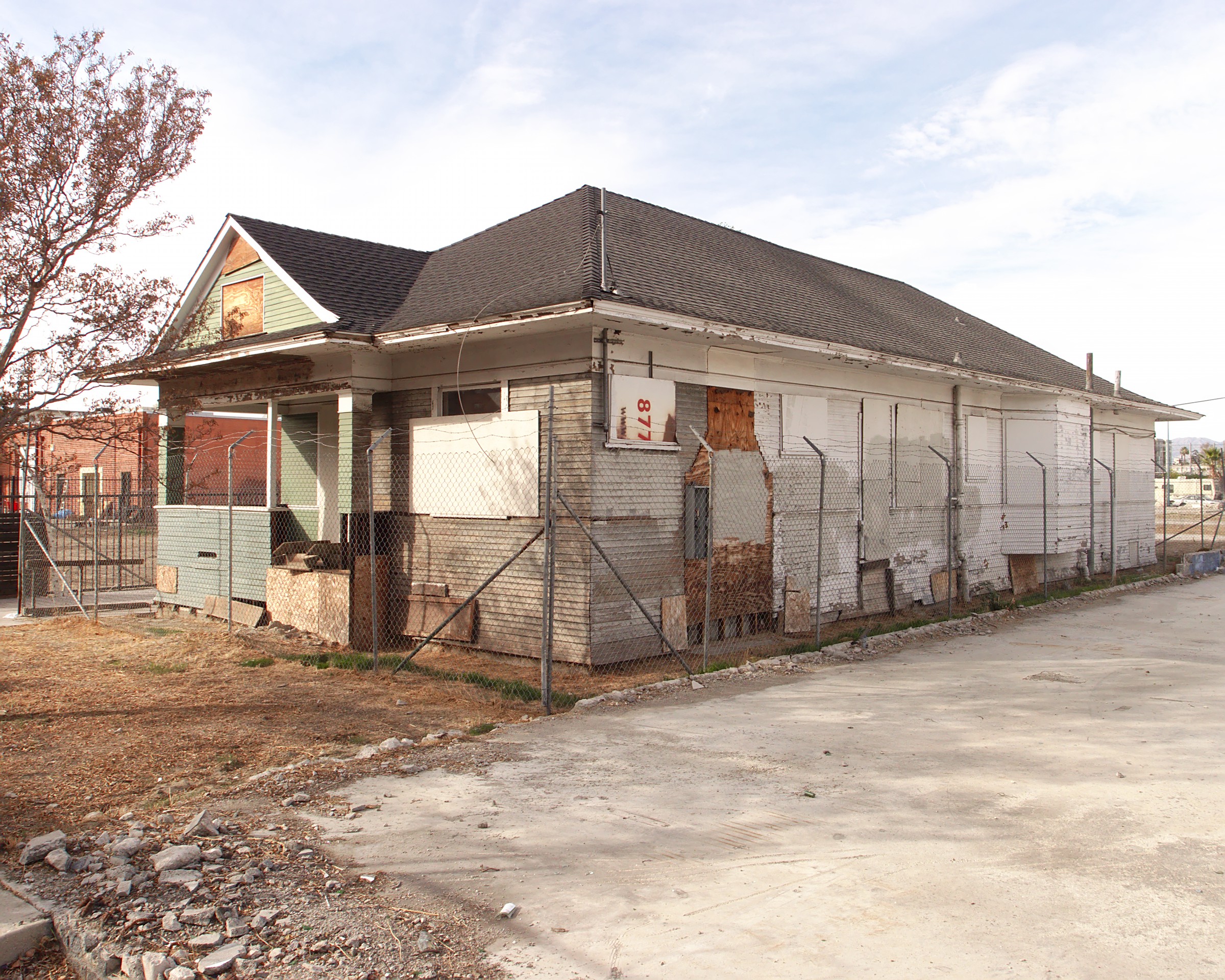
3. Weddington House 
1891
11025 Weddington St, North Hollywood

This dilapidated clapboard bungalow, considered "The Mother House of North Hollywood," on Weddington Street, nearly a block east of the CicLAvia route, has a long and storied history.

In 1889, a farmer from Storm Lake, Iowa named Wilson Weddington visited his sister, who lived in the San Fernando Valley, and fell in love with the place. So much, that he not only moved his own family here, but he dismantled his house and had it shipped by train to what was then known as Toluca.

Weddington, considered one of the founders of North Hollywood, had the house re-assembled in 1891 adjacent to a barley field. It was renovated in 1904, and later moved to make room for the El Portal Theatre. The building was moved three times down the same street, eventually resting in its current location, where it has been standing since 1924.

The building, a Los Angeles City Historic-Cultural Monument, is in a state of limbo. There are plans to eventually restore it, but the question is where. There have been offers to move it to Highland Park's Heritage Square, but many North Hollywood residents, including one of Weddington's descendants, want to see it remain in the neighborhood.

4. El Portal Theatre
1926
11206 Weddington St, North Hollywood

Before there was a "NoHo Arts District," there was the El Portal

Opened October 5, 1926 as a 1.346-seat Vaudeville venue and silent movie cinema run by Fox West Coast Theatres, and later, as part of the National General and Mann cinema companies, featured those moving pictures that talk. The theatre and its iconic (well, for NoHo folks, at least) Art Deco facade was designed by architect Lewis A. Smith, who also fashioned the Vista Theatre in East Hollywood and Highland Park's Highland Theatre. It screened films until closing in the 1980s. In 1994, it was a victim of the Northridge Earthquake and was rehabbed in the late 1990s, re-opening in 2000 as part of a re-development renaissance along Lankershim created with the opening of the Metro Red Line station, which in turn sparked the neighborhood's re-branding as the "No-Ho Arts District." What comes around, goes around.

Today it operates as three theaters featuring mostly independent plays, dance productions and musicals, and it was also the recipient of the carpeting from its organ donor, the late Schubert Theatre in Century City.


5. Amelia Earhart Statue
1971
Magnolia Blvd & Tujunga Ave, North Hollywood

The twentieth-century female aviation pioneer and feminist icon had several ties to the North Hollywood (and adjacent) area: In 1935 Earheart moved to a house in nearby Toluca Lake -- her last residence (or at least, her last known residence...). A number of the planes she flew in her famed flights were designed and built by Lockheed in nearby Burbank. 

In 1971, a steel and fiberglass statue, sculpted by Ernest Shelton, was placed on this corner of Magnolia and Tujunga at the edge of North Hollywood Recreation Center. Just a few yards north on Tujunga, the Los Angeles Public Library's North Hollywood Regional Branch was renamed the "North Hollywood Amelia M Earhart Regional Branch Library" in 1981. In 2002, the statue was temporarily removed for renovation, and it returned in 2003, this time rebuilt in bronze.


6. NoHo Gateway
2009
Lankershim Blvd & Huston St

Love it or hate it, it's there, and it welcomes all to the NoHo Arts District. A project of the now-defunct Community Redevelopment Agency of Los Angeles, the quirky, $800,000 NoHo Gateway was built in July 2009 and designed by artist Peter Shire, known for his equally-quirky-but-not-nearly-as-controversial art sculptures in the landscaped (former Pacific Electric) median of Santa Monica Boulevard in WeHo. This was also covered by The Militant in his 2010 blog post on NoHo

What does the Militant think of it? Well it's, um, you know...but people will get used to it eventually (a Facebook page called "Tear Down the NoHo Gateway" has not had any activity for the past three years, so maybe it's a sign that people are warming up to this thing...). Such is art.

7. Pacific Electric Right of Way
1911 (abandoned 1952)
Vineland Ave between the 101 Freeway and Chandler Blvd

The CicLAvia route cuts through the bewildering six-way intersection of Lankershim Blvd, Vineland Ave and Camarillo St. But look down through Vineland -- see that landscaped median? If you know your Los Angeles history, you know what that means. Like Leimert Blvd from the last CicLAvia, this, too, is an abandoned streetcar right-of-way. Vineland Avenue carried Pacific Electric Red Cars between the SFV and Downtown Los Angeles. From the other side of the hill, the Red Cars cut through the Cahuenga Pass (now the 101 freeway) and turned north on Vineland, where they once went all the way to San Fernando, Canoga Park or Van Nuys, all except the Van Nuys line closed down in 1938, with the final line closing in 1952. Just south of Chandler Blvd, the line through Vineland curved west (the diagonal wall at the Big Lots store on Vineland and Chandler is a vestigial remnant of this line) to join Chandler, where trains passed through the historic Lankershim Depot.

8. Pacific Electric Substation
1911
Vineland Ave & Riverside Drive

This white building which bears the signage, "The Howard Colonial" is also a vestigial remnant of the Pacific Electric's San Fernando Valley line through Vineland Ave. It served as one of the PE's electric power substations (Number 30 to be exact) that supplied power to the overhead lines that gave juice to the Red Cars that ran past it.

9. St. Charles Borromeo Church
1937 (old building)/ 1959 (current building)
10800 Moorpark St, North Hollywood

This Spanish Colonial-style church designed by Alhambra-based architect J. Earl Trudeau, who also designed Roman Catholic parishes in Culver City, South Los Angeles and Alhambra, has attracted famous parishioners such as actor Bob Hope -- who lived in nearby Toluca Lake and had his funeral here in 2003 (the corner of Lankershim and Moorpark was designated by the City as "Bob and Dolores Hope Square"). Directly west of the main church is the parish hall, which was built in 1937 and previously served as the original church structure. The architecture of the old church was based on the parish's namesake, the 1771 Mission San Carlos Borroméo del río Carmelo in Carmel.

10. Los Angeles River Access
c. 1940s
near Lankershim Blvd & the Los Angeles River

Have you ever seen service trucks drive on the Los Angeles River? How did they do that? Did they really drive all the way from Downtown? Well, no. from this bridge over the River, you can spot access ramps on both the north and south sides of the river; the one on the north side is accessible via a gated lot at the end of Agua Vista Street. Of course, anyone caught doing a RiverLAvia on Sunday , or any day, would be fined $1000.

On that note, how many of you are willing to bail out The Militant? (YOLO...)

11. New NBC Studios
2014
Lankershim Blvd and Muddy Waters Drive, Universal City

Though NBC and Burbank have become inseparable, their corporate relationship with Universal (and Later Comcast) has moved them west, and onto the Universal backlot. In February 2014, TV station KNBC 4 , KVEA Telemundo 52 and the NBC News West Coast Bureau moved into a new state-of-the-art digital facility along the Los Angeles River. The old NBC studios in Burbank is now an independent rental studio facility called The Burbank Studios. This is also a big year for its Universal parent/partner; Universal City celebrated its 100th birthday this past Sunday. Give Fritz Coleman a bi ol' shout-out if you see him this Sunday.


12. Campo de Cahuenga
1847
3919 Lankershim Blvd, Studio City

Yes, this adobe abode was the location where Lt. Col John C. Fremont and General Andres Pico signed the Treaty of Cahuenga in 1847, formally ending the frequent skirmishes between the U.S. and Mexico, and eventually paving the way for California to become an independent nation, and eventually a U.S. state. It all began here, people. Those northern Cali folks beta recognize! You'll have to go inside to experience more of the history, and if you want more, go to the Metro Red Line platform at the Universal City/Studio City station next door and read the art that adorns the station. Also, the actual table where the treaty was signed is on display at the Natural History Museum in Exposition Park as part of their Becoming Los Angeles exhibit, which The Militant wrote about in 2013.


13. "The Oasis" Native Plant Garden
2009
Ventura Blvd between Eureka and Arch drives, Studio City

This pleasant California native plant garden was a streetscape and pocket park project by the Studio City Beautification Association done in 2009. Located literally where the Santa Monica Mountains meet Ventura Boulevard, it gives pedestrians a chance to connect with the natural indigenous habitat of the mountain range. With a dirt "hiking" path subbing for the sidewalk here, one can see California Golden Poppies, Matilija Poppies, Purple Sage, California Lilac and purple Verbenas. And since we've experienced an early Spring this year, many of them are already in bloom.

14. Brady Bunch House
1959
11222 Dilling St, Studio City

Here's the story
Of a house named Brady
It's just a few blocks from the CicLAvia route
Go up Tujunga, turn right on Dilling
And see what it's all about...

No doubt you've seen this house numerous times on TV Land or in local syndication or (if you're old enough) on primetime on ABC from 1969 to 1974. It was selected by "The Brady Bunch" creator Sherwood Schwartz in 1969 to represent "California living," "a place that an architect would live in" and "not too affluent, but not too blue-collar either."

But though the television show had that famous iconic staircase, the real house on 11222 Dilling Street is only a single-story, split-level abode. The show's crew placed a fake window under the facade's A-frame during location shooting to depict a second level.

Here's an interesting tidbit about the Brady Bunch house: You already know about the history of the Weddington House. But did you know there's a direct connection between the two famous Valley houses? The Brady Bunch house was designed and built by Luther B. Carson (who, like Mike Brady was an architect) in 1959 on a then-empty lot after the construction of the Ventura Freeway forced them to move from their previous home nearby. He was already deceased by the time the house was selected by Schwartz for the TV show. His widow, Louise Weddington Carson (who died in 1994) was Wilson Weddington's great-granddaughter.

15. VETura Boulevard
Ventura Blvd between Colfax and Radford avenues

Did you know that this two-block stretch of Ventura Boulevard has the highest concentration of veterinary hospitals/clinics in the entire City of Los Angeles? Well, neither did The Militant until he recently surveyed the CicLAvia route. In this section of Ventura between Colfax and Radford avenues alone, there are five veterinary facilities: Parker Pet Hosptial, Veterinary Medical Center, Animal Emergency Centre, Studio City Animal Hospital and Tully & LaBounty Pet Clinic.

The Militant used to take his beloved K-9 unit (may his or her soul rest in peace) to one of those hospitals. Like Sunset Blvd's Guitar Row or Wilshire Blvd's Hair District, it's one of the many unofficial specialty retail districts of Los Angeles that makes this city so unique. And because there's so many pet health care facilities on this block, The Militant has thusly given this part of the street the moniker, "VETura Boulevard" (come to think of it, a famous cinematic pet detective had the name "Ace Ventura." Coincidence?).

16. Mack Senett Studio Site/CBS Studio Center
1928
4024 Radford Ave, Studio City

Do you know why Studio City is called "Studio City?" Because it's close to Universal Studios, right?
BZZZZT! WRONG! (That's Universal City...) It's because of this place.

Back in the '90s (er, the 1890s, that is), this area was called Laurelwood. With farming wrapping up by the end of the 19th century, it became a hotspot for real estate at the turn of the 20th. Mack Sennett, who already built Los Angeles' first movie studio in what is now Echo Park in 1912, decided to build a second, 20-acre studio on the banks of the Los Angeles River in this location in 1928. He sold the studio due to bankruptcy in 1933 to Mascot Pictures, changing hands over the decades to Monogram Pictures and Republic Pictures until the latter's demise in 1958. Then CBS started leasing, and later purchased the facility, and in the early 1960s it became the location where the network's own produced series were filmed. The classic TV shows "Gilligan's Island," "Gunsmoke," "My Three Sons" and "The Mary Tyler Moore Show" were all filmed on that lot. In fact, the large parking garage on the right before Radford meets the Los Angeles River was the site of the Gilligan's Island lagoon. Today, the studio is also the home of local television stations KCBS 2 and KCAL 9.

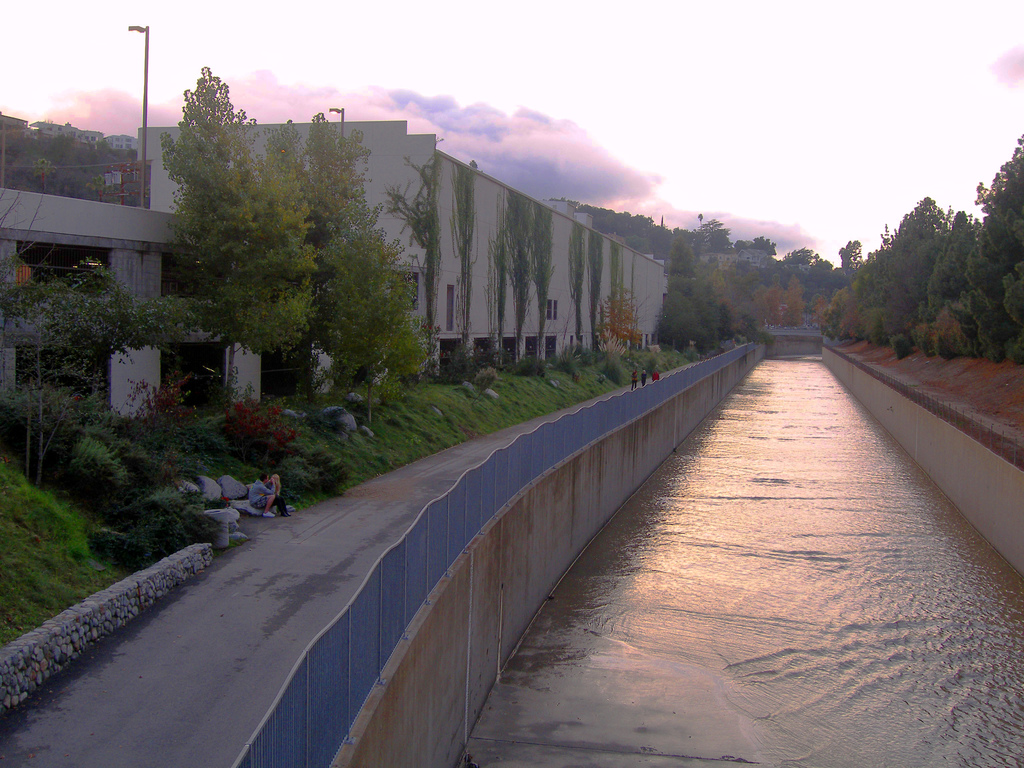
17. Los Angeles River Greenway Park
2004
Los Angeles River between Whitsett and Radford avenues

Yeah, so the Los Angeles River in the Valley isn't as scenic and green as what you see down by Griffith Park and Frogtown (except for this section, which is a few more miles upstream). But at least this picturesque greenbelt and walking path, which opened in 2004, is still much more pleasant and scenic than the other Los Angeles River crossing by Lankershim. If CicLAvia gets too crowded, you might want to use this route as an alternate. If you can't get enough of the river, you can re-join the greenbelt west of Coldwater Canyon, where a similar path runs west to Fulton Avenue. In the near future, a linkage path will connect the two linear river parks between Coldwater Canyon and Whitsett.

18. LAFD Fire Station 78
1943/2008
4041 Whitsett Ave, Studio City

Gentrification and hipsterization might be causing more segregation in our communities, but there was a time in our City' history when segregation in certain City institutions was the law.

Remember the story of the African American Firefighter Museum on Central Avenue from previous CicLAvias? Well, here's the sequel to the story.

For much of LAFD's history, only two fire stations, No. 14 and No. 30 (now the museum), were the only fire stations that allowed African American firefighters. a series of events in the 1950s raised issues of racial integration in the LAFD and in 1955, two black firefighters and six white firefighters (who supported integration) were re-assigned to replace the all-white staff at this fire station on Whitsett Avenue, and it became the very first racially integrated fire station in the LAFD. It was not without controversy, of course -- many community members protested and used the new firefighters' unfamiliarity with the local streets and topography (they came from other parts of the city) as one reason for opposing the re-assignment. Eventually, in September 1956, all Los Angeles Fire Department stations were racially integrated.

Although, this was not the original building of LAFD Fire Station No. 78; this was a new facility that was built in 2008. But you can still visit the original location along the CicLAvia route (adjacent to the Sportsmen's Lodge), which was on 4230 Coldwater Canyon Ave, just north of the 76 gas station.

19. Original Jerry’s Famous Deli
1978
12655 Ventura Blvd, Studio City

This was the very location where Jerry Seidman and business partner Isaac Starkman started their deli-food empire of celebrity clientele, 700-item menus and very mediocre, overpriced food. It's been said that an already-famous Andy Kaufman worked here as a busboy in the late '70s. In 2001, a fire damaged the restaurant, which was closed until it reopened to its currently-remodeled format in 2003. But if you want the Militant's advice, if you're hungry for a pastrami sandwich or cheese blintzes during CicLAvia, skip the long waits at this overrated joint and head a few blocks east to Art's Delicatessen on 12224 Ventura instead.

20. Sportsmen’s Lodge
1885
12825 Ventura Blvd, Studio City

Originally built as a place where Valley residents and visitors can experience the rapidly-vanishing rural lifestyle of the San Fernando Valley of the 19th Century, in the 20th century it became popular for its stocked fishing ponds, and a celebrity hang due to its proximity to the aforementioned studios on Radford Avenue, In recent history, its events center has become a venue for countless Angeleno wedding receptions, bar/bat mitzvahs, proms, quinceañeras, and other events. The Militant even had one of his high school reunions here.

As you may or may not have heard earlier this week, this place will soon be undergoing some changes. Gone will be the beloved events center and scenic grounds, to be replaced by some outdoor retail mall type thingie. The hotel will stay though. The Militant doesn't know what to think of all this (as if The Valley really needs another Crate and Barrel), but in the meantime, come check out this unique Valley institution while it lasts.

So there it is, take it. Happy CicLAvia this Sunday, and if you see The Militant on the streets, raise your fist for him!

Saturday, March 14, 2015

26.2 Points Of Light

If you squint, you can see some of the illumination columns from the Los Angeles Marathon lights (Taken from atop the La Cienega Metro Expo Line station parking garage).

So yeah, The Militant is a sucker for epic things in Los Angeles: Epic sunsets, epic space shuttle parades, epic CicLAvia tours, you know the deal. Naturally, when he found out earlier in the week that Asics America would be sponsoring a special by-the-mile illumination of the 2015 Los Angeles Marathon route on Friday night to celebrate its 30th Anniversary, he was down like James Brown for this, and even almost forgave Fr*nk McC**rt for running the Marathon (...almost).

We haven't seen anything quite like this. Not even for New Year's Eve, not even for the '84 Olympics. So this was pretty epic indeed.

The Militant instinctively knew that the usual vantage points -- Griffith Observatory, Runyon Canyon, the Getty Center, etc. would be crowded as hell, not to mention the usual parking snafus you'd expect from such a gathering. So being near the Crenshaw area at the time, he made a dash to the Baldwin Hills Scenic Overlook...where a Culver City police car was blocking the entrance.

Okay then. Plan B. Head to the Metro Expo Line's La Cienega park & ride station, and view the lights from the roof of the parking garage. So here goes:


Okay, that was subtle. It didn't quite look like this:


But we sure fell for it, huh? Actually, the rendering looks like each block was being illuminated, rather than each mile, and the actual time the lights went on was an hour or so after dusk.

But if he looked real hard, he could make out the lights, shooting up straight into the partly-cloudy nighttime summer winter sky. It just didn't turn out so well on his Militant Spyphone.

He wanted to see these lights up close so he headed east on the 10 towards Downtown, and made his way though Sunset Boulevard in Echo Park. The next light column was at Sunset and Silver Lake Boulevard, easily visible along the road ahead:


It wasn't a single Klieg light, but a quartet of Syncrolite SXL 7,000-watt Xenon skylight fixtures at each mile marker, plus the start and end of the Marathon route.

The Militant headed west along Sunset and then Hollywood Boulevard, but was shocked to find the nearest light turned off. He asked the attendant what was up, and he told The Militant, "They're doing something..."

Oookay.

But a few patient minutes later, four blue-white columns of light beamed up from atop the rented Enterprise flatbed truck, several thousand feet into the sky, where spots of light dotted the sky like an impromptu constellation above the City of Angels. The lights were so bright from the ground that dust and flying insects were automatically illuminated directly above the truck. The Militant was solo tempted to make shadow puppets.

It was incidental macro-sized public art (eat your heart out, Christo). Though it wasn't as impressive as the rendering -- admittedly more light into an already light-polluted environment isn't really going to be that outstanding -- it held a beauty on its own. You can trace the Marathon route in the sky, somewhat. From a distance, you can see what a mile looks like. For those who were attracted to the lights, it was a moment of community, of a shared experience, of beauty.


It might be cool to do this again. Maybe with brighter LEDs. Maybe with a more sustainable means of power than 27 diesel power generators. Maybe Metro can do this on the night of July 14 with light columns emanating from all 80 Metro Rail stations to celebrate the 25th anniversary of our modern rail transit system (no, maybe they should do this).

[Hey yo, Militant, not bad for your first blog post in three months...that didn't hurt, did it? Now let's try this again sometime soon, okay?]

Friday, December 5, 2014

The Militant's Epic Militant CicLAvia Tour 8.0!!!!!!!!


Interactive Map! Click on green points to view hotspots, or click on entire map for larger view.

Well well well, it's CicLAvia time again. Just when we thought we'd have to wait until Spring...BOOM! Here comes another one. Which is all right with The Militant.

Now, originally, The Militant was going to stop doing these tour guides because like only 20 people really read them. Yeah, they really, really like them, but if only 20 people will benefit from it, he might as well just send them a CC:'ed email.

But The Militant didn't want to leave South Los Angeles behind. There's a history to this place too, a very rich one, and by skipping this, many CicLAvians would be oblivious to it. Alas, he did this for the good of the community.

So for the 20 of you who really dig this, enjoy. The Militant will now get some sleep now after working on this all night.


Central Avenue Corridor


1. Tacos El Gavilan/Site of 1st McDonalds in Los Angeles
1957
1900 S. Central Ave, South Los Angeles

What is currently a taco stand at the southeast corner of Central and Washington was once the first McDonalds in the city of Los Angeles (and the 11th McDs in the entire chain) which opened in 1957. As you may or may not know, McDonalds originated in San Bernardino in 1940 by the McDonald brothers, and was later taken over by Illinois businessman Ray Kroc, who turned the unique Southern California hamburger chain into the gargantuan unhealthy corporate chain we know today. The trademark side arches were present on this building (and a single arch present on the corner sign) up until the early 2000s. But hey, tacos are more healthy for you than McDonalds junk, so eat up.

2. Lincoln Theater
1926
2300 S. Central Ave, South Los Angeles

From 1927 to the 1950s, this Moorish Revival theatre, designed by John Paxton Perrine featured the finest live entertainment by black performers, to a predominantly black audience (though notable white folks like Charlie Chaplin dug it as well). It was even nicknamed the "West Coast Apollo" during its heyday, which featured the likes of Duke Ellington, Nat King Cole and Billie Holliday gracing its stage. In 1962 the building was purchased by the First Jurisdiction of the Church of God in Christ and remains a house of worship today, this time as the the Iglesia de Cristo Ministries Juda. The Lincoln Theater building was designated as a City of Los Angeles Historic-Cultural Monument in 2003 and was added to the National Register of Historic Places in 2009.

3. Second Baptist Church
1926
2412 Griffith Avenue, South Los Angeles

Built around the same time as the Lincoln Theater is this building that has always been a church. But it's one building that's rich in African American history. It was the host venue for the NAACP's national conventions in 1928 (the first-ever on the West Coast), 1942 and 1949. In 1962, Malcolm X spoke at a meeting held at the church. And Dr. Martin Luther King Jr himself spoke here in 1964 and 1968 -- the latter appearance, just two weeks before he was martyred in Memphis. Tennessee. To top it all off, this Lombardy Romanesque Revival building was designed by none other than famed African American architect Paul R. Williams, who designed many buildings around Los Angeles, most notably this one. This building is also designated as a City of Los Angeles Historic-Cultural Monument (1978) and was likewise added to the National Register of Historic Places (2009).

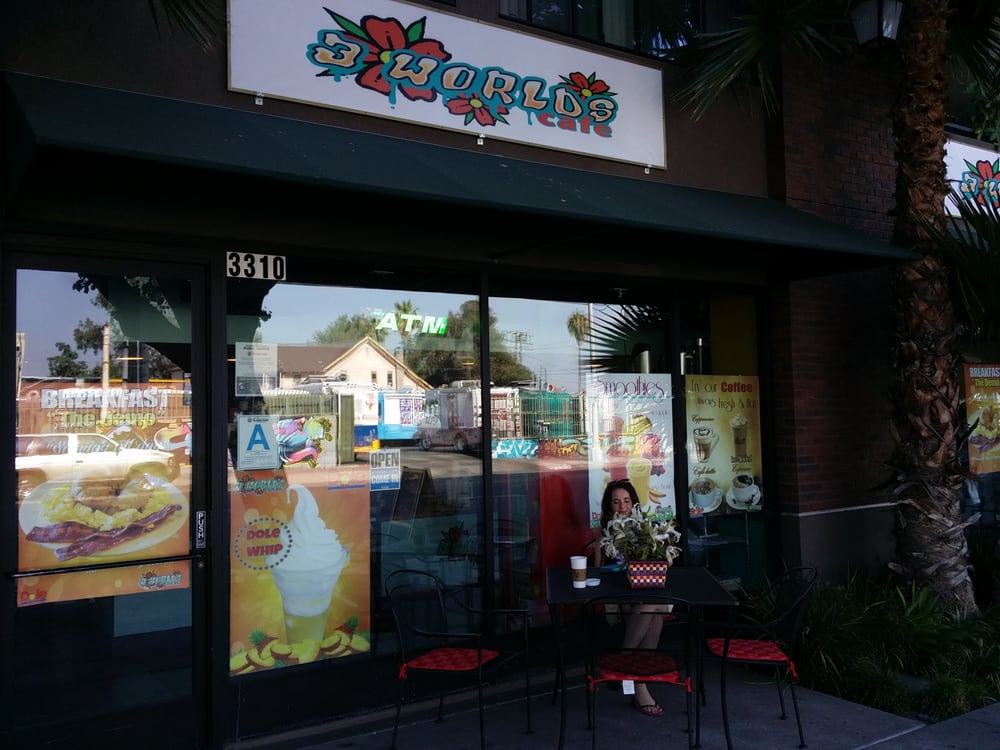
4. 3 Worlds Cafe
2013
3310 S. Central Ave, South Los Angeles

This social enterprise, created by the collaborative efforts of Los Angeles foodie magnate Roy Choi, the Coalition for Responsible Community Development, Jefferson High School and Dole Foods, trains local youth to make and serve healthy foods while learning job skills. The name refers to the Latino, Asian and African American cultures of the youth in the community. According to many folks, the food is pretty damn good, so don't sleep.

NAVIGATIONAL NOTE:
• If heading west on Martin Luther King Jr Blvd, skip to #9.


5. Masjid Bilal Islamic Center/Site of Elks Lodge
1929
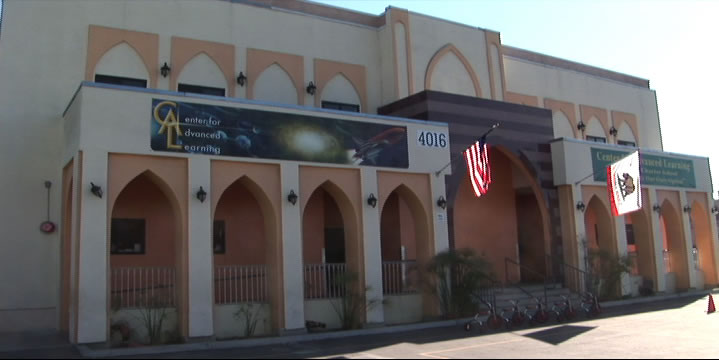
4016 S. Central Ave, South Los Angeles

This mainstay of the local Muslim community since 1973 also has a deep history in the local black community. The building was originally built in 1929 as the home of the local Elks club. But it was no ordinary Elks Club (who discriminated against black membership). It was run by the Improved and Benevolent Protective Order of Elks of the World, an African American-run organization founded in Cincinnati, Ohio in 1898 that functioned as a fraternal order for people of color. Though obviously not directly affiliated with the white Elks club, it is run with the otherwise identical customs and traditions, and with nearly half a million members worldwide, is the largest black fraternal organization in the world.

6. Ralph J. Bunche House
1919
1221 E. 40th Place, South Los Angeles

The Central Avenue corridor was home to Los Angeles' black community, primarily due to the racial covenants that restricted them from owning homes elsewhere in the city. But great things can come from places of injustice. Ralph J. Bunche was a teenager arriving with his family from Detroit, by way of Ohio and New Mexico, who attended nearby Jefferson High School and went to UCLA, graduating as the valedictorian at both schools. He went on to Harvard, where he earned his Ph.D in Political Science (the first African American to receive a doctorate in PoliSci from a U.S. university), and later was one of the founders of the United Nations. In 1950, due to his diplomatic work in the negotiations that ended the 1948 Arab-Israeli War, he won the Nobel Peace Prize -- the first nonwhite person to ever win the esteemed award. And he once lived right here, just two blocks east of the CicLAvia route.


7. Black Panther Headquarters
1969
41st & Central, South Los Angeles

The corner of 41st Street and Central Avenue wasn't just the Los Angeles headquarters of the Black Panther Party (that's some real Militants right there), but in a time where the names Mike Brown and Eric Garner have been fresh on the minds of people, it was the site of a significant event in the tumultuous history of relations between the black community and the Los Angeles Police Department. On December 8, 1969 -- 45 years before the day after CicLAvia -- police officers arrested a number of people on that corner for loitering, which eventually escalated into a four-hour armed confrontation. The LAPD used a previously untested paramilitary unit during the raid, which was called the Special Weapons And Tactics unit, or SWAT. Four LAPD officers and four Black Panther members were seriously injured during the shootout, but miraculously no one died. The building that housed the headquarters was demolished in 1970.

8. Dunbar Hotel/Club Alabam
1928
4225 S. Central Avenue

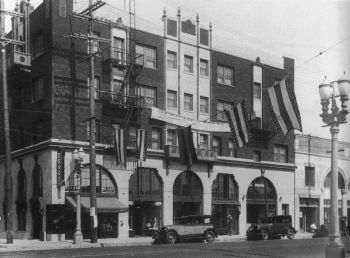
Built in 1928 (then known as the Hotel Somerville, the only hotel in Los Angeles at the time to welcome black people) as the primary accommodations venue for the 1928 NAACP national convention at the nearby Second Baptist Church, The Dunbar is one of the few remaining physical symbols of the Central Avenue of yesteryear, the hotspot of all that is jazz and blues. In the perspective of Los Angeles music history, Central Avenue in the 1920s-1950s was the Sunset Strip of the 1960s-1980s. And perhaps even more. A nightclub opened at the hotel just a few years after its opening, and legends such as Count Basie, Cab Calloway, Lena Horne and Billie Holliday. Next door was the Club Alabam, another one of the most popular jazz venues on Central Avenue. Known for its classy image and celebrity clientele (both black and white), legends such as Duke Ellington, Charlie Parker and Miles Davis graced the stage. Today, the Dunbar Hotel building serves as an affordable housing complex for seniors.

Martin Luther King Jr. Corridor

9. Site of Wrigley Field
1925  (demolished 1969)

Avalon Blvd & 42nd Place

Just a few blocks south of the CicLAvia route is Gilbert W. Lindsay Park, named after Los Angeles' first African American city councilman. But years ago, this was the place where home runs, strikeouts and 7th Inning Stretches took place in the City of Angels. And yes it was a city of Angels, as the Los Angeles Angels of the Pacific Coast League made the 22.000-capacity Wrigley Field (named after the chewing gum magnate, who had several stakes in Southern California, including Catalina Island) its home. And as any truly militant Angeleno knows, the ivy-and-brick Chi-town tourist trap, though 11 years older, was originally called Weeghman Park and wasn't dubbed Wrigley Field until 1927, which made Los Angeles' Wrigley Field the first Wrigley Field ever. The stadium also was popular with TV and movie shoots, such as Damn Yankees and The Twilight Zone. In 1961, it literally went Major League as the American League expansion team Los Angeles Angels of Los Angeles played its home games there before moving to Dodger Sta, er, Chavez Ravine for the next four seasons, and then finally moving down the 5 to Anaheim. Yes, there's a baseball field in the park, but it's not the same location as the original diamond.

10. Historic Southern Pacific Palm Tree
 Re-planted 1914
3939 S. Figueroa St, Exposition Park

Back in the late 1800s-early 1900s, the Southern Pacific Railroad operate out of a train station called the Arcade Station, on 5th and Alameda streets. A lone palm tree stood outside the station and functioned as a landmark for arriving passengers coming in from San Francisco or points east. In 1914 (dude, a hundred years ago) the Arcade Station was demolished (no, it wasn't consumed by a fire) to make way for a more modern station, called Central Station, and the palm tree had to go. So sentimental was the palm tree, instead of being cut down, it was moved to Exposition Park, where it has stood ever since. Like its neighbor the Space Shuttle Endeavour, it was a popular icon back in its day, and it's probably safe to assume that its transport through town was an event in itself. A little-known historic market at the base of the tree tells the whole story. So if you want to see a palm tree that was planted there 100 years ago, there you go.

11. Los Angeles Swimming Stadium
1932
Bill Robertson Drive & Park Lane, Exposition Park

The Coliseum's little brother, the Los Angeles Swimming Stadium was the 10,000-seat venue for the 1932 Olympic swimming, diving and water polo competitions, as well as the aquatic portions of the pentathlon event. Olympians such as Buster Crabbe swam in its waters. After the games, it became a public pool, and in the '50s, USC's swim team used it as their training and competing venue. After over a half century of wear, and damage from the 1994 Northridge Earthquake, the swim stadium was renovated in 2002 and operates today as the LA84 Foundation/John C. Argue Swim Stadium. Marco...Polo!

12. Community Services Unlimited Urban Garden
2003
Bill Robertson Lane and Martin Luther King Jr Blvd, Exposition Park

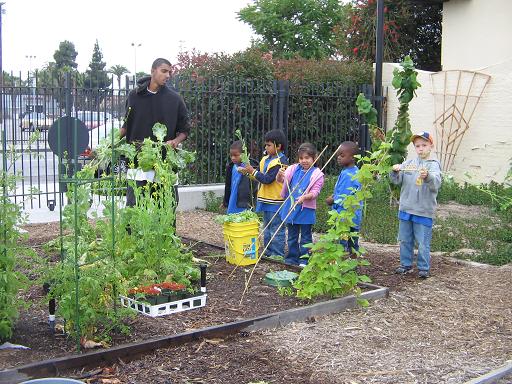
Did you know there's an urban garden along the CicLAvia route? Local nonprofit Community Services Unlimited (an organization that, interestingly enough, originated from the Black Panther Party's community outreach programs in the 1970s) grows their own organic fruits and vegetables in this Exposition Park urban garden that they sell and distribute in this predominantly food desert area to help local residents gain access to fresh, healthy produce. They sell this produce at a stand outside the LA84/John C. Argue Swim Stadium next door on Thursday afternoons from 3 to 6 p.m.

13. Celes King III Bail Bonds
1949
1530 Martin Luther King Jr Blvd, Vermont Square

Why is a Bail Bonds joint listed in the Militant's CicLAvia tour? WTF? Well, before 1983, this street was known as Santa Barbara Avenue. Celes King III was the person who lobbied to change the name of the street to Martin Luther King Jr (no relation) Blvd. A real estate broker, bail bondman, outspoken Republican, former Tuskeegee Airman, failed City Council candidate, co-founder of the Brotherhood Crusade and founder of the Kingdom Day Parade, he successfully lobbied the L.A. City Council in 1983 to re-name Santa Barbara Ave. after the slain civil rights leader -- albeit not without controversy. Some of his critics accused him of doing it to irritate then-Mayor Tom Bradley, one of his political enemies, and others have criticized CK3 of conflict of interest (his residence (he lived in the apartment upstairs) and his bail bonds business were located on Santa Barbara Ave after all) and even ego trippin' (the short-hand street signs say "King Bl"-- the same as his own last name). Whether this was a self-aggrandizing stunt or a genuine tribute to an American hero, we will never know: Celes King III died in 2003. But here's one interesting CicLAvia route fact: His father, Celes King, Jr was the owner of Central Avenue's Dunbar Hotel back in its heyday.

14. Worldwide Tacos
 [Year Unknown]
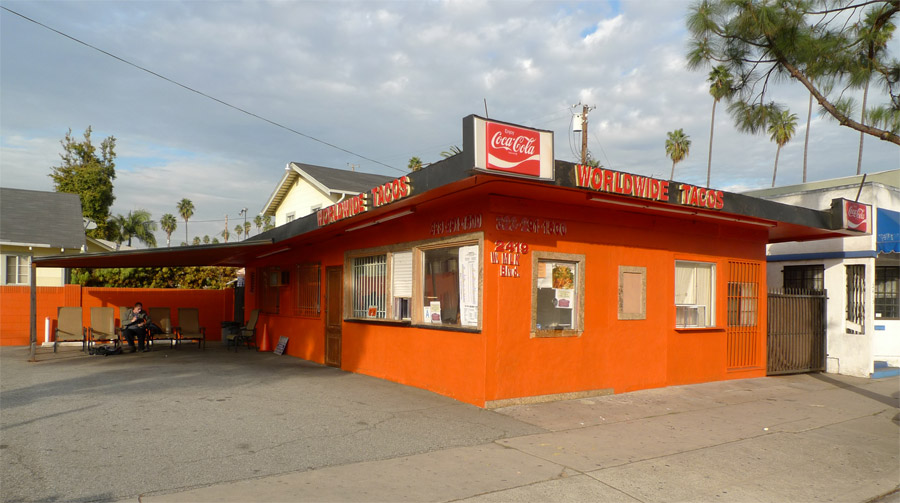
2419 Martin Luther King Blvd, Leimert Park

The Militant loves tacos, as you may or may know. But along the CicLAvia route is perhaps one of the most unusual taco joints around. Worldwide Tacos makes over 150 types of tacos, in chicken, beef, lamb, chicken, duck, turkey, pastrami, shrimp, fish and vegetarian varieties, all freshly-made and cooked to order. Prices range from $2.50 to $8.50 each. But that's not the catch. The catch is that the wait time ranges from 15 minutes to two hours. The Militant has not tried Worldwide Tacos (nor has he waited for one), but his operatives who have (and endured the long wait, though you can just leave them your cellphone number and they'll call you when they're ready) say they're pretty bomb-diggity. Hmmm...

15. Yellow Car Right Of Way
1902
Leimert Blvd between Martin Luther King Jr Blvd and Vernon Avenue

See that nice, wide, landscaped median to theleft of you through Leimert Park? Could you ever guess what it used to be? Yup, it was the right-of-way for the Yellow Car trolleys of the Los Angeles Railway, part of  The 5 Line, which ran from Eagle Rock (ya rly) to Hawthorne. Actually The CicLAvia route from the 110 Freeway to Vernon Avenue was part of the 5 Line, and because of that Leimert Park was originally planned as a transit-oriented community (it was also originally planned as a whites-only community, but so much for that, eh?) Incidentally, part of this historic Yellow Car Line, along Florence Avenue, will soon be re-used for rail transit as part of Metro's under-construction Crenshaw Line.

16. Leimert Theatre/Vision Theatre
1932
3341 W. 43rd Pl, Leimert Park

This Stiles O. Clements (who also architect'd the El Capitan and The Wiltern)-designed art deco movie theatre was designed  to serve the planned, Euro-inspired Leimert Park community as a stylish home of cinema. It was to be run by a venture co-owned by Howard Hughes, of all people. But the movie theatre business during the Great Depression wasn't that hot, so they soon sold it to the Westland Theatres chain, and later the movie house was owned by Fox West Coast theatres, who screened the last film there, 1968's Bonnie and Clyde. In 1977, the building was re-named "The Watchtower" and became a Jehova's Witness church. Actress Marla Gibd of "227" fame purchased the theatre in 1990 for African American arts events, but the after-efffects of the Los Angeles Riots were too strong. Finally, the City of Los Angeles bought it for arts usage, renamed it the Vision Theatre and...well, it's not quite done yet, but almost. Maybe. Cross your fingers. Neato trivia: The building's foundation was designed for a 13-story tower addition that was never built. Impress others with that fact as you pass by.

17. The World Stage
1989
4344 Degnan Blvd, Leimert Park

How interesting that things come full circle sometimes. Back towards the starting end of the route was a street that was made famous by its jazz music heritage. Now the route ends by a place that is preserving that heritage six miles across town. Founded by jazz drummer, the late Billy Higgins and poet Kamau Daaooud, there is no booze or food served here, just the arts. strictly the arts. And mostly music. Shortly after opening, the World Stage helped to inspire other jazz venues nearby, such as 5th Street Dick's Coffeehouse. Sure Degnan wasn't as jumpin' as Central back in the day, but at least the jazz was alive. Can you dig? Here's hoping you'll hear some great jazz here on Sunday.

Enjoy CicLAvia again and STAY MILITANT!