Showing posts with label Metro. Show all posts

Friday, October 7, 2022

Hey, What's (K)ookin: The Militant's Epic Metro K Line Food Guide!


Interactive Map! Click here for larger version.

K, so you've ridden Metro's brand spanking new light rail line. And you've just learned about 19 points of interest along the route from some Militant guy on teh Interwebz. Now what?

Fortunately, the Metro K Line runs down a corridor full of wonderful eating options. From hot dogs to desserts to soul food to ice cream, and even a nice microbrew, there's lots of culinary discoveries to be found along the K.

All of the eateries listed are independently-owned/run eateries. No chains, unless it's of local origin or significance. All listings are within a half-mile (6-block) walk of a Metro K Line station (And although it wasn't a requirement for this list, all but two of these businesses just happen to be Black-owned).

The listings for the Leimert Park and Downtown Inglewood station areas just barely scratch the surface; those two areas (especially the latter) could warrant their own location-specific food guides of their own. And surely the K Line will bring in new eateries within the foreseeable future. This guide is by no means comprehensive - it's just a starting guide to the bevy of restaurants accessible along the Metro K Line.

Expo/Crenshaw Station:

This place is nuts!

NE Conway Peanuts
3818 Crenshaw Blvd, Crenshaw District
Open Mon-Sat, 12 p.m. - 5 p.m.; Closed Sun

There isn't too much in the way of street food along this stretch of Crenshaw, but this converted U-Haul truck parked near the Crenshaw Square shopping center sign sells hot roasted peanuts by the bag. Though unsalted, they're freshly roasted that day and taste like nothing else. Where else in Los Angeles can you find hot, roasted peanuts on the street? Steven Conway, the vendor who has been operating this business for nearly 20 years is here 6 afternoons a week (closed Sunday) and also sells pre-packaged peanut brittle, almonds, cashews, pecans, walnuts and pistachios.

Earle's On Crenshaw - the place to be on a Saturday!

Earle's On Crenshaw
3864 Crenshaw Boulevard, Crenshaw District
Open Tue-Sat, 10:30 a.m. - 9 p.m.; Closed Sun

Brothers Cary and Duane Earle have been in the hot dog business since 1984, operating a street cart that became a brick-and-mortar presence on Crenshaw since 1992. Excellent hot dogs (standard, turkey and vegan options), chili dogs (standard and vegan) and chili fries.

Turkey Dog with onions, mustard and sauerkraut (L) and Vegan Chili Fries (R).

Extra props to the establishment who literally sacrificed themselves for the K Line (their previous location was demolished to build the Expo/Crenshaw K Line station up the street), so show them some love! Duane is a frequent presence who even serves and works the cash register. In the '90s he was also known as Don Jagwarr, the ragamuffin MC who guested on Ice Cube's 1992 track "Wicked." Don't come Sundays, since they're closed, but do come on Saturday afternoons - it's a literal party atmosphere with DJs and lowriders outside on the parking lot!


Martin Luther King Jr. Station:

Sweet cuppin' cakes! Southern Girl Desserts' Sweet Potato (L) and Red Velvet (R) cupcakes.

Southern Girl Desserts
3650 Martin Luther King Jr. Blvd, Suite 100 (in Baldwin Hills Crenshaw Plaza, 1st Floor, near Sears)
Open Tue-Sun 12 p.m. - 6 p.m.; Closed Mon

Though the Baldwin Hills Crenshaw Plaza has a requisite shopping mall food court, it's best to skip it altogether and head towards the south side of the mall on the ground floor where you can find Southern Girl Desserts. Run by Florida natives Catarah Coleman and Shoneji Robison (who call themselves "The Dessert Divas"), they won Food Network's Cupcake Wars competition with their signature Chicken & Waffle Cupcake and used their experience in cupcake warfare to open Southern Girl Desserts. Other cupcake flavors of note are Hennessy & Coke, Pecan Pie and Peach Cobbler. They also have standard (and still really excellent) standard cupcake varieties like Red Velvet, Sweet Potato, Double Chocolate and Vanilla. Speaking of Sweet Potato Pie, they also serve up some of that as well as Pecan Pies in mini sizes, and for full-size pies, you have to order in advance. They also make excellent cakes and cookies.

Post & Beam
3767 Santa Rosalia Dr, Crenshaw District
Open Wed-Sat, 5 p.m. - 10 p.m.; Sun, 11 a.m. - 4 p.m.

This acclaimed Californian-meets-Soul-Food-fusion spot located behind Baldwin Hills Crenshaw Plaza is all the rage for Sunday brunch and evening Happy Hours.

Leimert Park Station:


All Chill Ice Cream
3415 W 43rd Place, Leimert Park
Open Sat-Sun 12 p.m. - 5 p.m.; Closed Mon-Fri

Located just steps from the K Line Leimert Park station entrance (turn left) is All Chill
, which bills themselves as a "Hip-Hop Ice Cream Shop." No, you won't find gimmicky-named flavors like "The Notorious F.I.G." or anything like that, but they do serve unique "craft"-style flavors (the Whiskey Praline is a MUST here) in a store setting that doubles as a hip-hop memorabilia museum, replete with concert posters, photographs and artwork adorning the walls. In business since 2020, they're open weekends only, so you might not see them during the K Line's opening day, but if you're here for the African Marketplace on Sundays (which has a collection of notable food stalls in itself), definitely check them out.

Ackee Bamboo
4305 Degnan Blvd. Suite 100, Leimert Park
Open Tue-Thu, 11 a.m. - 8 p.m.; Fri-Sat, 11 a.m. - 9 p.m.; Sun 11:30 a.m. - 6 p.m.; Closed Mon

Open since 2004, this has been The Militant's go-to for Jamaican food in Leimert Park. The Jerk Chicken (and other variations) are excellent here, as with their Jamaican Patties appetizers. But their vegetarian dishes are worth trying as well, especially their Jackfruit and namesake Ackee (Jamaica's national fruit) selections.


Hyde Park Station:
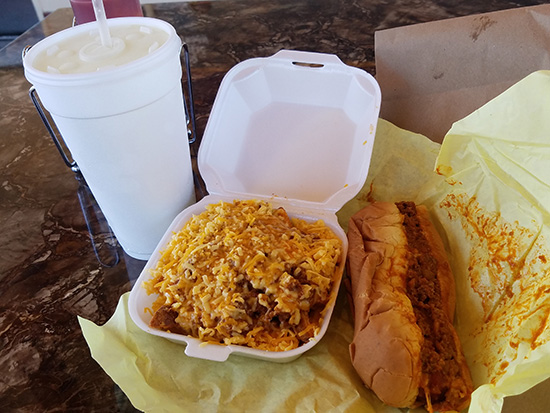
The Jordan's power trio right here: Chiller Diller (L), Chili Cheese Fries (C), Chili Cheese Dog (R).

Jordan's Hot Dogs
5960 Crenshaw Blvd, Hyde Park
Open Mon-Sat, 11 a.m. - 8 p.m.; Closed Sun

As you can see, hot dogs are a thing not just along Crenshaw but in this part of town. Just a couple miles southeast of here stood the legendary Art's Famous Chili Dogs on Florence and Normandie from 1939 until two years ago. Jordan's (which closed their doors during Art's closing day in March 2020 out of respect) carries the chili dog torch in this sector of South Los Angeles. With a far more robust menu than the specialty-based Earle's up the street, Jordan's also serves burgers, patty melts, BLTs and pastrami sandwiches. When in doubt, get the classic Harriet's Special, a chili dog and chili cheese fries combo. And if you're not already chili-cheese'd out, the Chilli Cheese Fritos are a must as well. And do try their Chiller Diller, a combination slush/ice cream shake fusion in various fruit flavors.

Woody's Bar-B-Q
3446 Slauson Ave, Hyde Park
Open Fri-Sun, 11 a.m. - 10 p.m.; Mon-Thu, 11 a.m. - 9 p.m.

It's pretty hard to beat this Southern-style pit BBQ institution that's more than worth the wait in line for. Serving up barbecue ribs, chicken, beef and links, along with the mandatory sides since 1975, every Angeleno needs to go to Woody's at least once in their life. If you're not here to pick up a massive platter for your party or gathering, then a sandwich or lunch special will still suffice, at least more than enough. 

Fairview Heights Station:

Your Bakery

6525 West Blvd, Inglewood
Open Mon-Sat, 9:30 a.m. - 7 p.m.; Closed Sun

Just five blocks up West Blvd from the Fairview Heights station is this no-frills neighborhood bakery that specializes in Bean, Cheese and various fruit (Pineapple, Blueberry, Lemon, Apple and Cherry) Pies. They also sell cakes, cookies and Monkey Bread.

Downtown Inglewood Station:

Red's Flavor Table

254 N. Market Street, Unit A, Inglewood
Open Wed-Sun, 7 a.m. - 3 p.m.; Closed Mon-Tue

For you early risers, this Louisiana/Southern breakfast establishment run by Creole chef Marilyn "Red" Wallace has got what you want and more just across Florence from the Downtown Inglewood station. There's no dine-in service; the food is take-out (you can call in your order or order online for pick-up), but there are outdoor tables for eating. Their Jambalaya Omelet is considerably-sized and can probably suffice as the only meal you'll have that day.

The Sammiche Shoppe
222 Regent St, Inglewood
Open Mon-Fri, 9 a.m. - 6 p.m.; Closed Sat-Sun

Just two blocks south of the Metro K Line station, Downtown Inglewood has their very own sandwich deli and it's pretty awesome. Home of their signature  Lucy Mae Air Fried Chicken Sammiche, their soups, salads and smoothies are also well-regarded.

Note: Downtown Inglewood has a large number of restaurants within walking distance south of the K Line station, including Inglewood branches of Hilltop Coffee + Kitchen and Dulan's Soul Food Kitchen (the main Dulan's on Crenshaw is currently closed for rebuilding/remodeling), as well as a number of African and Carribbean restaurants worth checking out.
 
Westchester/Veterans Station:


Randy's Donuts
805 W. Manchester Blvd, Inglewood
Open 24 Hours

Needs no introduction.

Mr. Fries Man

1120 W. Florence Ave, Suite C, Inglewood
Open Mon-Thu, 10 a.m. - 1 a.m.; Fri-Sat, 10 a.m.-2 a.m.; Sun, 10 a.m. - 1 a.m.

Although it's rapidly grown to a national franchised chain of 34 locations, this eatery, which specializes in loaded french fry (and The Militant means loaded) dishes had its humble beginnings just 6 years ago in Gardena. Owned by spouses-entrepreneurs Craig and Dorothy Batiste, Mr. Fries Man began in 2016 as a food truck whose loaded fries gained viral popularity via the Instagram platform. With around eight locations in Southern California, this is only one of two that are Metro-accessible (the other is their USC location on Figueroa, just south of the Metro E Line Expo Park/USC station).

Three Weavers Brewing Company
1031 W. Manchester Blvd, A-B, Inglewood
Open Mon-Thu, 3 p.m. - 10 p.m.; Fri-Sun, 12 p.m. - 10 p.m.

So you've arrived at the end of the K Line. Now what? You can't visit the airport (yet), you can't tranfer to another Metro line (yet). So what's to do out here? Well, you cross Florence Avenue at Hindry, walk one block west to Isis Avenue and have some brews at this local craft brewery with over a dozen beers on tap and enjoy them in the outdoor dog-friendly beer garden. There's no food served here but food trucks are parked outside regularly.

Whatup! Did you enjoy this food guide? Are you excited to try out some of the eateries listed here? Kindly show The Militant some support via his PayPal donation page! A Militant's gotta eat, ya know (and your support will guarantee there will be more of these food guides to come)!




Thursday, October 6, 2022

The Militant's Epic Metro K Line Tour!


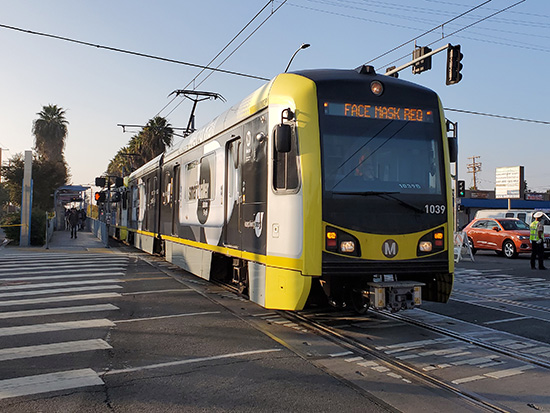
It's been an entire decade since a totally new Metro Rail line opened (The Metro Expo Line in April 2012). Since then, the game (and name) has changed - Metro is transitioning away from color names in favor of letters of the alphabet. This is the first Metro Rail line to open under the new letter-name format. So what was once known as the Crenshaw/LAX Light Rail Project and would have been known in some alternate universe as the Metro Pink Line is now the Metro K Line. K?

The new line opens on Friday, October 7, 2022 - just in time for the epic Taste of Soul food and music festival on Crenshaw next Saturday (Metro is a major sponsor). It's been a looooooong (rail) road to get to this point (the much-delayed line broke ground in 2014), and the line isn't even completed yet - only six miles will be usable starting Friday, with the line ending at the Westchester/Veterans station. The construction of the game-changing LAX Automated People Mover which crosses the K Line is the main reason for the hold-up of the last 25% of the route. So you'll have to wait until 2024 to get The Whole Shebang.


Fortunately, there's still lots of places to go, see and do on this 6.5-mile stretch of light rail, which will come in all flavors (subway, at-grade and aerial). And true to Militant fashion, The Militant Angeleno has composed another special Epic guide, this time featuring 19 points of interest along and near the Metro K Line route. Y'all get ready, K?

Expo/Crenshaw Station:


1. West Angeles Church
1999/1943
3600 Crenshaw Blvd, Crenshaw District

One of the largest and most influential African American faith communities in Los Angeles, West Angeles Church of God in Christ was founded in 1943 by Clarence E. Church, originally located in the West Adams neighborhood. Charles E. Blake, the current pastor, succeeded Church in 1969 and grew its congregation to over 24,000. West Angeles Church moved to 3045 Crenshaw Blvd in 1981, taking over a former furniture store. In 1994 the church created the nonprofit West Angeles Community Development Corporation as a community service outreach ministry, dedicated to serving at-risk youth, developing housing in the area and tending to the needs of the community's low-income and homeless residents. The current large church building, known as "the Cathedral" was built in 1999. Stevie Wonder is known to sing and play with their renowned gospel choir during Sunday services. During the week, the church also lends their parking structure to Metro for use to rail commuters.


2. Metro E Line/Santa Monica Air Line
2012
Exposition and Crenshaw boulevards, Los Angeles

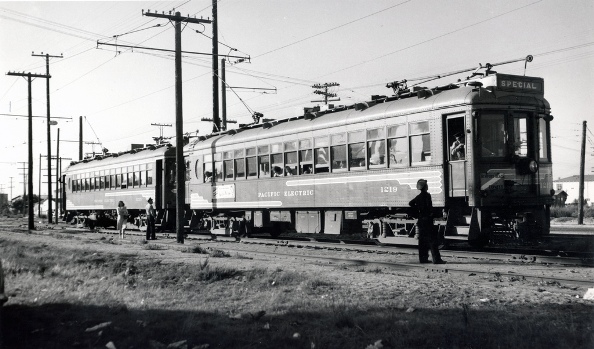
The last new line to open, the Metro E Line (a.k.a. The Metro Light Rail Line Formerly Known As the Expo Line), opened to similar fanfare a decade ago (and The Militant thusly made a similar Epic Guide to that line). As you may or may not know, the line was a Pacific Electric line in its past life (1909-1953) as one of four Red Car lines between Downtown Los Angeles and Santa Monica. Though of the four, it was the least-used (and had limited service due to it doubling as a freight line to serve various industries en route), it was the fastest one from Downtown to the ocean. A little bit of the Metro E Line's Pacific Electric history is reflected in the station art - look at the old Santa Monica Air Line map artwork on the floor of the station platforms.


3. Obama Boulevard
2019
Obama Boulevard between Martin Luther King Jr. Blvd and Gramercy Pl

Originally named Rodeo Road in 1911, presumably to honor the history of cattle ranchers of the area, most specifically those of nearby Rancho La Brea. After living in the confusing shadow of the more opulent Rodeo Drive in Beverly Hills since the 1920s, the street was officially re-named and re-dedicated "President Barack Obama Boulevard" in a public ceremony and festival on May 4, 2019, in honor of the 44th (and first African American) president of the United States, who made one of his first presidential campaign appearances at Rancho Cienega Park on February 20, 2007. The street is nestled south of Washington, Adams and Jefferson boulevards, and intersects with Martin Luther King Jr. Blvd. It joins 16 other thoroughfares nationwide named after Obama.


4. Ken Clark Pontiac/Majestic Pontiac Sign
1952
3740 Crenshaw Blvd, Crenshaw District

Although Crenshaw supported a streetcar line south of Vernon, the thoroughfare north of it had always been auto-centric in nature and design. From the late 1930s to 2000, The 'Shaw was once home to an auto row, boasting car dealerships such as Crenshaw Ford, Harry Mann Chevrolet (once the largest Corvette dealer in the US), O'Connor Lincoln-Mercury and Peterson Oldsmobile. The last of the lot, so to speak, was Majestic Pontiac, at Crenshaw and Coliseum. Originally Ken Clark Pontiac from 1952 to 1960, the business was sold and became Majestic Pontiac. The dealership's telltale neon sign with the Pontiac Indian logo was an icon on the boulevard, much like how Felix Chevrolet's cartoon cat smiles over Figueroa today. The dealership closed for good in 2000 and the lot was converted into a shopping center soon afterward. But the original 1952 sign still remains, Pontiac Indian head intact, this time adapted to bear the signage of Big 5 Sporting Goods and Goodwill Industries.


5. Black Dahlia Body Site
1947
3825 S. Norton Ave, Crenshaw District

On the morning of January 15, 1947, the mutilated body of 22 year-old waitress Elizabeth Short, a.k.a. "The Black Dahlia" - the victim of arguably the most famous unsolved murder case in Los Angeles history - was discovered on this site (at the time an empty lot; the house was not built until 1956) by a local woman walking with her young daughter. Short, a transplant from Boston who was reportedly an aspiring actress, was missing the week prior to the discovery of her body, and the case garnered national headlines due to the gory details of her murder. The LAPD's investigation yielded over 150 suspects but no arrests. The cultural intrigue surrounding Short's death became a huge influence on the 1940s 'Los Angeles Noir' phenomenon.

Martin Luther King Jr. Station:


6. Baldwin Hills Crenshaw Plaza
1947
3650 Martin Luther King Jr Blvd, Crenshaw District

Originally known as the Broadway-Crenshaw Center, it opened on November 21, 1947 as one of the first auto-centric regional shopping centers in the US. The Streamline Moderne shopping center, designed by Albert B. Gardner, was home to a 5-story Broadway department store, a Vons supermarket and a Woolworth's discount store. In 1949, a Silverwoods clothing store opened, and the landmark bridge over MLK (then known as Santa Barbara Avenue) was built to connect with the existing 1947 May Company building on the north side of the street. Today's version of the shopping center came about during a late 1980s remodel.


7. Sanchez Adobe
1791
3725 Don Felipe Drive, Baldwin Hills

In the streets behind the Baldwin Hills Crenshaw Plaza stands what may or may be the oldest building in Los Angeles. The crown was long believed to belong to the 203 year-old 1818 Avila Adobe on Olvera Street, but further historical research in 2012 revealed that this structure, originally part of Rancho La Cienega o Paso de la Tijera, dates back some 50 years prior to when it was deeded to Don Vicente Sanchez in 1843, making it around 230 years old.  The building was later owned by Baldwin Hills' namesake Elias Jackson "Lucky" Baldwin, who brought freed slaves to work in his homestead after the Civil War. The historic structure - 30 feet wide and two stories tall - has been integrated into a large single-story building built in 1927. It is currently home to Agape Church of Los Angeles.

Leimert Park Station:


8. African Marketplace & Drum Circle (Sundays)
c. 2010
Degnan Blvd between 43rd Street and 43rd Place, Leimert Park

What can The Militant say about Leimert Park? The heart and soul of Los Angeles' African American community can warrant an Epic Guide of its own. From iconic institutions like the Barbara Morrison Performing Arts Center to the jazz-centric World Stage to Eso Won Books, to the eponymous city park that has been the site of countless celebrations, rallies, demonstrations and memorials over the years,  where the annual Kingdom Day Parade on Martin Luther King Jr. Day ends up. It's what the late filmmaker and Los Angeles native John Singleton once described as "The Greenwich Village of  L.A.'s Black Community." The true flavor of Leimert Park happens every Sunday from 10 a.m. to 5 p.m. when Degnan Boulevard is transformed to an outdoor street market which had its origins in the annual Labor Day weekend African Art & Music Festival which lasted from the early 1990s to 2009, and then soon evolved into the weekly bazaar which features African and African American clothing and craft vendors and Southern, African and Jamaican food stalls. And there's a drum circle too.


9. Site of 1932 Olympic Village
1932
Mt. Vernon and Olympiad drives, View Park

The site of the first Olympic Village in the modern Olympic era was located right here in the Baldwin Hills. Some 1,836 male athletes representing 56 nations resided in this oval-shaped temporary community during the Games of the Xth Olympiad, living in 550 (24x10') O.G. Tiny Houses designed by H.O. Davis (the women stayed at the old Chapman Park Hotel in Mid-Wilshire). The $500,000 village also featured dining halls, a movie theater, a radio station, post office, medical and dental facilities and an administration office. After the games, the portable O.G. Tiny Houses were quickly sold for $140 each (that's $3,047 in 2022 dollars - not bad at all!) or $217 with furnishings (that's still $4,648 today - still a bargain) - a hot item during the Great Depression. One of the O.G. Tiny Houses can still be seen on Olvera Steeet.


10. Angeles Vista Boulevard
Angeles Vista Blvd, View Park

If there's ever a street in Los Angeles that truly lives up to its name, it's this one. From the Leimert Park Station, head up Olympiad Drive, follow the road fork left onto Angeles Vista Blvd, and walk up to the desired height. Then turn around 180 degrees and you'll see a sweet view of the Downtown Los Angeles skyline.


11. Destination Crenshaw
2023
Crenshaw Boulevard corridor between Leimert Park and Hyde Park

A unique 1.3-mile outdoor art gallery featuring permanent and temporary works, integrated with pocket parks, street furniture and landscaping makes up Destination Crenshaw. Designed by Zena Howard, the project, slated to open in 2023, will highlight the art, stories, creative energy and rich African American and African cultural heritage of the Crenshaw Corridor. The focal point of this linear art project is the triangular Sankofa Park, sandwiched between Vernon Avenue and the northern tunnel portal of the Metro K Line, where many of the structures of Destination Crenshaw are already visible.  


12. L.A. Railway 5 Line Right Of Way
1902-1955
Crenshaw Blvd between 48th and 67th streets

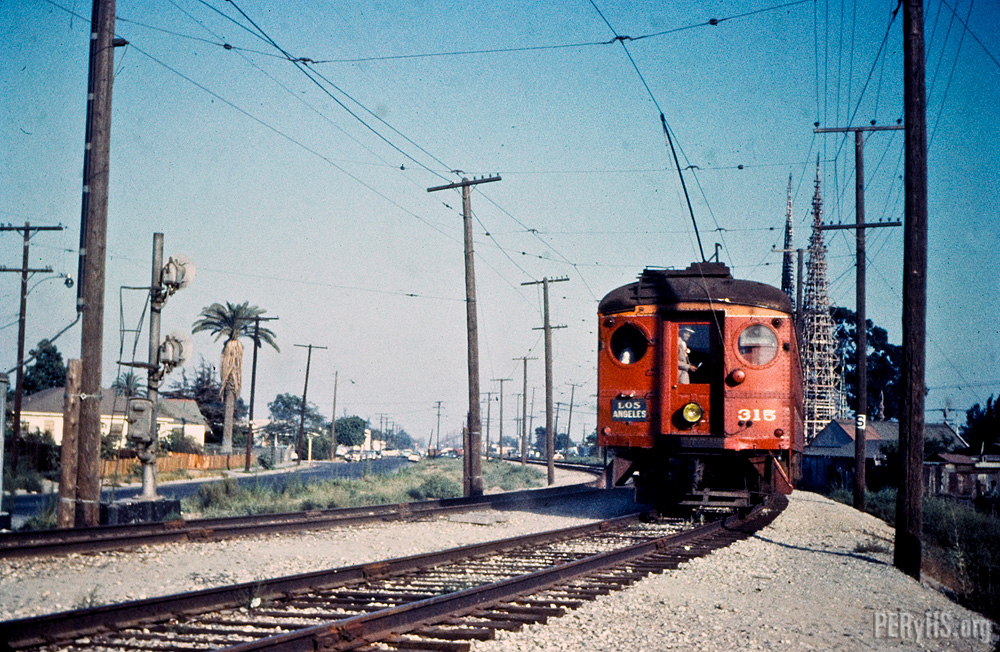
Like its older sibling the Metro E Line, the Metro K Line also has historic rail transit heritage through most of its route. From 1902 to 1955, the Los Angeles Railway (later Los Angeles Transit Lines) operated the 5 Line between Eagle Rock and Hawthorne (via Downton Los Angeles), the longest in its system. It is one of the main reasons for Crenshaw Boulevard's large width, which help allowed it to accommodate a modern light rail line today. Today's K Line runs along the same alignment as the 5 Line from Leimert Blvd's termination at Crenshaw Blvd down to Market Street in Inglewood, where it veered south down La Brea Avenue and Hawthorne Boulevard. Pictured is a 5 Line car in 1954 at Crenshaw and 54th Street.

Hyde Park Station:


13. Nipsey Hussle Square
2019
Crenshaw Blvd & Slauson Avenue, Hyde Park

No single person is more representative of this Hyde Park neighborhood than the late rapper Ermias "Nipsey Hussle" Asghedom. A native of the area, he joined the local Crips-affiliated gang in his teens, but experienced a cultural awakening after his father took him on a trip to his native east African country of Eritrea. He left the gangsta life to become a rapper in the mid-2000s and the rest is history. He opened his own clothing store, The Marathon, on 3420 Slauson and had designs to not only own more businesses and property in the neighborhood, but to empower local youth to work and eventually become local entrepreneurs themselves. But that history ended on March 31, 2019 when Hussle was shot and killed at age 33 in his store's parking lot by an acquaintance with a personal beef. The store and the adjoining mini-mall remain closed but fans and friends have turned the sidewalk along Slauson into a mini-street bazaar selling Nipsey Hussle-based clothing and merchandise. The rapper has also been immortalized in several murals within a one-mile radius of the intersection, notably Auto Tech Collision Center (3475 Slauson - Pictured), Fatburger (5817 Crenshaw), U.S. Bank (5760 Crenshaw), a residential wall (5951 Brynhurst Avenue) and a large basketball court-sized mural on the parking lot of Crete Academy/St. John the Evangelist Catholic Church (Crenshaw & 60th Street). The Marathon Continues...

Fairview Heights Station:


14. Aguaje de Centinela (Centinela Springs)
1837
600 Park Ave, Inglewood (Next to Willie Agee Playhouse at Edward Vincent Jr. Park)

A natural artesian spring known to have been flowing since the Ice Age on this very site was the namesake of the Mexican-era rancho (Rancho Aguaje de la Centinela) that existed before Canadian-born land developer Daniel Freeman named it after his hometown in Ontario. The springs hydrated wooly mammoths, saber-toothed tigers, the indigenous Tongva people, Mexican ranchers and American farmers and settlers. The stone monument to the spring, erected in 1939 stands today, adjacent to a monument signifying the springs' status as a California Registered Historical Landmark (#363). A working fountain with water basins was once incorporated as part of the monument but it was shut off in the 1970s. The spring still functions, albeit underground.


15. Inglewood Park Cemetery
1905
720 E. Florence Ave, Inglewood

This 200-acre memorial park was once the largest cemetery in California. And when the Los Angeles Railway's 5 Line ran just outside its gates, they even had their own funeral car for those who wished to take that one last trolley ride into eternity (the mission-style structure near the northwest corner of the cemetery was once an L.A. Railway power substation). Notable rest-idents here include Los Angeles Mayor Tom Bradley, music legends Ray Charles and Ella Fitzgerald, boxing legend Sugar Ray Robinson, architect Paul R. Williams, actors Cesar Romero and William "Buckwheat" Thomas, actress Betty Grable and O.J. Simpson trial lawyers Johnnie Cochran and Robert Kardashian. The Militant featured Inglewood Park Cemetery on This Here Blog in November, 2011.

Downtown Inglewood Station:


16. Market Street Shopping District
1908
Market Street between Florence and La Brea avenues, Inglewood

Inglewood's "main street" since its incorporation in 1908, Market Street (which carried the L.A. Railway's 5 Line tracks south after diverging from its Florence Avenue right-of-way) saw its heyday between the 1920s and 1940s. After suffering a decline period between the 1960s and 1990s, it's since been beautified and rejuvenated with various specialty stores, restaurants, cafes and art galleries. Though the "G-Word" is a concern due to the arrival of the Metro K Line, nearby SoFi Stadium and the future Intuit Dome, the number of existing and successful community-owned and Black-owned businesses in the Downtown Inglewood area might just keep the worst fears at bay. If you want to see a small-town Main Street vibe near the Metro, then Market Street is the place.


17. The 405 Freeway
1961
405 Freeway at Manchester Avenue

You know The 405. Nothing to see here, except to take the opportunity to look out the window and marvel at all those cars stuck in traffic, while you're not in it.

Westchester/Veterans Station:


18. Westchester Playhouse

1960
8301 Hindry Avenue, Westchester

This former warehouse building was transformed into a 112-seat live theater venue thanks to the renowned theater company The Kentwood Players (billed as "L.A.'s Most Professional Amateur Theater Group"). Where else can one see community theater at an affordable price (tickets are in the $20 range), accessible by the Metro?


19. Randy's Donuts
1952
805 W Manchester Blvd, Inglewood

It's as iconically Los Angeles as an Original Tommy's chiliburger, a Philippe French Dip, a Langer's Pastrami Sandwich and an El Tepeyac burrito. It's a big-ass concrete-and-steel donut by the freeway, what more can you ask? What started out in 1952 as a local branch of the Big Do-Nut chain (known for big-ass donuts on their roofs) designed by Henry J. Goodwin, it became known as Randy's (the son of the shop's first owner, Robert Eskow) in 1976, and the rest is history. Today, the 24-hour donut icon has grown to a dozen locations in Southern California, plus one in Las Vegas, and locations in South Korea, Saudi Arabia and the Philippines.

...that's it for now. As far as this train goes.

There are two stations still under construction - LAX/Metro Transit Center (opening 2024) which will interface with the long-awaited LAX Automatic People Mover, and the Aviation/Century station (opening 2023). The Militant will update this post when the line is fully completed. Until then, get your Kicks on the K Line!

RELATED: Wanna know where to eat along the new Metro K Line? The Militant has a few recommendations.

Whatup! Did you enjoy this post? Did you learn something new from it? Kindly show The Militant some support via his PayPal donation page! A Militant's gotta eat, ya know (those MRE Rations don't exactly get glowing Yelp reviews...)!

Extra special thanks for your support:

Margaret Wehbi
Daniel Pouliot

Wednesday, August 12, 2015

Happy 20th Birthday, (M) Green Line!

That's A Wrap: The Green Line, wearing a promotional wrap reading, "Metro Green Line Open Summer '95." was the first line to feature wrapped rail cars.
Twenty years ago today, Bill Clinton was president, Richard Riordan was mayor, most of us kind of started recovering from the Northridge Earthquake, Michelle Pfeiffer's Dangerous Minds was the #1 box office hit, and TLC warned everyone to not go chasing Waterfalls.

And the Metro Green Line opened on a warm, sunny Summer Saturday.

Truth be told, The Green Line is probably the overlooked middle child of the entire Metro Rail system (which is celebrating its 25th anniversary this year, BTW...). It lacks the edginess and maturity of the Blue Line, lacks the heavy crowds and underground nature of the Red Line, and unlike the Purple, Expo and Gold lines, doesn't take people to interesting places like K-Town, the Westside or Pasadena and the Eastside, respectively.

The line was given the designated color of green to reflect the green freeway signage along the 105 Freeway, which it runs down the center of, and to represent the "green" environmental concession that created the rail line to the communities impacted by the construction of the freeway during the early 1980s to early 1990s.

The Green Line also never lived up to its planned expectations: Inspired by Vancouver, Canada's SkyTrain, it was supposed to be the first fully-automated driverless rail transit line in the United States. But the transit workers' unions cried foul, and the driverless plan was eventually dropped.

It was also supposed to serve the suburban gateway communities of southeastern Los Angeles County with the aerospace industry jobs of El Segundo...only to see the Cold War end just as the concrete was starting to get poured, which is the main reason why it's been dissed as "The line to nowhere." And we all know it was supposed to serve LAX at some point, what with the large concrete structure next to the Aviation Station veering northward (which will finally see use once the Crenshaw/LAX Line opens in 2019).

So, sympathizing with overlooked middle children everywhere (Or maybe The Militant is just saying that to hide the fact that he wasn't a middle child), The Militant is dedicating today's blog post to the Metro Green Line's grand opening 20 years ago today!

It was the first Metro Rail grand opening The Militant attended via Metro Rail; he may have driven to  an unspecified free parking spot in DTLA (it no longer exists, sorry), and taken the Red and Blue lines to the Imperial Station (now called the Willowbrook or Rosa Parks station), where the Blue and Green lines met.
MTA CEO Franklin White speaks at the dedication ceremony. And there were balloons.
There they had a dedication ceremony at the park & ride underneath the 105 Freeway with all of them dignitaries, and they had these large colored balloons strewn above the podium area.

The Militant distinctly remembers there was a small Bus Riders Union protest there and he even got into a little debate with a privileged wannabe-Marxist white guy BRU lackey who was trying to proselytize to The Militant -- a person of color of unspecified ethnicity -- that Metro Rail was somehow racist. Yes, the Green Line, which serves lily-white, wealthy communities like Lynwood, Willowbrook and South Los Angeles. Really now. At some point The Militant asked Privilege Boy a "gotcha" question and he couldn't give an answer. Ooh, moted, sucka!

Anyways, the speeches were done and we all got in the long-ass line, up the stairs to the platform to ride the train.

Always a joy to finally see the train come after waiting in line on Opening Day.
The trains looked exactly the same as the Japanese-made vehicles on the Blue Line. In fact, the trains made their home at the Blue Line's yard near the 405 in northern Long Beach for a couple years before the Green Line got its own yard facility a few years later.

Also, the cars were packed, mainly because for the first few years due to a lack of cars (and lack of riders), the Green Line ran single-car trains. It wasn't until sometime in early 1997 when the new, rounded Siemens P-2000 vehicles entered Green Line service and the line finally had two-car trains.

Back then you can have a clear view to the front window.
The Militant and his accompanying operatives rode their first Green Line train from the Imperial station to the "I-105/I-605" station (now just called the Norwalk station).

There, there was basically nothing, except a small fair at the Park & Ride lot where he got some free Metro Rail swag. But then it was straight back in line to the train going the other direction.

Nothing to see here in Norwalk really.
The Green Line has been criticized for not going all the way east to link with Metrolink's Norwalk station, which would have been a real awesome thing and connected commuters to places like Orange County and the Inland Empire, but all of the plans and funding for the Green Line was already in place by the time Metrolink was first conceived in 1990, and opened just two years later.

We're in El Segundo! Please check if you didn't leave your wallet behind!
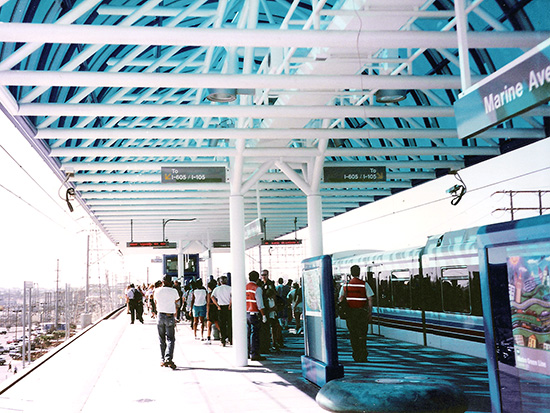
After some monotonous riding in the middle of the Century Freeway, it was time to head to the western section of the line, which The Militant was waiting all day to see. It was nice, sleek, elevated, almost monorail-like, passing over a bunch of sprawling business parks with well-manicured landscaped lawns.


These futuristic-looking stations look like you're in a toy or something.
We arrived at the Marine Avenue station, now called "Marine/Redondo Beach," in the extreme northeastern reaches of Redondo Beach -- you can smell the sea, and feel the sea breeze, but you still can't see the sea (unlike in Mar Vista...). How deceptive. The Militant wanted his King Harbor freshly-boiled crab NOW!
The end of the line, then as it is now.
It was time to head back to the Blue Line. There wasn't much to see here either, though there was a cool burger joint just a block or so away on Marine. And then there was the end of the line, a yellow bumping post to keep trains from falling off some 40 feet below. Twenty years later, though there's talk of extending the Green Line to the South Bay, there are currently no solidified plans to extend it in either direction.

Today the Green Line is the 5th busiest line in the Metro Rail system, carrying some 39,000 riders each weekday. Despite what it never became, it was the first rail transit line in the United States to go from suburb to suburb, avoiding the city center. It was the first Metro Rail line to open in its entirety, with no future phases or extensions to follow. It was also the first light rail line in the Metro Rail system to be totally grade-separated (and the only light rail line on the Metro to have zero automobile collisions!). The Green Line also had the first "wrapped" rail vehicles on the Metro Rail system, and though it was never automated, it was the first Metro Rail line to use the automated station call announcements, which are standard systemwide.

If the Metro Rail system map is an upside-down stick figure, The Green Line represents the arms. And you can't do too much without arms, so let's give props to the Green Line on its 20th birthday today! Happy Birthday, Metro Green Line!

Tuesday, July 14, 2015

The Militant's 25th Anniversary Ultimate (M) Blue Line Tour!

Happy 25th Birthday, you Millennial, you!
Today marks the 25th Anniversary of Los Angeles' Metro Rail system, which began with the July 14t, 1990 opening of the Metro Blue Line, Los Angeles County's first modern train transit system, and the first rail line to serve the area in nearly 30 years.

You may or may be familiar with The Militant's Angeleno's award-winning Epic CicLAvia Tour posts, highlighting various points of interest along the various open streets routes, but did you know The Militant has done the same for the Los Angeles-to-Pasadena Metro Gold Line and the Metro Expo Line?

This time around, to celebrate a quarter century of Metro Rail, The Militant offers his Epic 25th Anniversary Metro Blue Line Tour, which points out historic, surprising, and off-the-beaten-path locations on or very near our first light rail route. Even if you've been a regular Blue Line commuter for the past 25 years, if you think you know the Blue Line, guess again!


1. 7th St/Metro Center Countdown Clock
1993
7th St./Metro Center Station,  Downtown Los Angeles

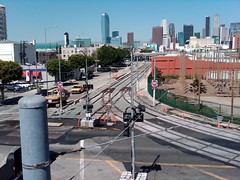
Riders waiting at the outbound platform at the 7th Street/Metro Center station may or may not have noticed a peculiar digital countdown clock situated on a pole in the middle of the tracks. It seems to count down regardless of whether there’s a train or not. What is it for?

In 1993, to speed up Blue Line travel times, the street signals along Flower Street and Washington Blvd. were synchronized to give priority to light rail trains along those streets. This timer clock allows train operators to time their exact departures in accord with the street signal synchronization, so that when the white light under the clock is lit and the train begins to depart under normal operating speed, the train will encounter a continuous series of green lights.

2. Pico Station
1990
Pico and Flower Streets, Downtown Los Angeles

Pico Station is where it all began; it was the first operational station in the history of Metro Rail. The station was the site of a public dedication ceremony kicking off the opening of the line (See The Militant's exclusive archived video of the event here). The Blue Line on opening day in 1990 was somewhat shorter than the line we ride today. For the first two months of operation, the Blue Line only ran from Pico Station to the Anaheim St. Station.

Back then, it was just located in a far-flung region of Downtown. It wasn’t until the late 1990s when the Staples Center was built that the South Park section of Downtown started to become revitalized. Today, the recent upgrades of the Blue Line stations have also given the station a minor facelift.

The station also has the shortest name of any Metro Rail station in the entire system (Well, okay, it's tied for 1st place along with Soto and Lake).

3. Flower Junction
2010
Flower Street and Washington Blvd, Downtown Los Angeles

The first surface-level "junction" track that switches trains among the Blue and Expo lines is located here. A few months after the Expo Line opened, the California Public Utilities Commission ordered Metro to replace a section of rail within the switch track that would potentially cause derailments.

The other junction track on the Metro Rail system is the one north of the Wilshire/Vermont subway station. Future junction tracks will be built west of the Metro Green Line Aviation Station (serving the Green and Crenshaw lines) and another switch track as part of the Regional Connector under Little Tokyo.

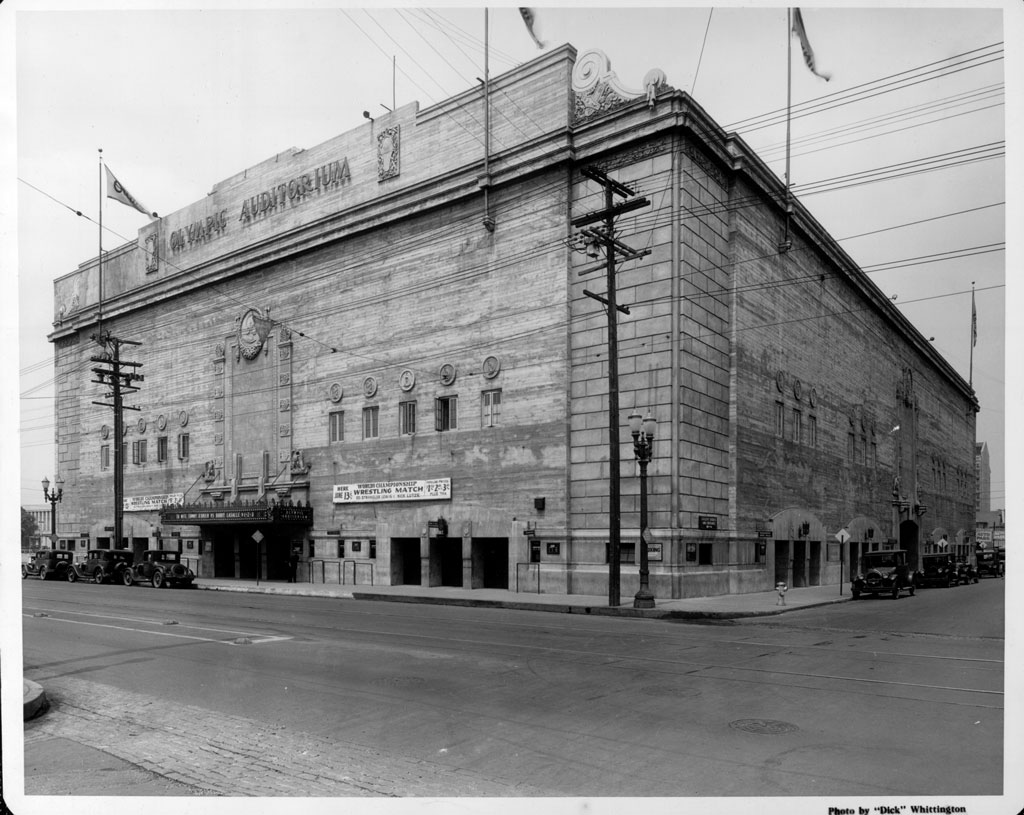
4. Olympic Auditorium
1924
1801 S. Grand Ave., Downtown Los Angeles

This historic venue through the years, easily seen from the nearby Blue Line Grand station, has hosted boxing matches (including the boxing competitions for the 1932 Olympic Games), wrestling bouts, roller derby events and concerts. The match sequences from the original Rocky movie was filmed here, as well as Bon Jovi's "Livin' On A Prayer" and Janet Jackson's "Control" music videos.

For the past decade the venue has been owned by a Korean Christian Church known as Glory Church of Jesus Christ (hence the large Jesus mural on its south wall).

5. Site of Washington Park and Chutes Park
1893
Washington Blvd and Hill Street, Downtown Los Angeles

The first permanent baseball field in Los Angeles isn't Dodger Stadium, nor was it South Los Angeles' Wrigley Field nor the Fairfax District's Gilmore Field. It was here at Washington Park, located near Washington and Hill, where the Pacific Coast League Los Angeles Angels of Los Angeles played from 1893 to 1925 (the first Washington Park stood from 1893 to 1912; the second was in use from 1912 to 1925. It was torn down in the 1950s. William Wrigley, the team's owner, left Washington Park after he was denied permission to build an underground parking garage. He then moved his Angels to his own Wrigley Field in 1925. Washington Park it was also one of the home venues of the USC Trojans football team before the Coliseum. Adjacent to Washington Park was an amusement park named Chutes Park that stood on the land where the municipal courthouse now stands.

6. Tacos El Gavilan/Site of 1st McDonalds in Los Angeles
1957
1900 S. Central Ave, South Los Angeles

What is currently a taco stand at the southeast corner of Central and Washington was once the first McDonalds in the city of Los Angeles (and the 11th McDs in the entire chain) which opened in 1957. As you may or may not know, McDonalds originated in San Bernardino in 1940 by the McDonald brothers, and was later taken over by Illinois businessman Ray Kroc, who turned the unique Southern California hamburger chain into the gargantuan unhealthy corporate chain we know today. The trademark side arches were present on this building (and a single arch present on the corner sign) up until the early 2000s. But hey, tacos are more healthy for you than McDonalds junk, so eat up.

7. Washington Blvd Buddha
c. 1941
1600 E. Washington Blvd, South Los Angeles

On your southbound Blue Line ride, look to the right just before the train curves towards the Washington Station and look for the "Hanson Tank" sign. To the left of the sign, and right above the main doorway is a tiny cubby-hole featuring a Buddha statue. Years ago, a Militant Elder told The Militant Angeleno that the buddhas were placed there to give Japanese Buddhists a clandestine place to worship after December 7, 1941. The Militant covered this location in an early MA blog post in October 2007.


8. Washington Tail Track
1989
Washington Blvd and Long Beach Avenue, South Los Angeles

Due across the street and due north of the Blue Line's Washington Station, there's a stretch of track that diverges from the Blue Line route that seems to head off into oblivion. The track is one of several along the Blue Line route that function as an emergency storage track for broken trains or so-called "gap" trains to replace trains that have been taken out of service due to technical issues.

The tracks follow the original Pacific Electric 4-track "speedway" alignment that led to the Pacific Electric Building at 6th and Main streets in Downtown Los Angeles. In fact if you follow the Washington Tail Track north to 16th Street, you can still see the old Pacific Electric tracks partially buried under the pavement!

The Washington Tail Track is rarely used nowadays, though in March the track was used to temporarily store the new Kinkisharyo light rail vehicle which was being tested on the Blue and Expo lines at the time.

9. Amoco Junction
1904 (discontinued early 1980s)
Long Beach Ave., south of 25th Street, South Los Angeles

About 6 blocks south of the Washington Station, look to your right and you'll see tracks in the street mysteriously end at the fence that protects the Blue Line tracks. Look westward and you'll see an abandoned rail right-of-way. That was, until 1958, the Pacific Electric Air Line trackage which went all the way to Santa Monica (and until the early 1980s as Southern Pacific freight track), and functions today west of Figueroa Street as the Metro Expo Line. During the Pacific Electric era, the Downtown-bound trains from Santa Monica headed all the way to Amoco Junction (named after the American Olive Company factory nearby) to join the 4-track "Speedway" trunk line and head north.

10. Site of South Central Farm
1994 (demolished 2006)
41st St between Long Beach Ave and Alameda St, South Los Angeles

This large, empty plot of land just east of the Blue Line tracks, a half-mile north of the Vernon Station was home to the 14-acre South Central Farm run by community members between 1994 and 2006. Acquired by the City of Los Angeles in 1986 via eminent domain from private landowners, it was originally slated for use as an incinerator site, a plan dropped due to community opposition. The City allowed the neighboring nonprofit Los Angeles Regional Foodbank to run the site as a community garden. Over 300 low-income families from nearby communities turned the land into one of the largest urban farming projects in America over 12 years. But in 2001, the land's former owner sued the City for breach of contract, because the incinerator plant was never built. Eventually the City settled with the landowner in 2003 and they began the process of re-claiming the plot, eventually evicting the farm in 2006. To this day, the land lies vacant.

The controversy attracted the support of various celebrities, public officials and philanthropic organizations, including a failed attempt by The Annenberg Foundation to purchase the land, but it did galvanize the community and led to the rise in urban farming activism, especially in the South Los Angeles area.

11. Augustus F. Hawkins Natural Park
2000
5790 Compton Ave, South Los Angeles

A few blocks west of the Blue Line's Slauson Station lies one of the best-kept secrets in South Los Angeles -- Augustus F. Hawkins Natural Park, an 8.5-acre surreal green oasis in the 'hood, featuring ponds, native plants, hiking trails, picnic areas and even wildlife. This former DWP pipe yard was converted into a re-created natural park, named after the late African American congressman who represented the area for 28 years, in 2000 by the Santa Monica Mountains Conservancy, which trucked in actual dirt from Malibu mudslides to the site to form the park's terrain. The park is popular with local residents seeking refuge from urban life, and the park is also popular with members of the local Audubon Society, who frequent the park to do bird sightings and bird counts.

12. Slauson Junction
1904
Slauson Ave and Randolph St, South Los Angeles

When passengers rode the Blue Line for the first time in July 1990, they were thrilled to have the train suddenly shoot up the elevated structure, with a towering view of the area below as the train stopped at the Slauson Station. While stopped here, you can see a piece of the Blue Line's Pacific Electric heritage by just looking to the east: The unmistakable curved "wye" tracks heading eastward formed another major junction to the PE's Long Beach Line trunk, as the place where trains bound for Fullerton, La Habra and Whittier diverged from the quadruple-tracked "Speedway."

Francis Nixon, the father of President Richard Nixon, was once a Pacific Electric motorman who navigated his Whittier-bound trains through this very junction.

13. Col. Leon H. Washington Park
8908 S. Maie Avenue, South Los Angeles

There are many parks that line the Blue Line route, but this one is unique for two reasons. As you head southbound and depart the Firestone Station, look immediately to your right and you'll see a park and recreation center. It's a Los Angeles County-run park called Colonel Leon H. Washington Park, named after the founder of the Los Angeles Sentinel newspaper (originally called The Eastside Shopper), the city's premier publication in the black community. The other reason is that the rec center here is a popular spot for NBA stars such as Kobe Bryant, Lebron James, Kevin Durant and others to play pick-up games and compete in the Nike-sponsored Drew League, a weekend summertime program where the biggest stars in basketball play with and against locals from the community.

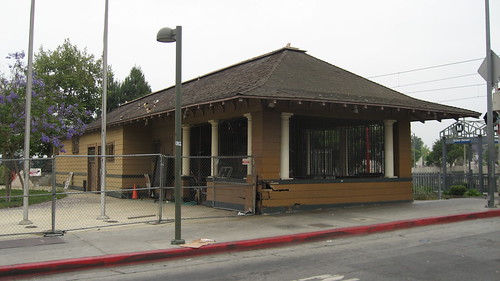
14. Watts Pacific Electric Station
1904
1686 E. 103rd Street, Watts

Adjacent to the Blue Line's 103rd St/Watts Towers station is a mustard-colored building that was once the Pacific Electric's Watts depot. A popular stop along the old PE Long Beach Line, the building survived not only the PE's abandonment, but was the only wooden structure that was not set on fire during the 1965 Watts Riots. After a renovation project in the 1980s, the Watts Station has functioned since 1989 as a Los Angeles Department of Water and Power customer service center.

15. Dominguez Junction/Watts Towers
1903
Graham Ave and 105th Street, Watts

In the Pacific Electric era, this junction, where the overhead pedestrian bridge is located today, marked the end of the four-track "Speedway" which had express trains from 9th and Hooper streets in Downtown Los Angeles go to/from Watts in the center tracks, while the outer tracks handled local stops Dominguez Junction is where trains along the Long Beach trunk line headed west to Torrance, southwest to San Pedro and southeast to Santa Ana via Bellflower.

Directly adjacent to the former Santa Ana tracks are the famed Watts Towers, built by Italian immigrant Simon Rodia (who actually called his sculpture "Nuestro Pueblo") between 1921 and 1954. There is definitely a direct relationship to the Pacific Electric: Rodia used the rails on the PE Santa Ana tracks as a fulcrum to bend his steel bars into shape, enabling him to build his masterpiece.

16. Metro Rail Operations Center/Connector Track
1990
Willowbrook Ave at the 105 Freeway, Willowbrook

At the nexus of the Blue and Green Lines, just east of the Willowbrook Station is Metro's Rail Operations Center (ROC), where all of the 87-mile rail system's signaling, dispatching and security systems are manned and monitored. The building also houses a Los Angeles County Sheriff's Department station, as part of their Metro system security operations.

Adjacent to the ROC is a non-revenue connector track that allows light rail vehicles to transfer between the Blue and Green lines for emergency or service purposes. The single track also allows light rail vehicles based out of the Metro Green Line yard in Torrance to move to the Long Beach yard, which houses a paint shop and heavier maintenance facilities. But in case you're wondering, the track is not equipped to handle revenue service from, say Long Beach to Redondo Beach.

The Willowbrook Station is due for a major renovation in the near future.

17. Blue Line Farmers' Market
2013
275 N. Willowbrook Ave, Compton

If you're a regular Blue Line commuter and need your fill of fresh, locally-grown produce, get off at the Compton Station on Thursdays from 3 to 7 p.m. and visit the weekly certified Blue Line Farmers' Market. Started in September 2013 to combat food desert concerns in the local community, the market has become a hit with locals and commuters alike.

There are currently 24 weekly certified farmers' markets at or near Metro Rail stations, visit them regularly!

18. Compton Creek and Rancho Dominguez Adobe Museum

The first waterway the Blue Line crosses isn't the Los Angeles River, but one of its tributaries, Compton Creek. You can see the 8-mile stream before approaching the Artesia Station and immediately east of the Del Amo Station. Be on the look out for horses, as there's an equestrian trail alongside it. The equestrian and cowboy culture of Compton actually predates its street gang reputation by several decades, and in fact lives on today in the form of a youth equestrian program called the Compton Jr. Posse.

Also located along Compton Creek, midway between the Artesia and Del Amo Stations east of the Blue Line tracks is the Rancho Dominguez Adobe Museum, highlighting the Spanish-era land grant roots and early California history of the Compton and Carson areas. Worth a bike ride from either of those stations!

19. Alameda Corridor
2002
Along South Alameda Street

Midway between the Artesia and Del Amo Stations is what appears to be a highway, which is actually Alameda Street. adjacent to it are a set of railroad tracks -- both the street and the tracks form the Alameda Corridor, a ground transportation system opened in 2002 that allows trucks and trains to easily access the Ports of Los Angeles and Long Beach -- important gateways for importing and exporting for not just Southern California, but the entire United States. Toys from China and cellphones from Korea pass through the Alameda Corridor in the form of intermodal shipping containers en route to Chicago or other U.S. destinations. The corridor began construction in 1997 as a way to consolidate the Union Pacific and BNSF railroads onto a unified, high-capacity, mostly grade-separated track to and from the port area. North of here, the tracks run in a trench alongside Alameda Street to railroad yards  southeast of Downtown Los Angeles.

20. Blue Line Yard
1989
4350 E. 208th St., Long Beach

Sandwiched between the 710 Freeway and the Los Angeles River is the Metro Blue Line Yard and Shops, otherwise known as Metro Division 11. It is here where Blue and Expo Line cars make their home and are cleaned, painted and serviced. Cars from other light rail lines also visit this yard for work that can't be performed at their respective home yards. Blue Line trains also stop near the yard regularly on a mini-platform to allow operator crew shift changes.

21. Pacific Electric Abutments
1901
East Bank of Los Angeles River, North Long Beach

As soon as your Long Beach-bound Blue Line train crosses the Los Angeles river, look to the right side of your train and you'll see about four concrete abutments next to the tracks. Those were part of the Pacific Electric Long Beach Line infrastructure -- the abutments supported the old Long Beach Line bridge that crossed the Los Angeles River.

22. North Long Beach Junction
1904
Long Beach Blvd, north of Willow Street

Look to the left after your train leaves the Willow Station and you'll easily see the now-paved-over right-of-way that diverged from here that formed Pacific Electric's Newport-Balboa Line, which reached the PE's southernmost point in Balboa Island. The line today supports parks and bikeways, as well as this bridge in Long Beach that still exists today, which The Militant covered in 2011.

23. Long Beach Loop
1990
Long Beach Blvd, 1st Street, Pacific Avenue and 8th Street, Downtown Long Beach

The first "extension" of the Metro Blue Line opened in September 1990 when the Long Beach Loop was completed, allowing Blue Line trains to run in a clockwise-loop around Downtown Long Beach before heading north to Los Angeles (Before September 1990, Long Beach Transit shuttle buses painted like Blue Line trains provided interim service on the Long Beach Loop). Early operation scenarios for the Blue Line planned for "Loop Only" trains (the original rolling head signs of Blue Line trains had such a designation) that ran continuously through the Long Beach Loop, but in reality they never had a need to happen.

24. Long Beach Bikestation
1996
223 E. 1st St, Downtown Long Beach

In 1996 the nation's first-ever Bikestation opened here in Downtown Long Beach, just yards away from what was then called the Transit Mall Station (now the Downtown Long Beach Station). It was a one-stop facility for bicycle commuters and recreational cyclists alike, as a place to park, maintain, rent or purchase bike accessories. In 2011, the operation moved into its current, very orange, expanded facility. The Bikestation was a pillar of Long Beach's bike community and bicycling infrastructure, which includes protected cycle track bike lanes, bike paths and several marked bike lanes across town.

25. Pacific Ave. Tail Track
1990
Pacific Avenue and 8th Street, Downtown Long Beach

Here is the southern-end counterpart to the aforementioned Washington Tail Track. This track was also designed to temporarily store bad-order or malfunctioning trains, as well as supplemental trains to fill in service gaps made from out-of-commission trains. It is also rarely used.