Showing posts with label Transportation. Show all posts

Monday, November 9, 2015

The Militant's Pacific Electric Archaeology Map

P to tha E, yo.
So how was your Summer? You might have watched the hottest blockbusters, attended some awesome outdoor concerts or spent some time at the beach...

...But The Militant hardly did any of those things.

Now, you may to may not know that The Militant has written things like his insanely popular Epic CicLAvia Tour posts, of which he has done for every single CicLAvia route in the last five years. And he has also dedicated an entire week of special posts to places like Long Beach or the San Gabriel Valley (Okay, he didn't do an entire week for the SGV, but he owes you 626ers another one, he promises!). He has even done posts throughout September 2011 dedicated to our native people, flora and fauna.

The Militant has spent the past five months hard at work on his most epic of epic works ever. His passion project, if you will. Something he's shed a lot of blood, sweat and tears over (but mostly gas, TAP card value, pedal power, hiking mileage and solitary reading): An interactive map detailing all of the existing remnants of the Pacific Electric Railway.

This is not the map you're looking for. You can hardly read it :P
Now, if you don't know what the Pacific Electric is, then you might as well close the browser window right now. But just in case you've suffered amnesia, the Pacific Electric was the 1,100-mile rail transit system that spanned across Southern California before the era of freeways. Its legendary "Big Red Cars," as their trains were affectionately known round these here parts, not only transported people, but played an unprecedented role in So Cal's population, economy, culture, growth and human geography. For the sake of reference, The Militant will use the terms "Pacific Electric," "PE" and "Red Cars" interchangeably. As a corporate entity, the Pacific Electric lasted from 1901 to 1953. But the rail system and infrastructure that comprised the PE stretched to as far back as the 1880s, and the Red Cars themselves, though no longer painted red, rolled on our local rails until 1961. And even today's Metro Rail system, unfairly compared to its older and much more expansive predecessor, is still, by all intents and purposes, a direct descendant of the PE (more on this later).

Throughout this week, The Militant will be doing posts on various aspects of the PE that you may or may not have known before, including some things that will totally change the way you see Los Angeles, like forever.

For now, though, let's get to that map.

The Pacific Electric was perhaps the main reason The Militant Angeleno became a Militant Angeleno in the first place (after seeing an article in the old Los Angeles Reader in the late 1980s). After learning gradually about locations where remnant tracks or stations remained, he had always wanted to create a list or map -- as comprehensive as possible -- with their exact locations.

The advent of Google's Google Maps changed the game, and this playa wanted to throw down.

And so, ladies and gentlemen, natives and transplants, here it is, at long last: The Militant Angeleno's Pacific Electric Archaeology Map [cue the John Williams score]:


The full-size version of The Militant Angeleno's Pacific Electric Archaeology Map can be seen here so you can inevitably add it to your Bookmarks (you know you want to):


How To Use This Map
This is an interactive Google Map, which means you can click, drag, and zoom using your navigational device of choice. The Militant highly recommends you zoom in as close as possible, as some icon locations are directly next to each other, and might not be visible in the zoomed-out views of the map.

The map features various elements: Track and Track Remnants, Stations and Depots, Infrastructure, Electric Power Substations, Public Art, Surviving Red Cars and the PE Lines themselves. Click on the icon representing each of them and a pop-up window featuring a photograph of the location (Virtually all visited and taken by The Militant himself unless otherwise specified) which features the address and a description.  Think of all of Southern California as a living Pacific Electric museum, and this is your guide to the exhibits. And this map is by no means a passive virtual coffee table pictorial. The Militant encourages -- no -- commands you to go out and visit these locations yourself, to see with your own eyes and experience the ghosts of the Pacific Electric first-hand (and sure, The Militant doesn't mind at all if you take PE selfies (please hashtag #PacificElectric though).

Track and Track Remnants 
Click on the purple track icon to view the locations of known remaining Pacific Electric track. Many of them are still peeking out of the pavement in the street, some are hardly visible. But some tracks are fully intact. A great deal of the track is abandoned, though several miles of former PE track have been re-purposed as freight track and is still in use. The thing about railroad track is that the rails themselves, when still in use, are replaced over time. Often times, the rails have the year that the steel was forged embossed on the rails themselves. But the wooden ties the rails sit on could be originals from the PE era, though they themselves can also be easily replaced. The Militant used his best judgment according to research and the visual condition of the tracks. All of the track sections on the map represent the ones still existing from the PE era. Removed or fully-covered track is not represented. A number of streets still have PE track buried in the pavement (Hollywood Boulevard, The Militant is looking at you), but unless at least the tops of the rails can be seen, they do not qualify for inclusion in the map.

Stations and Depots
Click on the circular Pacific Electric logo icon to see the two dozen station structures, ranging from large buildings, to depots, to simple passenger shelters, still in existence. Some have been moved from their original location, but as long as they still exist, their present location is listed on the map (their original location is listed in their description). Some have been preserved to their original look, but others have been re-purposed as restaurants or other businesses. In many cases, historical plaques and some sort of historical designation can be found on or near these remaining structures, as they are still proud elements of the histories of their respective communities.

Infrastructure
Click on the black bridge icon to see the over 40 extant bridges, foundations, abutments, bridge supports, tunnel portals and non-station structures from the Pacific Electric. Some of these are obvious sights, easily seen from a street, such as Torrance's iconic El Prado Bridge, but many of them are quite off the beaten path, such as various bridges over the Los Angeles, San Gabriel and Santa Ana rivers (in those cases, they are accessible from bike trails). You may or may not have seen some of these structures before and have never known they were PE artifacts! Note that the PE also ran a bus system called Motor Coach Lines. Though some of their structures are still existing as well, The Militant did not include them in this map (Rail bias, yeah).

Electric Power Substations
Click on the red lightning bolt icon to see the 10 remaining electric power substations. The substations were buildings that housed the transformer systems that took electricity from the regional Southern California Edison or Los Angeles DWP power grid and converted the juice to the 600 or 1200 volts that fed the overhead wires to power the Red Cars. They literally put the "Electric" in "Pacific Electric." And since they were all built in the early decades of the 1900s, they are far more architecturally ornate than their modern-day, utilitarian Metro Rail counterparts (which are also much smaller due to advances in technology).

Public Art
Click on the artist's palette to view the many PE-related public art installations scattered around the Southland. Though not a part of the Pacific Electric per se,  the legend and legacy of the PE has inspired artists throughout Southern California to create murals, sculptures and other art installations that were inspired by or pay homage to the iconic Big Red Cars. Most of these pieces were created in the 21st century -- indicative of both the importance of public art in today's world, as well as the historic and cultural stature of the PE. Nearly all of these art pieces pay homage to the PE lines that ran in the exact location or in the vicinity that the artwork is located in. Mural-wise, many of the pieces were done by three artists: Atwater Village's Rafael Escamilla, Long Beach's Jose M. Loza and Art Mortimer, who painted period-piece murals in the coastal and inland extremes of the PE system. The PE-inspired public art is a key element in conveying the history of our old transportation system.

Surviving Red Cars
Click on the red trolley car icon to see where over 40 remaining Red Cars can still be found, in some form, in Southern California. Most of the beloved Red Cars, upon the system's decline, were either sold off to transit systems overseas (such as Buenos Aires, Argentina and Cairo, Egypt), or unceremoniously buried at sea off the coast to create artificial reefs. But some Red Cars still survive. Most can not only be seen but can be ridden at Perris' Orange Empire Railway Museum, and a few are scattered around Southern California as historical display items, or even re-purposed as buildings. The two replica Red Cars that ran in the recently-closed San Pedro Waterfront Red Car line are included, as they did run on an original PE route and virtually carry PE DNA through their dimensions and functions. However, the little Red Cars that run around Disney's California Adventure theme park in Anaheim, though a heartwarming Disney-fied tribute, are not included in this section, as they did not run on any original PE line, nor are they accurate replicas of original cars. They are included in the "Public Art" category, though.

The Lines
Click on the red lines on the map to see exactly where the PE passenger routes went (there were also PE freight lines, many of which shared track with corporate parent Southern Pacific, but those are not listed on the map, and likewise the PE's Motor Coach Lines bus network is not part of this map). Another thing that must be mentioned is the separate-but-related Los Angeles Railway (LARy) system (a.k.a. The Yellow Cars), also founded by Huntington. Those lines were not included on this map (Sit tight, folks, The Militant might make his own map for the LARy one day). Many historic maps of the PE exist, but none give the exact locations of the routes. This map was meant to get Southern Californians to understand were exactly the lines ran. You might live or work right near, or even along a former Red Car line and have never even known it! The lines were meant to represent all of the locations where the PE's tracks ran at one time or another. Keep in mind that not all of the lines existed all at once -- some lines were shut down as early as the 1920s. Also, most of the lines on the map are a comprehensive representation of the entire route. The PE network used trunk lines that were shares by multiple routes, which then branched out into various destinations. The full route is listed in the description. This was perhaps the most research-intensive part of this map-making process. The Militant used the Electric Railway Historical Society of Southern California's PE website, Harry Marnell's PE line pages, Abandoned Rails.com, various PE books, the maps archive at the Los Angeles Central Library and the 1981 Caltrans Inventory of Pacific Electric Routes (thank you Dorothy Peyton Grey Metro Library!) as main sources of information.

You can also view larger-sized photos, plus additional pics at The Militant's Photobucket site:
http://s24.photobucket.com/user/militantangeleno/library/Pacific%20Electric%20Map?sort=3&page=0

So there it is, take it. If you happen to find any errors, or know of another location where PE artifacts can be found that have not been included in this map, please contact The Militant ASAP at militantangeleno@gmail.com.

Wednesday, August 12, 2015

Happy 20th Birthday, (M) Green Line!

That's A Wrap: The Green Line, wearing a promotional wrap reading, "Metro Green Line Open Summer '95." was the first line to feature wrapped rail cars.
Twenty years ago today, Bill Clinton was president, Richard Riordan was mayor, most of us kind of started recovering from the Northridge Earthquake, Michelle Pfeiffer's Dangerous Minds was the #1 box office hit, and TLC warned everyone to not go chasing Waterfalls.

And the Metro Green Line opened on a warm, sunny Summer Saturday.

Truth be told, The Green Line is probably the overlooked middle child of the entire Metro Rail system (which is celebrating its 25th anniversary this year, BTW...). It lacks the edginess and maturity of the Blue Line, lacks the heavy crowds and underground nature of the Red Line, and unlike the Purple, Expo and Gold lines, doesn't take people to interesting places like K-Town, the Westside or Pasadena and the Eastside, respectively.

The line was given the designated color of green to reflect the green freeway signage along the 105 Freeway, which it runs down the center of, and to represent the "green" environmental concession that created the rail line to the communities impacted by the construction of the freeway during the early 1980s to early 1990s.

The Green Line also never lived up to its planned expectations: Inspired by Vancouver, Canada's SkyTrain, it was supposed to be the first fully-automated driverless rail transit line in the United States. But the transit workers' unions cried foul, and the driverless plan was eventually dropped.

It was also supposed to serve the suburban gateway communities of southeastern Los Angeles County with the aerospace industry jobs of El Segundo...only to see the Cold War end just as the concrete was starting to get poured, which is the main reason why it's been dissed as "The line to nowhere." And we all know it was supposed to serve LAX at some point, what with the large concrete structure next to the Aviation Station veering northward (which will finally see use once the Crenshaw/LAX Line opens in 2019).

So, sympathizing with overlooked middle children everywhere (Or maybe The Militant is just saying that to hide the fact that he wasn't a middle child), The Militant is dedicating today's blog post to the Metro Green Line's grand opening 20 years ago today!

It was the first Metro Rail grand opening The Militant attended via Metro Rail; he may have driven to  an unspecified free parking spot in DTLA (it no longer exists, sorry), and taken the Red and Blue lines to the Imperial Station (now called the Willowbrook or Rosa Parks station), where the Blue and Green lines met.
MTA CEO Franklin White speaks at the dedication ceremony. And there were balloons.
There they had a dedication ceremony at the park & ride underneath the 105 Freeway with all of them dignitaries, and they had these large colored balloons strewn above the podium area.

The Militant distinctly remembers there was a small Bus Riders Union protest there and he even got into a little debate with a privileged wannabe-Marxist white guy BRU lackey who was trying to proselytize to The Militant -- a person of color of unspecified ethnicity -- that Metro Rail was somehow racist. Yes, the Green Line, which serves lily-white, wealthy communities like Lynwood, Willowbrook and South Los Angeles. Really now. At some point The Militant asked Privilege Boy a "gotcha" question and he couldn't give an answer. Ooh, moted, sucka!

Anyways, the speeches were done and we all got in the long-ass line, up the stairs to the platform to ride the train.

Always a joy to finally see the train come after waiting in line on Opening Day.
The trains looked exactly the same as the Japanese-made vehicles on the Blue Line. In fact, the trains made their home at the Blue Line's yard near the 405 in northern Long Beach for a couple years before the Green Line got its own yard facility a few years later.

Also, the cars were packed, mainly because for the first few years due to a lack of cars (and lack of riders), the Green Line ran single-car trains. It wasn't until sometime in early 1997 when the new, rounded Siemens P-2000 vehicles entered Green Line service and the line finally had two-car trains.

Back then you can have a clear view to the front window.
The Militant and his accompanying operatives rode their first Green Line train from the Imperial station to the "I-105/I-605" station (now just called the Norwalk station).

There, there was basically nothing, except a small fair at the Park & Ride lot where he got some free Metro Rail swag. But then it was straight back in line to the train going the other direction.

Nothing to see here in Norwalk really.
The Green Line has been criticized for not going all the way east to link with Metrolink's Norwalk station, which would have been a real awesome thing and connected commuters to places like Orange County and the Inland Empire, but all of the plans and funding for the Green Line was already in place by the time Metrolink was first conceived in 1990, and opened just two years later.

We're in El Segundo! Please check if you didn't leave your wallet behind!
After some monotonous riding in the middle of the Century Freeway, it was time to head to the western section of the line, which The Militant was waiting all day to see. It was nice, sleek, elevated, almost monorail-like, passing over a bunch of sprawling business parks with well-manicured landscaped lawns.


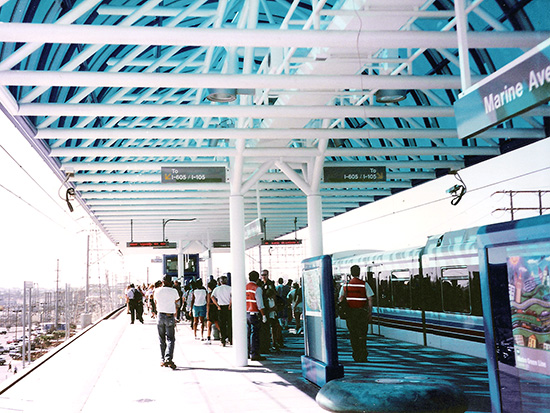
These futuristic-looking stations look like you're in a toy or something.
We arrived at the Marine Avenue station, now called "Marine/Redondo Beach," in the extreme northeastern reaches of Redondo Beach -- you can smell the sea, and feel the sea breeze, but you still can't see the sea (unlike in Mar Vista...). How deceptive. The Militant wanted his King Harbor freshly-boiled crab NOW!
The end of the line, then as it is now.
It was time to head back to the Blue Line. There wasn't much to see here either, though there was a cool burger joint just a block or so away on Marine. And then there was the end of the line, a yellow bumping post to keep trains from falling off some 40 feet below. Twenty years later, though there's talk of extending the Green Line to the South Bay, there are currently no solidified plans to extend it in either direction.

Today the Green Line is the 5th busiest line in the Metro Rail system, carrying some 39,000 riders each weekday. Despite what it never became, it was the first rail transit line in the United States to go from suburb to suburb, avoiding the city center. It was the first Metro Rail line to open in its entirety, with no future phases or extensions to follow. It was also the first light rail line in the Metro Rail system to be totally grade-separated (and the only light rail line on the Metro to have zero automobile collisions!). The Green Line also had the first "wrapped" rail vehicles on the Metro Rail system, and though it was never automated, it was the first Metro Rail line to use the automated station call announcements, which are standard systemwide.

If the Metro Rail system map is an upside-down stick figure, The Green Line represents the arms. And you can't do too much without arms, so let's give props to the Green Line on its 20th birthday today! Happy Birthday, Metro Green Line!

Saturday, May 3, 2014

75 Years Of Union Station


Today was the 75th birthday of Los Angeles Union Station, and Metro, the station's current owner, threw a massive celebration there in the form of an early National Train Day event.

Like previous NTD events, there were entertainment stages, the classic Fred Harvey Restaurant space was opened up, a model train layout was on display, and people got to climb inside real ones.  This time around, we were given a glimpse of the station's future, in the form of wayfinding signs, interactive touchscreen displays, a photographic exhibit, and overall cleaning up and renovation of the station's original fixtures.

Known as "The Last Of The Great Train Stations" built in the United States, Union Station was not only the culmination of points west, but the great national rail travel era, which would soon give way to the airplane in the decades to come. The station was originally built in 1939 as a shared facility for the three major western railroads that served it: The Atchison, Topeka and Santa Fe Railway, the Southern Pacific Railroad and the Union Pacific Railroad, as before then, each railroad had their own station in the vicinity (all surrounding the Los Angeles River, incidentally).

Today, the station is no longer shared by three private railroads, but by three public transportation agencies: Metro, Metrolink and Amtrak, and after the "dark ages" of the 1970s and 1980s, the station experienced a revival in the early '90s when Metrolink and the Metro Red Line began serving the station.

Here's some pics from Saturday's 75th anniversary celebration:

Chuggington, the cheap substitute for Thomas. But iz cool.
This swing band played in the Harvey House restaurant space and brought it, 1939 style!
People dressed up in '30s-'40s cosplay. And they looked sharp. 
Can we please bring this look back?
If hipsters wore this instead, they would be hated less.
A big oversized iPad installed in the terminal now gives information about Union Station. 
People waited in long lines to walk through the classic old-school passenger cars!
And here's an old-school MTA bus! Wonder if it accepts TAP cards...
THE MILITANT WANTS TO RIDE THIS TRAIN RIGHT NOW.
A Look Back At The 50th Anniversary

But this wasn't the first anniversary party for the classic Mission Revival/Streamline Moderne railroad terminal. Twenty-five years ago, the station, then owned by a company called Catellus, threw a golden anniversary bash on the weekend of May 6-7, 1989 to celebrate 50 years of service.

And The Militant was there!

Well, technically, it was the Mili-Teen, the younger version of The Militant, who hadn't quite earned his camo yet, but his interest, curiosity and pride for his hometown were nonetheless burgeoning even back then.

It was a similar event as today, but unlike today, the tracks weren't as active as are now. Back in the '80s, you'd have a handful of Amtrak trains roll in and out, and that was it for the day. On the positive side, and maybe because of the lack of activity on the platform tracks, it enabled the three railroads associated with Union Station's history to put some classic and modern trains on display.

The Santa Fe, the Southern Pacific and the Union Pacific all brought in some old-school steam streamliner diesel engines for public display, and some of them were set up where people can even walk inside! The steam locomotives were especially impressive, their whistles blew as loud as ships, probably echoing all over Downtown Los Angeles at the time.

One train display, though, changed The Mili-Teen's life. He had already known about the Metro Rail subway already being dug below the station, which has been under construction since 1986. But he knew its opening would be, like, eons away, sometime in the next decade.

But at the front of Union Station, he saw a 15-foot-long mockup of what looked like a rail vehicle. It was white with black trim, and blue stripes. It said "Los Angeles" on the front, but it looked nothing like the Metro Rail subway cars he'd seen in renderings.

He approached the information table and was pleasantly surprised to discover this was another rail line being built in town, that it would go to Long Beach, and best of all, it would open within next year!

It blew The Mili-Teen's mind.

The pamphlet called it "The Los Angeles-Long Beach Rail Transit Project." He saw the future. The world hadn't yet experienced the power of the phenomenon known as "Hammer Time," (though the MC wasn't totally unknown at the time). He knew people would be riding this thing before the subway opened. He then set himself on a quest to learn more about it...and the rest is history.

For The Mili-Teen, the 50th anniversary celebration of Union Station was a life-changing moment. He was able to experience both the past and the future on that day.

The Militant is proud to share some pictures from The Militant Archives:

This may or may not be a picture of the Mili-Teen!
There were some old school streamliner locomotives on display!
Even better - there were some old-school steam locomotives on display too!
Don't call it a "choo-choo," the whistles sounded like steamships!
A glimpse of the future: The Mili-Teen had his first encounter with the Metro Blue Line at this event!
Here's film footage of Union Station's 50th anniversary in 1989 filmed by K. Rutherford:


Thursday, January 31, 2013

Militant Contest: Win Some Historical Red Line Swag!


Twenty years ago yesterday, the Metro Red Line first opened. Twenty years ago today, people were still enjoying free rides during opening weekend. Today, The Militant is giving away a bunch of historical Metro Red Line mementos from The Militant Archives!

What You'll Win:

- Original, mint-condition 1993 vintage RTD first-ever Metro Red Line schedule from January 30, 1993

- Metro Red Line information brochure (Published 1989)

- Updated Metro Red Line information brochure (Published 1993)

- Old school 1993 RTD Metro Red Line ticket

- Red Line/MTA refrigerator magnet

- Old school Metro "M" logo stickers!

Cash value: PRICELESS! (You can't find these anywhere anymore!)

How To Enter:

1. You must have ridden the Metro Red Line at least once within the past 20 years (If you still haven't, there is no hope for you).

2. Send an email to militantangeleno@gmail.com with the following:
- Your Name
- City or Los Angeles neighborhood you live in
- A short, one-paragraph story, anecdote or interesting occurrence that happened to you while riding The Red Line.

3. One winner may or may not be chosen at random. Or maybe you have the most interesting story. The Militant hasn't quite decided yet.

4. Submission deadline: 11:59 p.m. PST,  Sunday, February 3, 2013.

The Militant will announce the winner on Monday, February 4 on the MA Blog. He may or may not also publish some of the more interesting stories!

Good luck and Stay Militant!

Wednesday, January 30, 2013

A Subway's Birthday: Happy 20th, Metro Red Line!

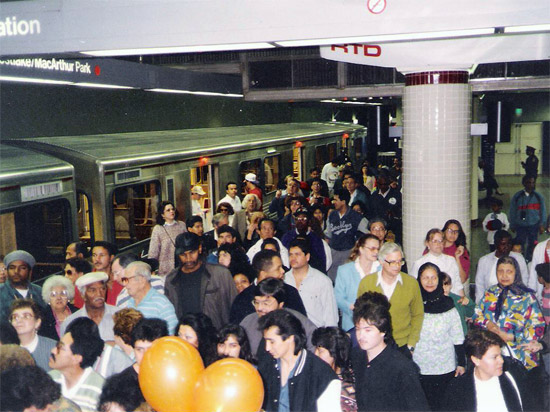
The Metro Red Line on Opening Day, January 30, 1993 (Note the "RTD" banner hanging on top and how shiny the trains were).
January 1993: Elvis appeared on a postage stamp, America inaugurated Bill Clinton as its 42nd president, teens and young adults used pagers to communicate, Michael Jackson performed at Super Bowl XXVII, held at The Rose Bowl. Speaking of the NFL, the Los Angeles Raiders and Rams didn't seem like they were going to go anywhere (both literally and figuratively), Whitney Houston's "I Will Always Love You" was the #1 song and a city long-chided for not having a subway system opened the first 4.4 miles of it to a curious, naive and skeptical public.

January 2013: Michael Jackson, Whitney Houston, pagers and Los Angeles' NFL teams are no longer with us. People can print their own postage stamps on their computers. We have an African American sitting in the Oval Office now, starting his second term (Bill Clinton refuses to be irrelevant, though). And the Little Subway That Could now stretches 17 miles to Koreatown, Hollywood and North Hollywood, connects with four other rapid transit lines, runs 24 hours on New Year's Eve, stays open to 2 a.m. on Fridays and Saturdays and last month logged in a record high 158,830 daily average ridership.

Yes, our Metro Red Line subway turns 20 years old today (Which means anyone who does the "L.A. has a subway?" thing now truly deserves an ass-kicking).

Unfortunately, unlike The Militant's 20-year-old vintage video of the Blue Line's opening he posted in 2010, the video he shot for the Red Line's Opening Day wasn't nearly as ceremonious. Just a bunch of people waiting in line and a few trains passing by. There was a VIP ribbon-cutting event the previous day, and a smaller ceremony that day, with free rides the rest of the weekend.

For those of you who were still in diapers back in '93 (or worse, still in the East Coast/Midwest, etc), The Militant will give you a glimpse of how things were back then. The Red Line only had five stations -- Union Station, Civic Center, Pershing Square, 7th Street/Metro Center and Westlake/Mac Arthur Park. That was it. 4.4 miles.  The ride lasted all but seven minutes. It was only used by the folks Downtown, and that really meant the people that worked Downtown. No one really lived there yet. There were no bars and restaurants and ArtWalks. Could you imagine that?

TAP what? This is an old-school Red Line ticket from '93!
To make up for the 7-minute subterranean adventure, the RTD (Southern California Rapid Transit District, to you youngins/newbies, as Metro was known at the time) set the fare to all but 25 cents. You can connect to the Metro Blue Line, which was just a couple years old, and Metrolink, which was just a couple months old, and had only three lines going to Moorpark, Santa Clarita and Pomona, respectively.

The trippiest thing about the Red Line back then was its schedule: 5 a.m. to 7 p.m.  Ya rly. 7 p.m. Like The Militant said, there wasn't really a DTLA back then. 

The first Metro Red Line schedule, January 1993.
Compared to today's timetable, it really wasn't much! Hopping on board a train (they were clean and shiny back then) at Union Station, you emerged at Mac Arthur Park 7 minutes later to a dredged-up lake across the street. Crews were busy at work building the second segment which would open up in 1996, adding the Wilshire/Vermont, Wilshire/Normandie and Wilshire/Western stations to the line (there was no Purple Line then, and incidentally the Wilshire corridor segment -- which was to be re-reouted along Olympic en route to the Westside thanks to certain politicians, was originally going to be named the "Metro Orange Line"). The 25-cent one-way fare remained in effect until the second segment opened.

How did people react? The Los Angeles Times  wrote articles about how riding in a subway was a strange new paradigm. Many people were leery of being in the tunnels during an earthquake (despite undamaged subways in other earthquake-prone cities like San Francisco, Mexico City and Tokyo) and others thought the whole thing was a $1.4 billion boondoggle and would never go anywhere.

But like the great El DeBarge once said, Time will reveal. A year later, the Northridge Earthquake caused only miniscule cosmetic damage and no structural harm. Within a few months, thousands of Downtown workers suddenly discovered that they were just 25 cents and a couple minutes away from the best pastrami in town, and injected new life into a once-floundering Westlake delicatessen, right across the street from the subway's western terminus. In 1994, The Red Line got its silver screen debut playing a supporting role to Keanu Reeves and Sandra Bullock in the transit porno flick Speed. After the Wilshire segment opened in '96, The Red Line got its real Hollywood premiere in the summer of 1999 with five new stations along Vermont Avenue and Hollywood Boulevard. And a year after that, the subway as designed was finally completed, speeding underneath the Santa Monica Mountains and reaching North Hollywood. People voted for more rail and more subways. Some politicians boasted having a Subway To The Sea as other electeds undid the Wilshire tunneling ban. Park N Ride lots in the Valley became full. The only haters were Libertarians and those yellow-shirted folks who blindly spout their "rail is racist" tirades. But subways are here to stay, yo.

Come 2023, our subway will be 30 years old - and will (hopefully) reach the Westside. Our first subway, the 1-mile trolley bypass tunnel built for the Pacific Electric, itself lasted 30 years. But this time it's for keeps.

If you can, wish our subway a "Happy Birtthday" by riding the Red Line today. It opened up people to new communities and new ways of travel. It even helped open up whole communities itself. It opened up even more possibilities in the city of many possibilities.

Go Metro, it's yo birthday...Happy 20th, Metro Red Line! 


Sunday, December 23, 2012

What Was THE Event of 2012? YOU DECIDE!


Yep, it's that time of the year when we wrap up those times of the year that made this year. Los Angeles had a pretty interesting year, to say the least. Here are some big stories that may or may not have made Twenty-Twelve the year that was:

Kings win the Stanley Cup
It took the Dodgers two years to win a title since arriving in Los Angeles. The Sparks, six. The Galaxy, seven. The Lakers, 12. But the Los Angeles Kings? 45 years of frustration, until this year, when they beat the New Jersey Devils in June to win their very first Stanley Cup. Kings fans, who are the most diehard in all of Los Angeles sportsdom, celebrated joyfully and responsibly. Look ma, no riot! From Disneyland to Dodger Stadium they proudly and rightfully showed off The Cup across the Southland. And with the 2012-2013 NHL season still being in limbo due to the lockout, it looks like we might get to hold on to the Stanley Cup a little bit longer...

Space Shuttle Endeavour returns
The most photographed subject in all of Los Angeles this year was not a celebrity nor a sunset, but the Space Shuttle Endeavour, decommissioned by NASA and making a triumphant return to its Southern California birthplace this past Fall. I wasn't just one event, but three: The playful flight of the shuttle atop a NASA 747 got nearly every one of us looking skyward on September 21; in mid-October, the impromptu parade through Westchester, Inglewood and South Los Angeles drew a million people in simultaneous displays of patriotism, scientific achievement and local pride. And in late October, the shuttle finally went on display at its new home at the California ScienCenter. In a year that saw the loss of the USC-educated Neil Armstrong and San Fernando Valley native Sally Ride,  the shuttle seemingly passed their pioneering astronaut spirit on to all Angelenos.

The opening of Grand Park
Los Angeles finally has its own town square in the opening of Grand Park, which stretches from Los Angeles City Hall to the Music Center in DTLA. Opened in two phases in July and October, the park has already been put to good use as a concert venue, a CicLAvia stopover and a place to watch the results of this year's presidential election. Gee, could we have like a New Year's Eve countdown celebration there sometime?

The Metro Expo Line opens
Rail transit finally reached the Westside for the first time in 60-something years as the newest branch of Metro's rail network had a new set of commuters "Going Metro" for the first time. Kings, Lakers, Clippers, Trojans and concert fans have already seen the wonders of Expo. And the story isn't over yet: By 2016, the Expo Line will become "The Trolley To The Sea" when it finally reaches Santa Monica.

Guggenheim buys the Dodgers
The long nightmare that was the Frank and Jamie McCourt era finally ended this year when Magic Johnson and some of his wealthy friends in the form of Guggenheim Baseball Management got together and made their 2-billion bid to purchase the Los Angeles Dodgers. The organization wasted no time in flexing its financial muscle, doing things like lowering the stadium parking fee to $10, resurrecting the Cool-A-Coo and making some high-profile mid-season acquisitions on the roster. If only the team's physical muscle were as strong...But hey, at least no more McCourt!

Dwight Howard joins the Lakers
Lakers diehards have talked about getting him for a while, and this year we finally landed Superman Iron Man. And okay, so he hasn't really done much this season aside from being a glorified (and expensive) cheerleader for the Purple & Gold, but he will be the face of the franchise following Kobe's inevitable retirement.

You as a reader of The Militant's blog has the opportunity to vote on which one of these was the Los Angeles event of 2012. Just select it on the upper right side of This Here Blog and vote! Polls are open from now until 11:59 p.m., Sunday, December 30, 2012 (That's New Year's Eve Eve!).

The Militant may or may not have missed some other important events this year...if you think there were some more he should have added to the list, feel free to list them in the comments!

Monday, July 30, 2012

Walk A L'Orange

The most interesting thing about the new Metro Orange Line extension is neither buses nor bikes...but pedestrians.


The (M) TAP card $5 daypass is a dangerous thing (in a good way). Provided one has the time, one can go off on an adventure on our transit system, which is exactly what The Militant did on Sunday evening.

Having not yet ridden on the new 4-mile extension of the (M) Orange Line from Canoga Park to Chatsworth, The Militant, bike in tow, set off on an 18-mile trek from North Hollywood just to check it out.

The new north-south bus rapid transit extension, which he had passed by on car just prior to its opening, looked pretty much like the 7-year old east-west line it was supplementing, what with park & ride stations, and a little urban renewal, eliminating some rather blighted, neglected spaces.

The only real unique things about the new extension was the sultry view of the radio tower-topped Oat Mountain, with the setting sun casting sexy shadows of its topography (as sexy as the Santa Susana Mountains can be), and the large, sweeping overpass at the end of the line that runs over the Amtrak/Metrolink/Union Pacific railroad tracks and lands the buses at the Chatsworth depot.

After poking around the area a bit and watching a northbound Pacific Surfliner train roll by, The Militant wanted to try out the bike path portion of the Orange Line.

After finally finding it east of the tracks off of Lassen, The Militant rode on south. It was nice; at one point, you had Canoga Avenue for the cars, a pedestrian path, the bike path, the Orange Line bus right-of-way and the railroad tracks, all running parallel to each other. There was a nascent plantscape with native drought-tolerant plants, and a faux creek with stone-lined bioswales running between the busway and the bike path.

There were few other cyclists at this point. What he did notice the most...were the pedestrians.


First he saw two. Then a group of four. Then a whole family of five, Then people walking dogs, then strollers. It was like a virtual boardwalk in the land-locked SFV. Wait a minute, this is the San Fernando Valley? As in the archetypal suburb?

Apparently so. This was a Sunday evening nearly an hour after sunset. The weather had cooled down considerably. What better thing to do to wrap up your weekend than to take a leisurely stroll along the Orange Line? "Honey, get the kids ready! We're all going for a walk!"

Though darkness grew nigh, the path was well-lit, and unlike its east-west counterpart, it was wide-open, adjacent to a major street, and not the boxed-in cricket jungle atmosphere where lawd-knows who might jump out of the bushes.

A trio of women, each holding water bottles, gossiped in Spanish. Couples, both young and old, walked hand-in-hand. Joggers dashed by, iPod headphones seemingly glowing in the dark.

The Militant unfortunately didn't make a count of all the pedestrians on the Orange Line path for those four miles, but he can clearly remember a dozen or so bikes, including his own. But there were perhaps over 60 people who were walking on this fine Summer evening.

The pedestrian path looked wonderfully safe, although The Militant passed by a police car finishing up its business and heading out, with a young woman walking away, holding a water bottle, nearly in tears. Whether she got a jaywalking ticket (she wasn't holding anything that resembled it) or was a victim of a robbery, is unknown.

After The Militant reached the junctioned Canoga Station, he decided to forge on east and ended up pedaling the 18-mile bike path in its entirety to the North Hollywood station. The entire journey took him almost 2 1/2 hours.


When The Militant started his bike path trek in Chatsworth, he noticed the parallel bike/pedestrian path with their respective icon markings on the pavement. Riding on the O.G. Orange Line path, it was only then did he realize that the same arrangement existed there, too, only not very many people walked that path.

Granted, on a sweltering 105-degree Valley summer day at 130 p.m., you're hardly going to see any pedestrians out on that path, unless they choose to spontaneously combust. But Metro and whoever wants to do any development on Canoga needs to seize upon this newfound pedestrian activity. Maybe a linear farmer's market. Perhaps a designated food truck zone.

 It's 2012 now. People aren't just "Walking in El Lay;" they're walking in the Valley! Who knew?!


Monday, July 9, 2012

The TAPture!

As you may or may not know, The Militant loves using his TAP Card as his preferred fare media during his various transit journeys around his City. He's been rocking one since June of 2008!  All has been going well until one recent day when he TAPped his wallet against the TAP target on one of the Metro Rail turnstiles, and instead of the usual "Go" green screen, he got the red screen you see on the left:

STOP
Expired Card
Purchase New Card

Hmmm.

As it turned out, there was a group of three other passengers after him who all TAPped and got the same screen.

Could this be?

It may or may not be...

The TAPture!

Now, The Militant, who was in quite a rush to get to his Downtown destination, either went back and bought a paper ticket or just illegally TAPped ahead on the unlocked turnstile and on to his train... Buuut all that is sort of irrelevant to the story. The whole point was...HIS TAP CARD EXPIRED.

Which is kind of odd, since the ticket vending machine, after TAPping to get the TAP Card Status, indicated that it expired on June 30, while the taptogo.net webiste, where he has his TAP card registered online, said that his card doesn't expire until early September 2012.

Hmmm.

Of concern to The Militant was the fact that his expired TAP card still had about $7.50 in stored value. Could he transfer that balance to a new card, or is it gone forever?

The Militant called Metro's Customer Service number and tried to find out for himself. His terse response:

"Sir, we don't handle TAP card issues. You would have to call 866-TAPTOGO."

Alrighty then. So he called the other number and got someone who sounded much more satisfied with their job. She told The Militant that he could go to a Metro Customer Service Center, buy a new TAP card for $2, and have his $7.50 stored value transferred from the old card to the new card (it would take up to four days to transfer though...). It is not gone forever in to the ether of space and time.

Phew!

Later that day, The Militant happened to be in close proximity to the Metro Customer Service Center at the Baldwin Hills Crenshaw Plaza mall, so he merrily walked in with his TAP card and asked to have the old balance transferred to a new card.

"Umm, sir," the woman in the window said in her 'I Hate This Job' monotone Customer Service voice. "We cannot do this right now. You need to call TAP and have them send us a fax confirming that they have transferred the balance to your new card."

Whoa, hold it there. FAX?!?! WTF?!?!

Isn't the high-tech, 21st-century RFID-laden TAP card on the cutting edge of fare media technology? Why does one have to send a fax?!? WHO SENDS FAXES IN 2012?!?!

The fact that it was already 5 p.m. and the TAP center had already closed for the day didn't help things much.

The Militant asked Customer Service Drone Lady if he could just buy the TAP card for $2 and have the funds transferred later. She told him, "We can only sell you the card with a pass or stored value."

(The Militant only had $2 cash on him...)

"Can the balance be transferred online?" The Militant innocently asked.

"No," she replied.

Both The Militant and Customer Service Drone Lady briefly stared at each other with a, "I can't believe you're such a f'ing idiot" look on their faces.

The Militant told her, "The Militant had no idea this was so complicated."

"The Mill what?" Customer Service Drone Lady asked.

"Never mind," said The Militant, on his way out the door.

The next day, The Militant called up the TAP customer service line, where people sound much more happier and much more willing to help you out, and reiterated his dilemma.

Basically, all The Militant really had to do was buy another card at a Metro Rail ticket vending machine, pay $1.50 in stored value, and call the TAP customer service again, give his two TAP card numbers, and wait for the remaining $7.50 to transfer from the old card to the new one within four days.

The Militant had no idea this was so simple.

He asked the happy TAP lady if she worked for Metro.

"No, this is a call center, we work for TAP..."

Hmm, there is no such company as "TAP," but Militant research points to a San Diego-based company called Cubic Transportation Systems, which manufactures and operates similar contactless fare card systems around the world.

But The Militant was able to replace his TAP card after all.

The Militant took one for the team. Just to make things painfully simple, to avoid this mess, this is all you have to do when your card is within a couple months of expiring, in three easy steps:

1) Let the pass period expire or the stored value go down to $0.
2) Buy a new damn TAP card.
3) There is no Step 3!

Curious, The Militant compared his old TAP card (circa 2008; top) and his new one (circa 2012; bottom):


The older TAP card has a slightly more teal tint, whereas the older one has that "Expo Line" shade of light blue goin' on.


On the back, the differences are more pronounced; the older card has a bigger "TAP" logo and single column rules and regulations table. The new one has a smaller logo and a two-column table, with additional bullet points.

(Dude, was that being transit geek right there or WHAT?!)

So why do the cards expire in the first place? The Militant had a conversation with a fellow transit-using, technologically-literate Operative, who told him that the TAP cards have an RFID chip embedded near the edge of the card. Being a hardware device, the chip has to become obsolete over time so that the TAP system's software can eventually be upgraded with new features. So, it's assumed that with each generation of TAP cards, they embed a newer version of the RFID chip.

The Militant won't have to worry about updating his TAP card until July 2015 (according to the TAP card status feature at the station ticket machines)...or is that June 2016 (according to the taptogo.net website)?

Friday, April 27, 2012

ARE YOU READY TO EXPO?!?!

The (M) Expo Line, taken here during last weekend's Los Angeles Times Festival of Books, was a major tease. But this weekend, it's ready to go all the way, baby.
Can you feel it, Los Angeles?

THE MILITANT SAID, CAN YOU FEEL IT?!?!

Yes folks, It's that time again, time for another Metro Rail line to be added to our 22-year old system as the (M) Expo Line opens up this weekend at long last! The Militant has been attending every single Metro Rail Grand Opening since The (M) Blue Line opened in 1990, and he was there to bring you the (M) Gold Line Eastside Extension's opening back in aught-nine.

The Militant may or may not be gearing up to bring you another Vlogstyle video. But he has been noticing that Metro has been gearing up itself lately in terms of maps and wayfinding displays.
The local vicinity way finding displays on the subway level have been updated, to show Los Angeles attractions that tourists from around the world come to this fabled land just to visit, like the 777 Tower Building.
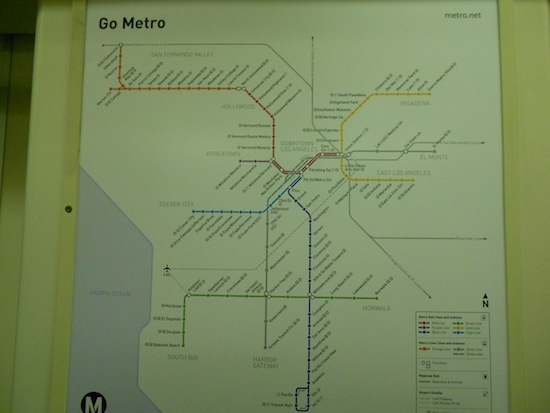
The Tree Has More Branches: Notice anything new about this Metro system map?
Even the line maps on the Red/Purple Line trains have been updated.
This big way finding display was placed at 7th Street/Metro Center, where now four rail lines converge. The middle panel wants you to make sure you don't get your trains mixed up. It's unfortunate though that the Nippon Sharyo light rail cars had to stay with the old-school rolling signs and not the more practical LCD displays.
The (M) Gold Line was once considered to be dubbed "The (M) Rose Line" but that was shot down because, quoth one of the County Supes: "Rose is too close to Red." Of course...EXPO IS TOO CLOSE TO BLUE.
The good news is that we'll see a lot more of these line openings in the years to come. This summer, the Farmdale and Culver City (M) Expo Line stations will complete the first phase of this route, and in just four years we'll be Ready To Expo all the way to Santa Monica. Around that time, the Foothill Extension of the (M) Gold Line will also take us to Aczusag-na. But wait, there's more! The (M) Purple Line Westside Extension will take us from K-Town to the edge of Beverly Hills at long last (as for the rest of the line, those rich muh'fus in BH better grow up and stop BitcHing). Then there's the fifth light rail line going through the Crenshaw Corridor and to LAX. We'll also have the Regional Connector - DTLA's second subway - which will turn three of the light rail lines into two (Doing away with "Expo Light Blue" and having a north-south Blue Line and east-west Gold Line - so get ready for the paradigm shift, folks!), and even a possible rail line which May Or May Not go through the Sepulveda Pass.  

Think it takes forever to build them all? Consider we've had Metro Rail operating longer than you'll have to wait for nearly all of the aforementioned lines to get built. Time flies when you're going Metro!

Saturday, March 24, 2012

Delayed Expo-sure

"The Metro Expo Line may or may not open this Spring."

That was not a mere trademark Militant Angelenoism™, but a statement of fact, as The Light Rail Line That Has No Actual Opening Date has endured delay after delay after delay. It was probably assumed that the Phase 2 segment from Culver City to Santa Monica would open up even before the first part.

The time to worry has ended at long last, as Metro took a bunch of politicos on the train on Friday and announced that, yes, Virginia, The First Metro Rail Line Not Named After A Color is finally opening on Saturday, April 28, 2012.

Phew.

Transit fans will pop open bottles of champagne, Libertarians and Bus Riders Union-types alike will roll their eyes and curious Angelenos from East to West will take to the rails a little over a month from now.

It's a pity, nay, a DAMN SHAME though that the trains for The Other Blue Line won't even be open for the Los Angeles Times Festival of Books at USC, with the Expo Park/USC station, virtually ready-for-business, standing just yards from the nearest booth like some sort of cocktease. Visitors will no doubt grumble at not just paying the $20 parking fee, but spending a long-ass time queuing to find it. But maybe that was all intentional...

Maybe Metro should run express preview trains from the 7th St/Metro Center and La Cienega stations only during festival hours to USC. What a concept, huh?

Surely that won't happen, since such an idea is too Militant for any local body to fathom. Sigh, oh well.

Speaking of gripes, whatup with the Expo Line's promo campaign?

"Explore." With a coloring-book drawing of some of the line's nearby landmark icons as drawn by a middle school art student. Um, wow. Dude, the Metro Gold Line's "Discover Gold" campaign was waaaay slicker. This is probably the most-anticipated light rail line in the entire system and this is what Metro is using to try to get people to ride it?

But who is The Militant kidding, Metro could use a picture of a cow turd and he'll still be riding the thing.

So here we go. You know the drill: The system maps in the trains and stations get changed, and come 4/28, loooooooong-ass lines will be forming in the 7th Street/Metro Center and La Cienega stations. There will be live music, booths with Metro swag and the inevitable free shuttle bus that will carry passengers who don't want to wait in Disneyland-like lines for their train ride back. And The Militant may or may be there, just like he has for every Metro Rail line and extension opening since The Metro Blue Line opened nearly 22 years ago. It's that time again, folks. He's glad to see it all unfold before his very eyes.


Tuesday, February 28, 2012

Secrets of the Metro: Wilshire/Vermont's 'Metro PCS'

One of The Militant's favorite Metro Rail subway stations is Wilshire/Vermont, because it's so different. First off, it's the only 'junction' station in the subway, being the diverging point for the Red and Purple lines. Also, because of that, it's the only stations where the tracks run parallel on top of each other (as opposed to the perpendicular nature of the 7th Street/Metro Center and the Imperial/Wilmington/Rosa Parks/Willowbrook/MLK Medical Center/Metro Central Control/Dennys stations. It's the only Metro Red/Purple line station to have a weekly farmer's market at street level (Though The Militant recently learned that one will also be coming to Hollywood/Western this Spring). It also sports the looooooooooooongest escalators in the state of California.

But most of all (and the whole dang point of this blog post), is the fact that it's the only Metro subway station that offers cell phone coverage.

Kinda sorta.

Metro bus and light rail riders currently enjoy chatting, texting, surfing and Tweeting from their phones during their journeys, and most of the time it makes the long ride a bit more enjoyable (unless you're not on the phone and sitting in close proximity to someone who's yapping louder on a call than they would talk to someone in person...). Even the Blue Line offers a place to charge one's mobile device.

But Red and Purple line riders do not have that privilege. Those QR codes on the subway car advertisements are useless. This all may or may not change in the near future though.

Some frequent riders who board at Wilshire/Vermont know what's up though. They can talk, text, Tweet and surf from 120 feet below the street - the deepest station in the entire system.  Because of the particular design of the station, which lacks a proper mezzanine level that would buffer cellphone signals from the surface, mobile users are able to get coverage here.

Cellphone reception is best near the escalators on either level, but if you're sitting on the train and your car is situated close to the escalators during your stop. you can send out that text or Tweet you were suddenly inspired to write while immersed in the zen of the whooshing of tunnel air and the acceleration and deceleration of the train's electric motors (Hey, at least The Militant finds those sounds to be soothing...).

So there you go Metro subway riders...you can use your mobile phone in at least one station. Of course, in that not-too-far-off future when those calming subway noises make way for the cacophony of People Yapping Too Damn Loud and the annoying din of Really Awful Ringtones, y'all gonna look back fondly at the days when only one station gave you the privilege of cell phone usage.
And lookie here, there's even a plug for you to charge up!