Showing posts with label Plantlife. Show all posts

Saturday, May 26, 2012

North Atwater Park: Up Close and Personal with the Los Angeles River

Oh, it's been one of those blog lapses again.

Very well. Moving forward...

It was an ordinary Saturday...The Militant was dropping off some E-Waste at a local Los Angeles City S.A.F.E. disposal center when he ventured around the area out of his own militant curiosity. He found himself on Chevy Chase Drive in Atwater Village and the voices inside his head his militant instinct told him to venture forward, to the road's end. It was there where he saw it: North Atwater Park.

There was a small parking lot along with a bicycle parking rack, so he knew he was in the right place. Any beyond the lot was an open area with picnic tables, benches, a clay dirt path and various California native plants. But beyond that...

...The Militant found his personal El Dorado.


It was the Los Angeles River, flowing, running wild and pure. Yes, he had encountered The River before. But this time, there were no fences or railing to encumber him.

This is what nearby Griffith Park, just yards away, past The River and the the 5 Freeway, was meant to be like over 60 years ago. A peaceful parkland that welcomed one to the Los Angeles River, interrupted due to the aforementioned freeway. All but realized until recently.

On this day, there were several people painting along the banks of the river. No, not taggers or graff artists wielding spray paint cans, but people holding brushes, painting on canvases set up in locations to their liking (pictured left).

According to one of them, they were all enrolled in Barnsdall Art Park's 3-hour Plein Air painting class, where they were assigned this week to show up at North Atwater Park and paint their subjects along the riverside.

The Militant was in awe. He could hear the river water rush just inches away from him. He walked further south along The River's east bank, passing by some people chatting, one of them greeting The Militant, and an Australian Shepherd dog who seemed to take a liking to him. He saw ducks walking in the standing water along the concrete riverbed, watching them march hurriedly towards the water as The Militant approached.

It was the perfect scene that was marred only by the sound and occasional sight of cars whooshing by on the 5 Freeway on the other side of The River. If not for that, The Militant would probably never leave (which may or may not be problematic, as he couldn't blog again if he did).

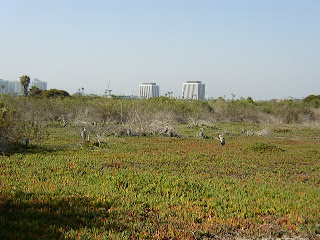
Next to the native plants area was a large dry ravine, with native wildflowers, which ran diagonally towards The River (pictured right). It's gated off by temporary fencing, but there are stairs leading down to it, so it might be accessible in the future. The purpose of the ravine, according to an informational sign, was for a means to allow runoff water from the nearby water treatment plant to cleanse itself naturally by entering the local water aquifer. It seems that sustainable water runoff treatment is the in-thing these days.

This is Memorial Day weekend, and most of you have better things to do than to real local blogs (unless you're looking for something to do). If you're like The Militant and don't get leave town (or at least never publicly admit to doing so), he recommends spending a few hours chilling here by The River at North Atwater Park. It's free to visit, after all. Our river is a link to both our past and our future. A pedestrian/bicycle/equestrian bridge across The River here will begin construction next year.

Most of all, The Militant found his new Happy Place. You may or may not see The Militant here sometime. But if ever you do, please turn off your cameras/recording devices and raise ya fist!

Deux Ducks.
The Militant makes a new friend.
Save for these motorcycle remains, The River was amazingly clean and junk-free!
Rapids transit.

Monday, September 26, 2011

Native Month: The Secret Life Of Local Plants (Part 2)

In his last post, The Militant introduced you to the wonderful world of California native plants. But where can these fantastic flora be found? They're not as rare as you think they are! One day, an operative took The Militant for a walk around the neighborhood and pointed out various native plants growing in people's front yards. It was like another world opened up to him.

But instead of The Militant pointing out where his neighborhood is (and thusly blowing part of his cover), here are some places around Los Angeles and the Southland where you can be in the presence of native plants -- and true to Militant fashion, they're all 100% free to visit!

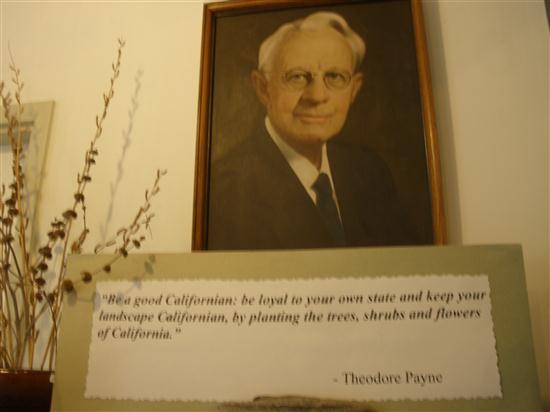
Theodore Payne Foundation Nursery & Gardens, Sun Valley - Theodore Payne (or T-Payne for short...ay) was an Englishman in the late 19th century who was so fascinated with California native plants, he moved here, only to discover that agricultural development in Southern California was depleting the land of its native vegetation. So, as part Luther Burbank, part Johnny Appleseed, he dedicated his life to preserving native plants, even going up into the hills and fields to collect seeds. T-Payne created native plant displays in Exposition Park, Cal Tech and Descanso Gardens and owned nurseries in Downtown and in Atwater (before it became a "Village," yo). T-Payne retired and died in the early 1960s, but The Theodore Payne Foundation was formed to carry on his work. In Sun Valley, the nonprofit operates a nursery where one can buy numerous varieties of potted natives and a living native plant environment growing in the hillside (you can even just drop by and have a picnic -- there's even tables there). They also conduct classes and native garden tours.  They should be the first place to check out if you want to learn about native plants!
Real talk from T-Payne.
Vista Hermosa Natural Park, Downtown - The Militant covered its opening back in '08, revealing a new place to get a killer Downtown skyline view. But this 10.5-acre plot of land, originally intended to be part of the LAUSD's beleaguered (isn't that being redundant?) Belmont Learning Center complex features the scent of sage and other native varieties. It's run by the Santa Monica Mountains Conservancy for the specific purpose of re-introducing native plant environments in urban Los Angeles.

Angels Knoll Park, Downtown - Speaking of DTLA, this mini-park, directly adjacent to Angels Flight Railway, is a virtual mini-version of Vista Hermosa, with fragrant Cleveland Sage bushes growing abundantly, as well as decorative native succulent plants (Of course, the pleasant sage aroma was likely intended to help mask the smell of the local homeless people's urine...)

Griffith Park - Toyon, chamise, sage and other chaparaal plants grow here in the eastern end of the Santa Monica Mountains. Hop on any of the 4.310-acre park's hiking trails and you'll see them. In some cases, they've been growing there just as they have in the days of the Tongva.

Bernard Field Station, Claremont - This 86-acre wildlife peserve along Foothill Blvd on the campus of The Claremont Colleges exists for both conservation and study, with both wild and human-planted native growth in a coastal sage scrub environment. As a bonus, native birds, reptiles, insects and wild mammals can be seen roaming the grounds.


'Cause native wetlands have a way with B-A-L-L-O-N-A...
Ballona Wetlands, Playa Del Rey - Even before he learned about Tongva culture, The Militant was downright outraged at Steve Soboroff's Playa Vista development taking over our last vestige of natural wetland in Los Angeles (apparently bad ideas aren't foreign to him...). Having biked the adjacent Ballona Creek bike path for nearly two decades, The Militant couldn't help but try to mentally block out all modern development and imagine taking a look back in time. Eventually, he did learn that this was the Tongva village of Saangna, which also included a large ancient sacred burial ground which was discovered during Playa Vista excavation.

Others have recently listed traits and criteria on being a true Angeleno -- well, The Militant believes that you can't be a true Angeleno without visiting the Ballona Wetlands and appreciating the (relatively) untouched serenity that have lasted for centuries. Developments can always be built elsewhere, but the wetlands are irreplaceable. May this land be disturbed no more!

Friday, September 23, 2011

Native Month: The Secret Life Of Local Plants (Part 1)


Los Angeles might frequently be dismissed as a "desert," but that's not actually accurate. The Militant believes people who tend to use that term are usually transplants want to secretly push a negative image of emptiness, of lifelessness, that there was nothing here to begin with, and therefore this place means nothing.

The truth is, Los Angeles is in a Mediterranean climate zone that is shared by only a handful of places in the world: Southwestern Australia, Southwestern South Africa, the central coast of Chile and the coast regions of the Mediterranean Sea. Is Cannes, France also considered an "empty, lifeless desert?"

The other truth is, before colonization, all of California was a lush paradise filled with an amazing biodiversity. In an example of life imitating art, The Spaniards named this part of the world after a paradside-like island of the same name fron a 16th century novel called Las Sergas de Esplandián by Garci Rodríguez de Montalvo.

Many of the indigenous plants are gone, either supplanted by introduced species from other parts of the globe or outright torn out by human development. But in our remaining wetlands, meadows and hillsides, they prosper. And thanks to contemporary issues like water conservation and ecological sustainability, California native plants are making a comeback in our parks and frontyards.

The Militant consulted one of his operatives, who started a few native plant gardens in his neighborhood and got a crash course in this whole native plant business. Needless to say, he can't wait to start a native plant garden in his compound!

Nearly all of our native flora are drought-tolerant since their growth cycles are compatible with our dry, rainy and blooming seasons (see, we do have seasons after all). They need no fertilizer since they know the soil. They also prosper by growing roots deep enough into the soil where moisture or a water source is always present. And best of all, they are a source of food, shade and shelter for some of our native insects and animals, being a foundation for our native ecosystem.

The plants in this post are but a sampling of the many varieties of So Cal indigenous flora and is by no means a comprehensive guide. But they are common and/or interesting enough for you to take notice when you spot them.

Native Plants
 
White Sage - This was perhaps the most important native plant to the Tongva and neighboring tribes. Its leaves are burned as incense for ceremonial uses, which is why white hippie/new age types like to rape and pillage the plant in the wild and sell for a profit as smudge sticks (capitalism, yaaaaay). They also provide high medicinal value (usually drunken as a tea), curing everything from coughs to colds to stomach aches. The greenish-grey leaves give off a strong, distinct scent when rubbed. In the Spring, tall flower stalks come from seemingly out of nowhere and bloom, making it a favorite nectar source for bees -- it's also known in its Latin scientific name as "bee sage."


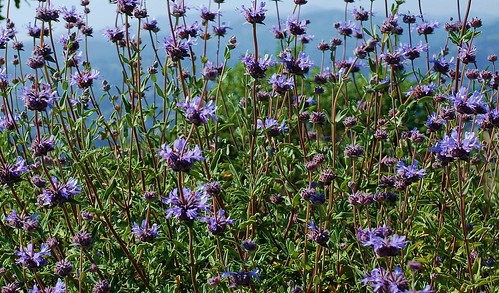
Cleveland Sage - Named after plant collector Daniel Cleveland, this sage (pictured at top of the post), popular with butterflies and hummingbirds, as well as California quails who seek shelter in its bushes, has an etremely pleasent, minty scent from its small green leaves (rub your fingers on one and take a sniff...ahhh). Its purplish-blue flowers bloom from orb-like stalks in the Spring and Summer. Got bedbugs (you know those bloodsucking parasites that East Coast people bring with them)? Take a bunch of Cleveland sage leaves and sprinkle them around your beddings. The sweet scent you smell is downright overpowering for them little critters, and they are naturally repelled by it. NATIVES FTW!


Toyon
- This hillside bush with dark, leathery green leaves and spiny edges are common sights in chaparral environments like the Santa Monica Mountains. If you hike Runyon Canyon or Griffith Park, you can't miss them. In the winter, they sprout berries (edible, but not very tasty, unless you're a deer or a bird) and resemble a holly. In fact, the toyon is also called the California Holly, and was the origin of the 9-letter name given to a famous landmark sign, the entertainment industry and an entire community that was built over the Tongva village of Cahugna. For more toyonic talk, check out The Militant's post from Christmas of last year.

Chamise - One of the most common chaparaal (the term "chaps" refers to the sturdy pants one must wear when navigating through the typically spiny plants in that environment) flora, this plant is also highly flammable during fire season due to its resin content. But like all natives, it adapts well to its conditions. In fact, fire is a part of its life cycle and not only germinates following a conflagration, but releases its own toxins into the soil to prevent competitor plants from growing on its turf. This plant is straight up gangsta!


Manzanita
- Not just a street in Silver Lake, but a type of plant of varying sizes known for its twisty branches, reddish hard wood trunks, bright floral blooms and berries that resemble tiny apples (hence its name in Español). The Tongva resourcefully used its leaves as toothbrushes, made cider from the berries and tea from its bark to cure stomach maladies. They also used its wood to make utensils and tools. Butterflies and hummingbirds can't get enough of their flowers.


Desert Agave
- This succulent plant that's grows primarily in the deser region can also be found in the Los Angeles area, in the more drier corners. This spiny plant lives for about 10-20 years and only flowers once in its lifetime, and then dies. But throughout its lifespan, agave "pups" will spring up from the ground, seemingly multiplying itself. Although agave is associated with tequila, this isn't the same variety that produces the booze (it's possible though, but not very commonplace). But the Tongva and the neighboring Cahuilla tribe used it for food, rops, utensils, weapons, soap and medicine.

Native Trees


Oak 
- The Coast Live Oak and the Scrub Oak most common varieties 'round these here parts. These trees were (and still are, relatively speaking), still numerous in the region, enough that places like Encino (Español for oak) and Thousand Oaks were named after the trees. The trees also grow acorns, popular not just with our native squirrels, but with the Tongva, who used them in multiple food uses. Aside from eating the acorn nuts, they also ground them and made them into flour, which was made into baked goods.

California Fan Palm - Palm trees are a Los Angeles icon no doubt, and developers and city planners were eager to plant them Like All Over The Freaking Place back in the 1920s-1940s. About half a dozen types of palms can be found locally, but only one is actually native: The California Fan Palm. It's actualy native environ is the lower desert region, where they grow in groves next to water sources. Places like Twentynine Palms and Palm Springs were named after these trees, but a few could be found in the Tongva nation. The Tongva's neighbors to the east, the Cahuillas (a.k.a. The Iviatim), used the fruit of the palms for food and flour, and used the leaves for sandals, baskets and roofing material.  


California Sycamore
-
This hardwood tree is known to grow near rivers, streams and foothills. It's also a deciduous tree, which means its green leaves turn orange in the fall (You East Coast people who constantly bitch about us "not having seasons" should cream in your pants just for that). Sycamore Avenue in Hollywood and Aliso Street in Downtown were named after the tree. And of course, our stately local sycamore was revered by the Tongva, most especially in center of the village of Yangna, especially one 400-year old specimen which you may or may not have heard of before.

If anything, The Militant noticed that our native plants share much in common with its native people: Deep roots, low maintenance and thrive best in this climate!

Having trouble spotting native plants? The Militant will show you where to find them in his next post!

Friday, December 24, 2010

Deck The Halls With Boughs Of Hollywood


Hollywood and Christmas seem to go hand-in-hand. Not only are there countless motion pictures over the years (like this one, this one and maybe even this one), blockbuster theatrical releases and a post-Thanksgiving weekend parade to kick off the season, but its very name is a reference to the holiday as well.

Those of you who know your local history know that Hollywood started as its own town, independent of Los Angeles, founded in the 1870s and incorporated in 1903. Unlike many local towns and communities named after places in the so-called "Back East" such as Beverly Hills (Beverly Farms, MA) and Wilmington (Wilmington, DE), Hollywood was named after a local, a native even.

The hills above Tinseltown are populated with numerous native bushes known as the Toyon a.k.a. California Holly a.k.a. Christmas Berry a.k.a. Heteromeles arbutifolia a.k.a. Hollywood Plant. Those of you who hike up Griffith Park's many trails have seen them - they have oblong dark green leaves with jagged edges, and in the fall grow clusters of tiny red berries (edible but not very tasty, for humans at least). The word "Toyon" is referred to many times in the Griffith Park area (Toyon Canyon). Yes, Hollywood was named after this very plant.

Around a century ago, Angelenos used to pick Toyon off of the hills for use as Christmas decorations. Eventually this practice became so widespread and noticeably depleted a number of the bushes that a 1920 California state law made it illegal to pick Toyon from public lands.

Thanks to that law, Toyon is plentiful in the Santa Monica Mountains today, where you can easily see them on any hiking trail, or on the road up to the Observatory. Of course this law is still in effect, but many local nurseries sell Toyon for you to grow if you want to revive the old Angeleno holiday tradition. Next time you spot one of these indigenous plants, think about how it's entrenched in history (and how the East Coast-based media hegemony has purposely corrupted its name to stand for all that is materialistic, vacuous and superficial). Militant Christmas, everyone!