Showing posts with label Environment. Show all posts

Saturday, February 25, 2012

The Militant Gets Wet...For The Wetlands

A couple of weeks ago, everyone was talking about the brand spankin' new South Los Angeles Wetlands Park that was about to open. So The Militant, preparing to do a whole big-ass post about its opening, scoped out the area, took a few pics and was all set to go to the dedication on February 9...

...But some unspecified matters came up, and The Militant put it on the shelf.

In fact, The Militant put many things on the shelf the past couple months. But he didn't think it would matter. Aside from a couple rabid Militant Geeks out there, who cares? No one reads The Militant's Blog anymore. Heck, no one really ready blogs anymore period.

Basically, The Militant has taken some time off to think things over. Should he change his game, or hang up his cleats? Should he try a different angle? Should he try to stay ahead of the game? He is still trying to think these things through.

But here's the part of the blog post where The Militant realizes he's gone off on a large tangent, some four paragraphs into his post, and has yet to really tackle the intended subject matter.

So what's new?

Okay, Angelenos, The Militant was in The South Side on Friday, and after he got P.O.'ed at the Sectional Center Facility down on Central Avenue, he decided to pay the South Los Angeles Wetlands Park a visit.

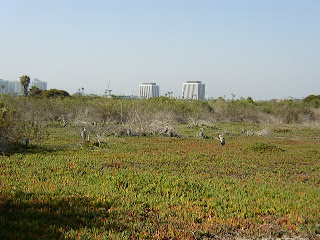
It was a neat place, albeit slightly barren. White light poles with large, angled solar panels in some systematic fashion lined the grounds like an array of SETI instruments. The ground comprised of nearly all dirt paths.

The focus was the large lagoon running through the north end of the park, its main functional feature. Water is diverted from the San Pedro Street storm drain, separated, filtered and runs through the 3-foot deep body of water, and then out back again into the storm drain system, where it winds up, cleaner than ever, in Compton Creek, The Los Angeles River and The Pacific Ocean, respectively.

The symbolic Elephant In The Room is a massive "Existing Concrete Structure" (according to the park map) which seems to have no functioning windows nor doors. More on this later.

At the 2:00 p.m. hour, the park was quiet and serene. Aside from the whooshing of cars and the planes queuing to land at LAX, it was mainly the sound of the breeze, and occasionally the cacophony of seagulls or crows flying overhead. This was pretty cool.

There were a few teenagers walking in the park, a mother and her kids taking a walk through the park and posing for pictures, and a few other parents pushing their little ones on strollers. But come 3 o'clock, the kids from The School With No Name across the street (really, there's no signage whatsoever, but nearly a half hour's worth of Militant research came up with the name "Dorothy V. Johnson Opportunity High School," formerly known as Central Region HS #16...typical LAUSD, always making things more complicated than they have to be...tsk, tsk...) filter out and make the park their hang...which both may and may not be a bad thing.

Already the few picnic benches have permanent marker graffiti -- albeit more of the bathroom stall variety than gang turf markings. And snack food wrappers (Cheetos Puffs seems to be the most popular around here for some reason) can be found on the grounds and on the shores of the lagoon, as well as discarded water and soft drink bottles. But the youth have found value in the place, some of whom were seen kicking a mini-soccer ball around an open area towards the west side of the park. Teens being teens, The Militant's sure that a few adolescent couples have found this to be a place to walk while holding hands [Cue "Awwww" sound effect].

During this time of the day, the parking lot started to fill up, but not with park patrons -- it's turned into a temporary parking area for parents to pick up their kids.

Thing was, the parking lot could hold some 67 automobiles, but 0 bicycles! Zero! Zilch! Nada! No bike parking! So much for all this eco-wetlands-runoff-oasis! Like WTF?!

But alas, this is a young park. Its barren look will in time be overtaken by the eventual growth of the California native flora (The Militant, after learning much about native plants since his Native Month series, was quick to spot some white, purple, Cleveland and Bees' Bliss sage).

Most importantly, the park was made not so much for curious urban explorers from other parts of town, but for this South Los Angeles community. The community will find its own value and worth for the park, which admittedly, even in an upscale neighborhood, would still look a bit odd at the moment.

Now about that "Existing Concrete Structure." The property was once home to the Los Angeles Railway's South Park Shops (and, until recently, Metro's Division 14 Bus Yard), a facility where streetcars, and eventually buses were stored, repaired and maintained.
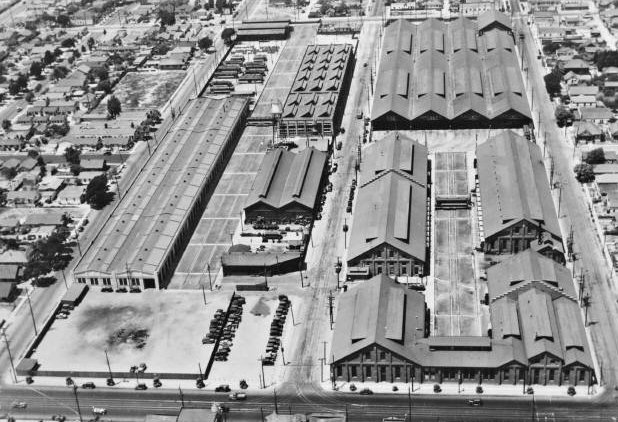
The old Los Angeles Railway South Park Shops. The left half of the property is now the South Los Angeles Wetlands Park, the right is now The School With No Name. The dividing line is 54th Street.
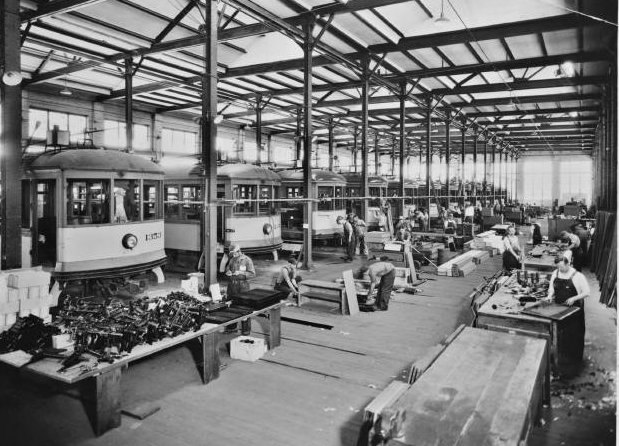
The South Park Shops were in operation from 1906 to 2008, encompassing the various transit entities of the City over those 102 years. The Existing Concrete Structure was a relatively new addition to the facility, built in 1926. It kinda looked like this inside:
Inside the South Park Shops. Safety was highly regarded here, though for some reason the few fatalities that did occur were attributed to workers named "Kenny."
It has no function today, but there are rumors that the Existing Concrete Structure will one day be turned into a streetcar museum. The Militant is feelin' kinda giddy over that. But other remnants of the area's transit past are still evident, for just a block north, on the corner of 53rd and San Pedro, one can see fractures caused by paved-over Yellow Car tracks:
See them cracks? That's track! Cool, huh?
The Militant was glad to finally visit the park, which inspired him to get off his lazy ass and finally do a blog post. Urban design, open public space, environmentally sound (well, mostly...get those bike racks installed, people!), native plant life, and with a historical transit theme...how much more militant can you get? The Militant looks forward to returning a few years from now when the plants are all grown up and the streetcar museum is ready. South Los Angeles, take good care of this place, and enjoy it with pride.

AW HECK WHY NOT (a.k.a An Excuse To Post More Pics):
Looks like a river. Existing Concrete Structure representin'.
A local family enjoys their new park.
A young native California Laurel grows here. Why, they even named a canyon after it.
Did you know Purple Needle Grass is the State Grass of California?
Underneath this gated section is where the storm drain water enters the park and gets filtered.
The new look of South Central.
Poor Jan Perry, she just doesn't get any respect these days...
The infamous School With No Name.
No comment.
These birds find the new Wetlands Park something to crow about.


Monday, September 26, 2011

Native Month: The Secret Life Of Local Plants (Part 2)

In his last post, The Militant introduced you to the wonderful world of California native plants. But where can these fantastic flora be found? They're not as rare as you think they are! One day, an operative took The Militant for a walk around the neighborhood and pointed out various native plants growing in people's front yards. It was like another world opened up to him.

But instead of The Militant pointing out where his neighborhood is (and thusly blowing part of his cover), here are some places around Los Angeles and the Southland where you can be in the presence of native plants -- and true to Militant fashion, they're all 100% free to visit!

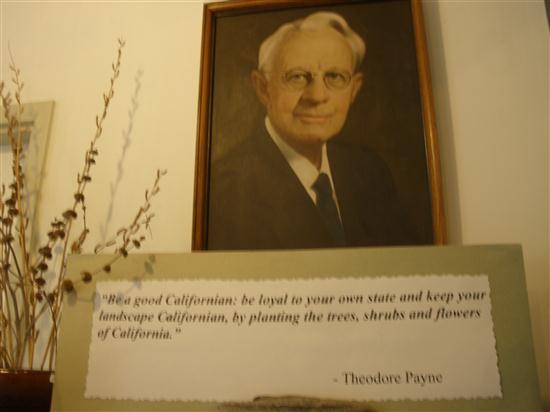
Theodore Payne Foundation Nursery & Gardens, Sun Valley - Theodore Payne (or T-Payne for short...ay) was an Englishman in the late 19th century who was so fascinated with California native plants, he moved here, only to discover that agricultural development in Southern California was depleting the land of its native vegetation. So, as part Luther Burbank, part Johnny Appleseed, he dedicated his life to preserving native plants, even going up into the hills and fields to collect seeds. T-Payne created native plant displays in Exposition Park, Cal Tech and Descanso Gardens and owned nurseries in Downtown and in Atwater (before it became a "Village," yo). T-Payne retired and died in the early 1960s, but The Theodore Payne Foundation was formed to carry on his work. In Sun Valley, the nonprofit operates a nursery where one can buy numerous varieties of potted natives and a living native plant environment growing in the hillside (you can even just drop by and have a picnic -- there's even tables there). They also conduct classes and native garden tours.  They should be the first place to check out if you want to learn about native plants!
Real talk from T-Payne.
Vista Hermosa Natural Park, Downtown - The Militant covered its opening back in '08, revealing a new place to get a killer Downtown skyline view. But this 10.5-acre plot of land, originally intended to be part of the LAUSD's beleaguered (isn't that being redundant?) Belmont Learning Center complex features the scent of sage and other native varieties. It's run by the Santa Monica Mountains Conservancy for the specific purpose of re-introducing native plant environments in urban Los Angeles.

Angels Knoll Park, Downtown - Speaking of DTLA, this mini-park, directly adjacent to Angels Flight Railway, is a virtual mini-version of Vista Hermosa, with fragrant Cleveland Sage bushes growing abundantly, as well as decorative native succulent plants (Of course, the pleasant sage aroma was likely intended to help mask the smell of the local homeless people's urine...)

Griffith Park - Toyon, chamise, sage and other chaparaal plants grow here in the eastern end of the Santa Monica Mountains. Hop on any of the 4.310-acre park's hiking trails and you'll see them. In some cases, they've been growing there just as they have in the days of the Tongva.

Bernard Field Station, Claremont - This 86-acre wildlife peserve along Foothill Blvd on the campus of The Claremont Colleges exists for both conservation and study, with both wild and human-planted native growth in a coastal sage scrub environment. As a bonus, native birds, reptiles, insects and wild mammals can be seen roaming the grounds.


'Cause native wetlands have a way with B-A-L-L-O-N-A...
Ballona Wetlands, Playa Del Rey - Even before he learned about Tongva culture, The Militant was downright outraged at Steve Soboroff's Playa Vista development taking over our last vestige of natural wetland in Los Angeles (apparently bad ideas aren't foreign to him...). Having biked the adjacent Ballona Creek bike path for nearly two decades, The Militant couldn't help but try to mentally block out all modern development and imagine taking a look back in time. Eventually, he did learn that this was the Tongva village of Saangna, which also included a large ancient sacred burial ground which was discovered during Playa Vista excavation.

Others have recently listed traits and criteria on being a true Angeleno -- well, The Militant believes that you can't be a true Angeleno without visiting the Ballona Wetlands and appreciating the (relatively) untouched serenity that have lasted for centuries. Developments can always be built elsewhere, but the wetlands are irreplaceable. May this land be disturbed no more!

Friday, September 23, 2011

Native Month: The Secret Life Of Local Plants (Part 1)


Los Angeles might frequently be dismissed as a "desert," but that's not actually accurate. The Militant believes people who tend to use that term are usually transplants want to secretly push a negative image of emptiness, of lifelessness, that there was nothing here to begin with, and therefore this place means nothing.

The truth is, Los Angeles is in a Mediterranean climate zone that is shared by only a handful of places in the world: Southwestern Australia, Southwestern South Africa, the central coast of Chile and the coast regions of the Mediterranean Sea. Is Cannes, France also considered an "empty, lifeless desert?"

The other truth is, before colonization, all of California was a lush paradise filled with an amazing biodiversity. In an example of life imitating art, The Spaniards named this part of the world after a paradside-like island of the same name fron a 16th century novel called Las Sergas de Esplandián by Garci Rodríguez de Montalvo.

Many of the indigenous plants are gone, either supplanted by introduced species from other parts of the globe or outright torn out by human development. But in our remaining wetlands, meadows and hillsides, they prosper. And thanks to contemporary issues like water conservation and ecological sustainability, California native plants are making a comeback in our parks and frontyards.

The Militant consulted one of his operatives, who started a few native plant gardens in his neighborhood and got a crash course in this whole native plant business. Needless to say, he can't wait to start a native plant garden in his compound!

Nearly all of our native flora are drought-tolerant since their growth cycles are compatible with our dry, rainy and blooming seasons (see, we do have seasons after all). They need no fertilizer since they know the soil. They also prosper by growing roots deep enough into the soil where moisture or a water source is always present. And best of all, they are a source of food, shade and shelter for some of our native insects and animals, being a foundation for our native ecosystem.

The plants in this post are but a sampling of the many varieties of So Cal indigenous flora and is by no means a comprehensive guide. But they are common and/or interesting enough for you to take notice when you spot them.

Native Plants
 
White Sage - This was perhaps the most important native plant to the Tongva and neighboring tribes. Its leaves are burned as incense for ceremonial uses, which is why white hippie/new age types like to rape and pillage the plant in the wild and sell for a profit as smudge sticks (capitalism, yaaaaay). They also provide high medicinal value (usually drunken as a tea), curing everything from coughs to colds to stomach aches. The greenish-grey leaves give off a strong, distinct scent when rubbed. In the Spring, tall flower stalks come from seemingly out of nowhere and bloom, making it a favorite nectar source for bees -- it's also known in its Latin scientific name as "bee sage."


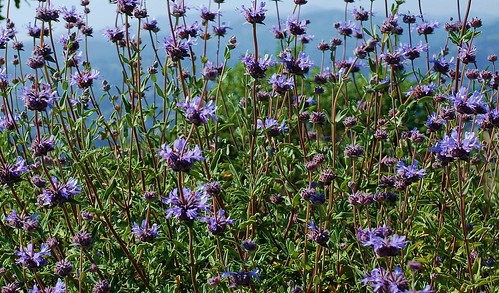
Cleveland Sage - Named after plant collector Daniel Cleveland, this sage (pictured at top of the post), popular with butterflies and hummingbirds, as well as California quails who seek shelter in its bushes, has an etremely pleasent, minty scent from its small green leaves (rub your fingers on one and take a sniff...ahhh). Its purplish-blue flowers bloom from orb-like stalks in the Spring and Summer. Got bedbugs (you know those bloodsucking parasites that East Coast people bring with them)? Take a bunch of Cleveland sage leaves and sprinkle them around your beddings. The sweet scent you smell is downright overpowering for them little critters, and they are naturally repelled by it. NATIVES FTW!


Toyon
- This hillside bush with dark, leathery green leaves and spiny edges are common sights in chaparral environments like the Santa Monica Mountains. If you hike Runyon Canyon or Griffith Park, you can't miss them. In the winter, they sprout berries (edible, but not very tasty, unless you're a deer or a bird) and resemble a holly. In fact, the toyon is also called the California Holly, and was the origin of the 9-letter name given to a famous landmark sign, the entertainment industry and an entire community that was built over the Tongva village of Cahugna. For more toyonic talk, check out The Militant's post from Christmas of last year.

Chamise - One of the most common chaparaal (the term "chaps" refers to the sturdy pants one must wear when navigating through the typically spiny plants in that environment) flora, this plant is also highly flammable during fire season due to its resin content. But like all natives, it adapts well to its conditions. In fact, fire is a part of its life cycle and not only germinates following a conflagration, but releases its own toxins into the soil to prevent competitor plants from growing on its turf. This plant is straight up gangsta!


Manzanita
- Not just a street in Silver Lake, but a type of plant of varying sizes known for its twisty branches, reddish hard wood trunks, bright floral blooms and berries that resemble tiny apples (hence its name in Español). The Tongva resourcefully used its leaves as toothbrushes, made cider from the berries and tea from its bark to cure stomach maladies. They also used its wood to make utensils and tools. Butterflies and hummingbirds can't get enough of their flowers.


Desert Agave
- This succulent plant that's grows primarily in the deser region can also be found in the Los Angeles area, in the more drier corners. This spiny plant lives for about 10-20 years and only flowers once in its lifetime, and then dies. But throughout its lifespan, agave "pups" will spring up from the ground, seemingly multiplying itself. Although agave is associated with tequila, this isn't the same variety that produces the booze (it's possible though, but not very commonplace). But the Tongva and the neighboring Cahuilla tribe used it for food, rops, utensils, weapons, soap and medicine.

Native Trees


Oak 
- The Coast Live Oak and the Scrub Oak most common varieties 'round these here parts. These trees were (and still are, relatively speaking), still numerous in the region, enough that places like Encino (Español for oak) and Thousand Oaks were named after the trees. The trees also grow acorns, popular not just with our native squirrels, but with the Tongva, who used them in multiple food uses. Aside from eating the acorn nuts, they also ground them and made them into flour, which was made into baked goods.

California Fan Palm - Palm trees are a Los Angeles icon no doubt, and developers and city planners were eager to plant them Like All Over The Freaking Place back in the 1920s-1940s. About half a dozen types of palms can be found locally, but only one is actually native: The California Fan Palm. It's actualy native environ is the lower desert region, where they grow in groves next to water sources. Places like Twentynine Palms and Palm Springs were named after these trees, but a few could be found in the Tongva nation. The Tongva's neighbors to the east, the Cahuillas (a.k.a. The Iviatim), used the fruit of the palms for food and flour, and used the leaves for sandals, baskets and roofing material.  


California Sycamore
-
This hardwood tree is known to grow near rivers, streams and foothills. It's also a deciduous tree, which means its green leaves turn orange in the fall (You East Coast people who constantly bitch about us "not having seasons" should cream in your pants just for that). Sycamore Avenue in Hollywood and Aliso Street in Downtown were named after the tree. And of course, our stately local sycamore was revered by the Tongva, most especially in center of the village of Yangna, especially one 400-year old specimen which you may or may not have heard of before.

If anything, The Militant noticed that our native plants share much in common with its native people: Deep roots, low maintenance and thrive best in this climate!

Having trouble spotting native plants? The Militant will show you where to find them in his next post!

Wednesday, September 7, 2011

Native Month: Wild Wild Life

Animals like this Brush Rabbit are only found
on the West Coast. Represent! 
One night, as The Militant took out the trash at his secret compound he saw it...just...staring at him.

The Militant, only rarely having seen it at his compound, simply blurted to the grey procyon:

"Dude, you're a raccoon!"

It just kind of stood there, with a "WTF?" look on its face, then deflty turned away.

Today on The Militant Angeleno's Native Week,after indroducing to you the native people and their villages, The Militant will talk about some the native animal life in the Los Angeles area.

Interestingly, despite heavy urbanization and development, most of the native animal species of this region are still around and can easily be seen, climbing on trees, scurrying on the grass, flying in the skies, prowling through the hillsides, and wading on the local waters. The Militant notes that in the past 230 years, the inhabitants of Los Angeles have actually done a better job preserving its native animals than its native people.

Although it is quite obvious that decades of developing the human environment have greatly compromised the habitats of these animals, either pushing them farther away or unintentionally pulling them closer.

Now, there are many animal species that are native to our area, and the Militant could even start another blog to talk about them all (he won't), but this list is a good primer. Birds are too numerous, but fortunately, public art comes to the rescue in this case. So the Militant will just limit the scope to land mammals you may or may not see on a daily basis.

Coyotes are probably the most popular animal of legend in the Southwestern U.S. A natural predator, they are naturally feared. But in actuality, most of the time, they actually fear humans, especially since development and sprawl have invaded their habitat. And with that, interactions between coyotes and humans and their domesticated animals have increased. Recent unfortunate human and pet encounters with coyotes have caused Orange County's Laguna Woods to make it legal to shoot them, but like The Red Hot Chili Peppers once said, True Men Don't Kill Coyotes.

The Mule Deer can be seen in hillsides. Straight up vegetarians, they have been a problem for some folks as these critters prey on garden plants. People can deer-proof their gardens via fencing or establishing plants and shrubs that deer aren't fawn'd fond of eating.

Mountain Lions, or more specifically, the North American Cougar (the Militant will refrain from making predictable older single women jokes, at least for now). But like the other kinds of cougars, the wildlife version is commonly feared (Okay, can't resist that one). Though there have been notable incients of mountain lion attacks, the animal is also normally afraid of humans, though will attack when provoked. Still, humans cause far more harm to mountain lions than the opposite. Just days ago, a mountain lion was struck by a car while crossing the 405 in the Carmageddon Pass.

Opossums - You see these critters all over the city, especially in backyards, making nasty hissing sounds (usually when they're afraid). People fear them because they are thought to carry rabies, but dem 'possums actually have a high level of immunity against rabies. The only marsupials found in North America, they're also omnivores that eat plants, berries, snails, snakes, rodents and even roadkill. Unfortunately, due to their slow velocity they themselves frequently become roadkill. Still they like to be left alone and it's best to keep your trash bins secure from them.

Rabbits were so numerous in the Southland, that an entire valley in southeastern Ventura County was named after them. As The Militant mentioned on Monday, the Tongva hunted rabbits for dinner. Two native species are common in the region: The Desert Cottontail, living in drier environs, and the smaller Brush Rabbit, which inhabits our local chapparal vegetation.

Raccoons, like opossums, are onivorous continental scavengers that fancy our trash cans. There have been incidents of them little masked marauders ravaging our local neighborhoods. Same as opossums, best to leave them alone and keep your trash bins secure from them. Unlike opossums, these dudes have attitude. Not just in The Militant's aforementioned encounter, but the fact that they can bite you and even have the ability to turn doorknobs.

Skunks are very common in hillside communities, especially noted for their stank, which can be smelled several freeway exits away. The Militant could easily recall the time he dropped on a Los Feliz-based operative off home one early morning and witnessed a Striped Skunk take a morning jog down the sidewalk on Hollywood Blvd. The Western Spotted Skunk is another native species that's common in these here parts. If you see one, try not to startle them. And if you get sprayed, run down to the store and get thee some baking soda and hydrogen peroxide to neutralize the stank and wash it off.

Squirrels are common in our backyards and parks, but the most visible one, the Eastern Fox Squirrel is not native. It was introduced by Civil and Spanish American war veterans around 1904 who stayed at the Sawtelle Veteran's Home. They brought them in as pets from Tennessee and soon got introduced to the wild. The native squirrels though are the California Ground Squirrel and the Western Grey Squirrel (mostly found in the foothill and mountain areas)

Despite being a large City, Los Angeles has its own animal kingdom. Again, they were here before we were so if ever there were another reason for discouraging suburban sprawl (other than traffic, long commutes, air pollution, obesity, real boring culture and Claim Jumpers), it would be to lay off their gang turf. Because these four-legged OGs don't mess around.


Wednesday, February 2, 2011

Urban Serenity: The Los Angeles River Bike Path

The Militant finally had an opportunity to ride the new section of the Los Angeles River Bike Path through Elysian Valley this week, which opened to huge fanfare two months ago. The Militant really wanted to check out the opening festivities, but he was tied up with some Militant community activities that day, not to mention that he may or may not have been easily spotted there.

But although the opening was blogged about many times, The Militant has always been about showing you a different angle. So during his recent ride, he was able to enjoy the bike path, not with politicians and crowds, but the way it was meant to be experienced.

After riding south through Atwater Village, he finally broke on through to the new section past Fletcher Avenue, marked by asphalt paving so smooth and dark, it almost looks like it was still wet from this past weekend's rains.

After passing the 2 Freeway overpass, the harsh white-noise roar of cars rushing above soon transitioned into the soothing rush of water and the intermittent quacking of ducks. Ducks? Yes, ducks! Lest you forget, the entire section of Los Angeles River, from Griffith Park to Elysian Valley, lies close to the underground water table, and was therefore never fully paved. The result is a glimpse of the what the River used to be -- and what many hope it will once again become -- replete with islands boasting California Bay Laurel trees protruding from the riverbed, and both native and migratory fauna walking, swimming or flying throughout. There are even mini-rapids where water rushes through rocks in the riverbed, forming calming sounds which soothe the senses. Aromatherapy, anyone?

It is in this section you can witness the Los Angeles River in pure serenity, with only the occasional whoosh and horn blare of a passing Metrolink train across the river interrupting the unexpectedly pastoral setting in the middle of this bustling metropolis.

Once in a while, you'll get a view like this, which just blows away most people's (predictably negative) perceptions of The River:
It was also a unique glimpse into the Elysian Valley (a.k.a. Frogtown) neighborhood - a tiny nook of 8,000 working-class residents living in the shadow of Chavez Ravine. A handful of pocket parks line the route, and the backyards of several houses face the river, some of which have roosters, dogs and California native plant gardens. Interesting to note, that the opposite side of Elysian Valley -- Riverside Drive -- is also a popular bicycling corridor, which The Militant has rolled through many times.

There was a time when the Los Angeles River Bike Path was just a boring, tiny little strip that ran 3.2 miles along the east end of Griffith Park. Whoopty-doo. But now it's grown to a decent 7.2-mile ride (that's 14.4 miles round trip - without worrying about cars); and even a one-way ride through its entire length will take you a while. Now all we need is a link south past Downtown to link to the rest of the River Path and north to the Valley! Let's do this!

More picturetude!


Cleaning crews were here today to maintain the Path.

FROGTOWN REPRESENT!

Frogtown? A couple of locals beg to differ.

The Militant wasn't the only one taking pictures of The River today.


Friday, December 24, 2010

Deck The Halls With Boughs Of Hollywood


Hollywood and Christmas seem to go hand-in-hand. Not only are there countless motion pictures over the years (like this one, this one and maybe even this one), blockbuster theatrical releases and a post-Thanksgiving weekend parade to kick off the season, but its very name is a reference to the holiday as well.

Those of you who know your local history know that Hollywood started as its own town, independent of Los Angeles, founded in the 1870s and incorporated in 1903. Unlike many local towns and communities named after places in the so-called "Back East" such as Beverly Hills (Beverly Farms, MA) and Wilmington (Wilmington, DE), Hollywood was named after a local, a native even.

The hills above Tinseltown are populated with numerous native bushes known as the Toyon a.k.a. California Holly a.k.a. Christmas Berry a.k.a. Heteromeles arbutifolia a.k.a. Hollywood Plant. Those of you who hike up Griffith Park's many trails have seen them - they have oblong dark green leaves with jagged edges, and in the fall grow clusters of tiny red berries (edible but not very tasty, for humans at least). The word "Toyon" is referred to many times in the Griffith Park area (Toyon Canyon). Yes, Hollywood was named after this very plant.

Around a century ago, Angelenos used to pick Toyon off of the hills for use as Christmas decorations. Eventually this practice became so widespread and noticeably depleted a number of the bushes that a 1920 California state law made it illegal to pick Toyon from public lands.

Thanks to that law, Toyon is plentiful in the Santa Monica Mountains today, where you can easily see them on any hiking trail, or on the road up to the Observatory. Of course this law is still in effect, but many local nurseries sell Toyon for you to grow if you want to revive the old Angeleno holiday tradition. Next time you spot one of these indigenous plants, think about how it's entrenched in history (and how the East Coast-based media hegemony has purposely corrupted its name to stand for all that is materialistic, vacuous and superficial). Militant Christmas, everyone!

Saturday, August 1, 2009

Let's Get Wet...lands, That Is!

Don't call it a comeback.

No, the Militant isn't referring to his recent return to blogging, which may or may not have come after a vacation to an unspecified far-off land, illness, a busy schedule, just plain laziness, or one or more of the above.

The Militant is talking about wetlands.

The original pre-urban Southern California landscape was once dotted with wetlands, swamps and marshes, which go down as far south as San Diego. Here in Los Angeles, wetlands live on mainly in the historical etymology of streets (i.e. La Cienega - "The Swamp") or, as one of the most well-known remaining wetland areas - the Ballona Wetlands south of Marina Del Rey.

Another well-known wetland is the Bixby Slough, an area near Harbor City and Carson, straddled by the 110 Freeway. Today it makes up Ken Malloy Harbor Regional Park, which contains Lake Machado, best known worldwide as the former home of Reggie The Alligator, who at one point was Southern California's most popular reptile, surpassing this guy for a time.

Today's Ken Malloy Park is but a tiny fraction of the size the original wetlands area was, but the Militant is glad to report that a recently-restored part of the Bixby Slough is making a return in the 21st century.

On Saturday, August 1, the Los Angeles County Sanitation District will open to the public the Bixby Marshland, a 17-acre plot of wetlands near the corner of Sepulveda Blvd and Figueroa Street (yes, they do intersect!) in Carson. The Sanitation District, which runs a water pollution control plant nearby, has decided to restore the marshland to support native flora and fauna to re-create the ecosystem once lost in the rush to industrialize the land.

You can't just walk in anytime, though, the Bixby Marshland will only be open to the public from 8 a.m. to 12 p.m. on the first Saturday of the month -- which means you'll only have today, September 5, October 3, November 7 and December 5 of this year to check it out.

The Militant may or may not be there today, but if you spot him (give it a shot, who knows?), raise a fist and he'll raise his back!

Friday, May 23, 2008

The Militant Shopped At HK...Today Was A Good Day

You know it's a slow blogging pre-MemDay weekend Friday when the Militant's topic is something as mundane as grocery shopping. But it doesn't matter, most of you probably won't get to read this until Tuesday, and no one seemed to be interested in the last two posts anyway, and only now has the local blogosphere started to notice a post the Militant wrote over a week ago. Bleah, you people...

...Where was the Militant? Ah yes, grocery shopping. Anyhu, the Militant decided to go pedal on down Oxford Avenue to K-Town and into one of his favorite Korean markets right at 1st and Western, HK Super Market (an acronym which, if it were located in the SGV would stand for something else, but in this case, it stands for "Han Kook" (Han-guk) which in Korean is the commonly-used nickname for the Republic of South Korea, and is probably the main reason why Korean immigrants in the late '60s decided to build their community more or less where it is today - in close proximity to Hancock Park (betcha LAist wasn't even aware of that)).

As the Militant locked up his bike, he saw a Latino grocery store employee playfully converse with a departing female Korean customer in her native language. If that doesn't exemplify Koreatown, the Militant doesn't know what does.

The Militant took along, and for the very first time, his freebie Belmont Station reusable grocery bag he got at a nearby event about a month ago and bought some strawberries and cherries (which cost way less here than in some other markets). But there was something here which the Militant totally dug - FREE SAMPLES!

Bookending some of the aisles there were salesladies giving away free samples (pictured right) of tofu soup, udon, soba, sushi, plum juice and many other food items co-opted from Japan. Some of them insisted on speaking Korean to the Militant (which he may or may not be, in whole or in part). Of course it's a marketing ploy, a tasty, delicious marketing ploy. So the Militant bought a soba noodle "kit" and a package of laver (seasoned dried seaweed). Sold!

When the Militant went to the checkout counter, he didn't know what to expect. The grocery bag dude was reaching for the plastic bags and the Militant was expecting a "WTF?" look from him. It was now or never...But as soon as the Militant reached for the big green reusable bag, the grocery bag dude held out his hand, received the reusable and nonchalantly loaded it up with the Militant's purchases. The future is now, folks.

The Militant rode back to the compound, but the weighty bag, slung through his shoulder as he was pedaling, was a tad bit awkward, as his leg brushed against the bad on every up-pedal. The Militant sees a lucrative future for anyone who designs and markets a reusable grocery bag with backpack straps...

Tuesday, April 22, 2008

Earth Day Festival: Wilshire Goes Car-Free

Drawn by the streetlight banners that hung over this City's other great boulevard in the past several weeks, the Militant made it down to the first-ever Wilshire Center Earth Day / Car Free Day Festival on Tuesday along Henry Gaylord Wilshire's namesake thoroughfare, between Western and Harvard to celebrate Urf Day.

Now, as you may or may not know the Militant by now, many days of his week are already Car -Free days, so really this kind of day is like a Lenten Friday for a vegetarian Catholic. But still, the Militant skeedaddled on his trusty two-wheeler, this time down the nice, bike-friendly corridor of Serrano Avenue, where he found a lively street festival and an even more lively crowd in front of the fest's entertainment stage at the Radio Korea building's front lawn (pictured above - nice use of open space, btw).

The festival location was Metro-accessible (the festival was bookended by two (M) Purple Line stations), but it seemed the mode of choice was la bicicleta, (excellent, as it gave the Militant an opportunity to blend in with the crowd, and not become easily recognized). The Los Angeles County Bicycle Coalition had their bike valet get-up, a free service which the Militant may or may not have taken advantage of.

The booths featured what you'd usually expect to see from an eco-oriented event: Environmental awareness/advocacy groups, Green-conscious merchandise, non-profit organizations and alternative energy demonstrations (pictured left). The Militant, who is eco-conscious yet can't stand the whole hippie-dippie culture thing was pleased to see this was a festival that did reach out to everyone. The trilingual signage reflected the local English, Spanish and Korean communities and people of all ages - from the little tykes who came in groups bearing the bright violet L.A.'s Best and bright green KYCC t-shirts to the older set.

The Los Angeles Eco-Village booth caught the Militant's attention, not because of their recently-inaugurated Bimini Place Shared Street project, but because they had a historical display of the old Bimini Baths, which stood near the present village, which not only showed wowee pictures of the old days, but depicted Sacatela Creek (sorry, no pictures online), a natural perennial stream which once ran from the Los Feliz area down towards Ballona Creek, but was ultimately replaced by an underground storm drain and filled in the 1930s (boo!).

There was live musical entertainment, some of it that hippy-dippy folksy stuff the Militant couldn't stand, but thankfully on the big entertainment stage there was a variety of live music, headlined by Michael Franti (of Disposable Heroes of Hiphoprisy and Spearhead fame), as well as acts that ran the gamut from hip-hop to reggae to latin to electronic.

Spurred by the whole we- gotta- eschew- plastic- bags- like- right- now movement, the hottest item at the festival by far were reusable grocery bags, being given away by sponsors like the overpriced Whole Foods Market. Thing though, he saw a lot of greedy people out there walk around with a half-dozen or so bags, leaving very few or none for people who came looking for them. Learn to share, people! The Militant got a little agitated at the lack of their ability he threatened one vendor vowing to continue to use plastic bags unless he got his reusable. But he quickly calmed down once he found a dude handing out reusable bags printed with the logo of the Belmont Station apartment complex - incidentally built right in front of a famous Pacific Electric Red Car relic.

But two middle-aged women asked the Militant in Spanish where he got his green bag. El Militante regretfully had to tell them, "No mas." But hey, it's a good sign these things are more in demand these days.

The Militant also found time to chat with several operatives, one of which worked in a nearby building (but didn't do the car-free thing, boo) as well as running into some familiar faces who also pedaled it in (if there are any transplant n00bs reading this (probably not very many as the Militant has probably scared many of them away), when you run into people you know randomly on the street, it makes our city feel much smaller. Remember that).

Word on the street was that the event's organizers, who longed to do this kind of event for quite a while, deemed the event was a great success and plan to make this an annual affair. So make your car-free, green-baggin' plans for Wilshire Blvd come Urf Day '09.

URF!

Happy Urf Day, everyone.

Tuesday, April 8, 2008

Plastic, Oh No, Banned

Some of the other local blogs have already reported that Swedish-based furniture retailer Ike...oops, wait, it's all caps...IKEA will discontinue its use of disposable plastic bags by Fall of this year. Since March 15 they have already charged five cents for people who do need the bags, and are encouraging customers to bring their own reusable bags, which they are selling at 59 cents a pop.

The Militant, a frequent reader (and commenter) of rival guerrilla factions, was engaged in commenting to an IKEA-bag post, when he hit the three-paragraph limit and decided to copy and paste the text into Notepad and make is own damn post instead. So here 'tis.

The Militant was at the Burbank IKEA last week to buy an unspecified piece of particle-board material furniture, plus a couple of cheap plastic storage bins (extra kudos to them for having bike parking, and not the cheap-ass wheelbender kind either, though the Militant had to drive there since his purchase weighed over 100 pounds, and that would have been one helluva masochistic bike ride back to the compound). He obviously didn't need any bags but applauded IKEA's effort to reduce plastic bag consumption by 50%. No not because he's some knee-jerk treehugging cliche, but for the obvious fact that those bags are everywhere - on the street, on sidewalks, in alleys, not to mention scattered all over the Los Angeles River. They're also found in our beloved beaches (as any Heal The Bay cleanup volunteer would attest), and worse, they're part of that two-times Texas-sized big-ass floating plastic crap thing (pictured right) currently circulating in the Pacific Ocean.

On a little tangent here, the Militant was eating some imported Japanese chocolate-filled cookies bought recently from a specified Echo Park grocery. The plastic foil package, with a plastic tray inside, contained 10 cookies -- each individually concealed in its own plastic foil wrapping. WTF here? All this plastic just for a few damn cookies?

But as a shopper who has bought reusable bags from other stores, namely Trader Joes, the Militant tends to forget to bring his canvas bag, especially since his TJs trips are mostly spontaneous events. He can leave the bag in his car trunk, but then if he decides to make a bike trip there, he's SOL. Oh well, he settles for paper most of the time, which makes for a convenient container when it's that time of the week to feed the blue bin.

Oh well, its all excuses anyway. But old habits, from both the retail and consumer ends, need to be broken. TJs does give an incentive for shoppers using the reusable bags, usually in the form of a raffle for a gift certificate. Surely the larger chain stores and supermarkets can do it too, and probably will eventually, but what about the smaller mom & pop markets-cum-liquor stores in the hood that all use black plastic bags? What about the local farmer's market or swap meet?

The Militant would love it if there was some rolling clump-like thing that could collect all the plastic crap on this planet (and perhaps result in a plastic mass large enough to function as Earth's second moon). Or maybe some alien Fred Sanfords from outer space would come visit Earth in search of our plastic crap (which would be like gold to them, and toxic waste like diamonds), and declare to the Earth-dwellers, "All Your Plastic Are Belong To Us?"

Oh well, in the meantime, while the Militant monitors his SETI signal feed, its time for us humanoids to fess up and start reducing our plastic waste habits. And not just for total environmental reasons -- plastic is derived from petroleum so the higher price at the pump will affect the price of them bags accordingly. Ergo, you're gonna pay a little more for stuff just because them bags will cost more for stores to purchase.

The Militant already declines to use bags for small purchases. He will commit more to the reusable bag route. Little steps to put this big-ass problem in the bag.

Monday, July 23, 2007

Villaraigosa So Far...

Call it a progress report, or some spin for this city to prove Da Mayor has been doing more than just Mirthala Salinas, but a 40-page document from the Mayor's Office entitled Midterm Report 2005-2007: Delivering Results for Los Angeles was released last week and personally handed to various community leaders from around the city at a meeting this past weekend by Deputy Mayor Larry Frank. (The Militant was able to obtain a copy, but the report is available online as a .pdf in the link above). The report enumerates various accomplishments and works-in-progress from Mayor Villar. In the report:

• Sidewalks repaired: 145 miles
• Streets resurfaced: 425 miles
• Potholes filled: 540,833
• Trees trimmed: 147, 209
• Graffiti removed: 35 million sq feet
• New parks opened: 10
• Recreation facilities opened: 20
• New fire stations & training facilities opened: 6
• New libraries opened: 6

In the works-in-progress department, the report indicated that 300 of the 1,000 new LAPD officers promised by Villaraigosa have been added to the force, and according to Frank, 98,000 of the one million trees promised by El Alcalde have been planted (They can reach their goal by re-greening Griffith Park alone). Frank also admittedly attributed the pothole-filling progress to our recent lack of rain (water helps erode the integrity of asphalt), and jokingly stated that "we might run out of potholes to fill."

But Frank mentioned some interesting factoids on Los Angeles regarding energy and the environment that were news to this Militant, mainly that 60% of Los Angeles' (population: 4,000,000) electricity comes from a coal plant in the Great Basin town of Delta, Utah (population: 3,200). Further Militant research indicated that, according to the town history, "Delta is rather unusual among the primarily agricultural towns in the state, since it was founded in the twentieth century and owed virtually nothing regarding its establishment to direction from the general hierarchy of the Church of Jesus Christ of Latter-day Saints." The power plant (pictured above) is part of the Intermountain Power Project and run by the Intermountain Power Agency. Seventy-five percent of its power goes to Southern California, which, besides Los Angeles, also juices-up the cities of Anaheim, Riverside, Pasadena, Burbank and Glendale (The Los Angeles Angels of Anaheim, whose stadium once sold its naming rights to an energy company, has their Triple-A Minor League affiliate based in Utah. Coincidence?). Frank mentioned that the Mayor more than doubled the amount of renewable energy sold by the DWP - from 3% to a whopping 8%. Frank did mention to the community leaders (and not mentioned in the report) that the City is working out some deal with companies in China to create training and manufacturing opportunities to build solar energy panels locally. Fingers crossed...

Shield Us From Destruction!
The Militant finds humor in repetition, cliches, the predictable. So on Saturday on his way to the Pilibos School in Little Armenia for the LACommons event he spotted one of those little FilmLA filming notices posted in front of an apartment building for a shoot on Tuesday. Gee, that's cool they're filming in this neighborhood, I just hope it's anything but The Shiel...D'oh!