Showing posts with label MacArthur Park. Show all posts

Wednesday, October 14, 2015

The Militant's Epic Militant CicLAvia Tour 3.5!!!!


A certain state/local agency believes that the first 5 years of a child's life is crucial for its development and eventual success and well-being later in life. Our little youngster CicLAvia is now old enough for Kindergarten and during its first 5 years of life, it's taken us all over Los Angeles from Venice Beach to East Los Angeles, from North Hollywood down to South Central (and even Pasadena as well). Our little kindergartener has been well-loved by Angelenos, and well-cared for by its parents and godparents. Since it was born, it even has younger siblings born in places like San Diego and Long Beach. So, this child is off to a very happy start in life, and like every happy youngster, never fails to make us all smile. Happy 5 years, little CicLAvia!

As you may or may not know, The Militant has been doing these local CicLAvia guides ever since the second CicLAvia in April 2011. Though this "Heart of L.A." ride -- the 15th iteration of CicLAvia since it be can in 2010 -- runs through some very familiar territory, especially for you veteran CicLAvians (all you 15-timers, let's hear ya!), this is a City that's known for change, and even in the past 5 years, certain places have changed with a look towards the future. This Epic Militant CicLAvia Tour guide also reflects that, with a few updated locations added to the route, including a couple sites that will never look the same again.

To celebrate 5 years of CicLAvia, The Militant invites you to comment or tweet (Hashtag #EpicCicLAviaTour) some of your favorite memories from the past 5 years.

Happy CicLAvia and STAY MILITANT!

1. Hollenbeck Park
1892
4th and St. Louis streets, Boyle Heights

John Edward Hollenbeck was a rich dude in the late 19th century who founded the First National Bank of Los Angeles (more on this later) and purchased parcels of land in Downtown, the San Gabriel Valley and the Eastside, where he made his home. Hollenbeck was also credited with the creation of what is now called Exposition Park. His sister married his friend, James George Bell, who founded...Yep, you guessed it! After Hollenbeck's death in 1885, his widow, Elizabeth, donated a 21-acre parcel of land, which was essentially their front yard, to the City. One of the Los Angeles’ oldest parks, it was established in 1892 and continues to function today.

2. Hollenbeck Palms (Site of the Hollenbeck Residence)
1896
573 S. Boyle Ave, Boyle Heights

Take a quick detour from the CicLAvia route on 4th street and head down Boyle Ave a block and a half south. On the site of this retirement facility, which directly dates back to the Hollenbecks' involvement, John and Elizabeth Hollenbeck made their home. The original Hollenbeck residence had a room built for the care of John's elderly father. After John's death, Elizabeth donated land she owned across the street (since visually separated from Boyle Ave in the 1950s due to construction of the 5 Freeway) for Hollenbeck Park and, in another act of philanthropy, created the Hollenbeck Home for The Aged on her property in 1896, offering free board and care for the residents for the rest of their lives. After Elizabeth's death in 1918, the Hollenbeck Trust operated the elderly home (modernized in 1985), and continue to run it today.

3. 6th Street Viaduct
1932
6th Street (visible from the 4th Street Viaduct) at the Los Angeles River, Downtown

While on the 4th Street Viaduct, pause for a moment (when you're not pausing to take that group selfie with the Downtown skyline in the background), point your eyes due south and take a good look at your bridge's cousin, the 6th Street Viaduct, with its trademark double arches. This will most likely be the last time you'll see it in its present form.

In 2007, engineers discovered that the 3,500-foot concrete connection between Downtown and Boyle Heights had a condition since it was first built called Alkali-Silica Reaction, which meant that the high alkali content in the source material in the concrete causes a chemical reaction to weaken it, rendering the bridge extremely vulnerable to collapse during a stressful event such as an earthquake.  The City of Los Angeles will shut down the bridge in November and begin demolition work for its 21st century-style replacement -- but not before throwing a big-ass concert and street party (bridge party?) next Saturday.
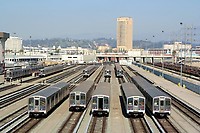
4. Metro Division 20 subway car yard and site of old Santa Fe LaGrande Station
1992 / 1893
320 S. Santa Fe Ave (visible from the 4th Street Viaduct), Arts District

Take a break from riding/walking/skateboarding/pogo-sticking/etc. and take a glance off the north side of the bridge from the west bank of the River. This facility is where the 104 Italian-built subway cars of the Metro Red and Purple line cars are stored, repaired, serviced and cleaned. This was also the temporary storage and repair site of the Angels Flight railway cars after the fateful 2001 accident. The Militant actually visited this facility back in May 1992.

The subway cars are also serviced on the site of the old Santa Fe Railway La Grande Station (hence the name of the street) that was on Santa Fe and 2nd. Built in 1893, it was precisely where midwestern transplants arrived in Los Angeles after paying their $1 train ticket from Chicago. In 1933, the landmark dome was damaged by the Long Beach Earthquake and subsequently removed. In 1939, it was rendered obsolete by the opening of the new Los Angeles Union Passenger Terminal a few blocks north.

5. Site of Southern Pacific Arcade Station
1888-1914
4th and Alameda streets, Downtown Los Angeles

Before there was a Union Station, there were various rail passenger terminals in Los Angeles, many of them just a short distance from the Los Angeles River. On what currently stands as a large shopping mall, this was the original site of the Southern Pacific Railroad’s Arcade Station which served passengers up until 100 years ago. A popular landmark of this station was a young palm tree, which was moved a century ago to Exposition Park where it stands today, much taller, in front of the Los Angeles Memorial Coliseum. Unfortunately for indie rock fans, the Arcade Station was not devastated by a Fire, but was dismantled and replaced by a new station, the Central Station, located one block south.

6. Metro 1st St /Central Station Site
2020
1st Street and Central Avenue, Little Tokyo

Up until last year, this lot was home to the popular SeƱor Fish taco joint (formerly the site of '70s-'80s punk venue Atomic Cafe) and Weiland Brewery Restaurant (which opened replacement locations in Echo Park and Uptown Long Beach, respectively). Both buildings were demolished in early 2014 to make room for this new Metro subway station for the Regional Connector Transit project, which, upon opening by 2020, will merge three light rail lines into two and allow passengers to ride from East Los Angeles to Santa Monica and from Azusa to Long Beach, without a transfer to the Red/Purple lines. This new station will replace the surface-level Little Tokyo/Arts District station across the street.

7. Site of Quaker Dairy, Original Little Tokyo Restaurant
1890
304 E. 1st St., Little Tokyo
On the southeast corner of 1st and San Pedro streets once stood the Quaker Dairy, a restaurant started on this site in 1890 by Sanshichi Akita, an immigrant from Japan. Though preceded five years earlier by another restaurant on First St (location unknown), this is the oldest traceable location of a Little Tokyo business. By the end of the 19th century, there were over 16 Japanese-owned restaurants in this stretch of 1st Street, creating what we know as Little Tokyo.
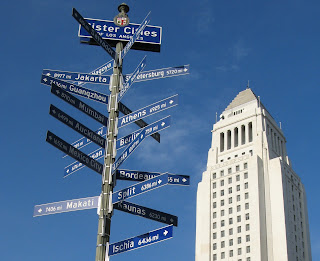
8. Los Angeles Sister Cities Monument
1987
1st and Main streets, Downtown

On the northeast corner of 1st and Main streets stands a pole bearing signs (in the "Blue Blade" style, no less) for every one of Los Angeles' 25 Sister Cities, each pointing towards their location. The signs range from Lusaka, Zambia (the farthest sister city, 10,017 miles) to Vancouver, Canada (the nearest, 1,081 miles) and everywhere in between. Nagoya, Japan is Los Angeles' oldest sister city (1959); Yerevan, Armenia is the newest (2007). Los Angeles, an Olympic host city (1932, 1984) also has that in common with sister cities Athens (1896, 2004), Berlin (1936), Mexico City (1968) and Vancouver (2010). Okay, the Militant is just filling up this paragraph with mindless trivia.

9. Los Angeles Police Administration Building
2009
100 W. 1st St, Downtown

Having opened less than two years ago, there's nothing really historic about this building, but do stop and take a picture of City Hall's reflection from the facade's glass panel. It's like, the thing to do!


[NOTE: If going on the northern leg to Chinatown, skip down to 21.]


10. Site of the Wilcox Building, First National Bank
1896
2nd and Spring streets, Downtown

Remember Mr. Hollenbeck? He be makin' serious bank! Oh wait, he literally did. As was mentioned, he founded a bank called the First National Bank of Los Angeles, which made its original home here on the southeast corner of 2nd and Spring in what once stood the Wilcox Building. Check this out: First National Bank merged with the Farmers and Merchants Bank to become the Security-First National Bank, which became Security Pacific National Bank (1967), and was eventually purchased by Bank of America in the 1990s. 
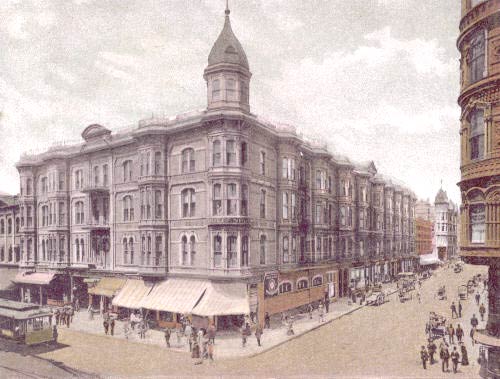
11. Site of Hollenbeck Hotel & Metro 2nd St/Broadway Station Site
1884/2020
2nd and Spring streets, Downtown

Man, this Hollenbeck dude got around! We're not quite through with him yet. Directly across Spring Street from the bank stood the Hollenbeck Hotel, a pretty swanky, bougie inn back in the day. He owned not just the hotel, the entire block the hotel stood on (He sooo money!). As more hotels were being built in Downtown, this one eventually lost ground to its competitors and was demolished in 1933. The site has been a parking lot for the past several decades, but is currently the construction site for the upcoming Metro Rail Regional Connector Transit Project 2nd/Broadway Station, one of three new light rail subway stations coming to Downtown in 2020.

12. Broadway-Spring Arcade Building
1924
541 S. Spring St, Downtown

This unique building is actually three, opened in 1924 on the site of Mercantile Place, a 40-foot street cut between 5th and 6th streets connecting Broadway and Spring. Mercantile Place was a popular shopping and gathering locale in the early 1900s. Having fallen into decay by the 1970s, it was recently renovated and is now famous for, of all things, vendors selling rock band t-shirts. It also becomes an artistic venue during the DTLA ArtWalk. And The Militant probably doesn't need to mention that this building is home to the DTLA Guisado's.

13. Site of Original Ralphs Supermarket
1873
6th and Spring streets, Downtown

Before the Hotel Hayward building was built in 1905, George A. Ralphs (see, that's why there's no apostrophe) and his brother Walter B. started the Ralphs Bros. Grocers on the southwest corner of 6th and Spring. Their company still continues to this day, and in 2007, the company that started in DTLA returned to the area after some 50 years.

14. St. Vincent Court
1868
St. Vincent Ct and 7th Street, Downtown

You'd hardly knew it was there, but this alley nestled between Broadway and Hill (blink and you'll miss it!), with its decorative brick pavement and European decor, seemingly belongs to another world. Originally the site of a Catholic college that was the predecessor of today's Loyola Marymount University, today it's a unique food court featuring Armenian and Middle Eastern eateries. The Militant calls it, "Littler Armenia." Check out this Militant Angeleno post on St. Vincent Court from 2008 for more info!

15. The Bloc (Formerly Broadway Plaza/Macy's Plaza)
1973
7th Street between Flower and Hope streets, Downtown

A poster child for change in Downtown, this shopping center, originally built in 1973 and designed by Charles Luckman & Associates as the first suburban-style mall in DTLA combined an indoor (though massively truncated) indoor galleria, a hotel and a 32-story office building. Initially known as Broadway Plaza, named after the old upscale Southern California department store anchor tenant, its name was changed to Macy's Plaza in 1996 after The Broadway merged with the NYC-based equivalent Macy's. Its blocky, street-unfriendly design was derided by many, especially in an era where the outdoor mall format pioneered by Santa Monica's Third Street Promenade, and Rick Caruso's faux-urban monstrosities (and more recently, the newly-opened The Village at Westfield Topanga),  so in 2013 it was re-conceptualized as "The Bloc" and currently stands as a work-in-progress, (which will also feature a direct entrance to the 7th Street/Metro Center subway station). Expect its 2016 grand opening to feature a big-ass Bloc party (The Militant made a funny, hardy har har...).

16. Wilshire Grand Center Site
2017
Wilshire and Figueroa (SW corner), Downtown

What's with all this construction going on here?

Previously the site of the Wilshire Grand Hotel, and formerly (in reverse chronological order) the Omni Hotel, Los Angeles Hilton, Statler Hilton and Statler Hotel, on this site will rise the Wilshire Grand Center, Los Angeles' (and the West's -- suck on it, Salesforce Tower SF!) tallest building at 73 stories and 1,100 feet (kinda sorta, there's a spire, you see...). It will also be Los Angeles' only modern skyscraper without a flat roof, which will house Wilshire Grand Hotel 2.0 and a bunch of shops and condos. The building will also have a "sky lobby" up at the top and will be the first skyscraper anywhere to sport a mohawk.

In February 2014, this construction site earned a Guinness World Record as the longest continuous concrete pour for its foundation structure.

17. City View Lofts/Young's Market Company Building
1924
1610 w. 7th St., Pico-Union

Ever wondered what's the deal with this 4-story Italian Renaissance-style building? It was built in 1924 as a liquor warehouse and original headquarters for Young's Market Company, which still operates today as the largest liquor distributor in the West. This building features actual marble columns and a decorative frieze made of terra cotta. The company, in the roaring, pre-depression 1920s, just felt like it. The building was looted and burned in the 1992 Riots and was rehabbed in 1997 to become the City View lofts. The building is in the National Register of Historic Places.
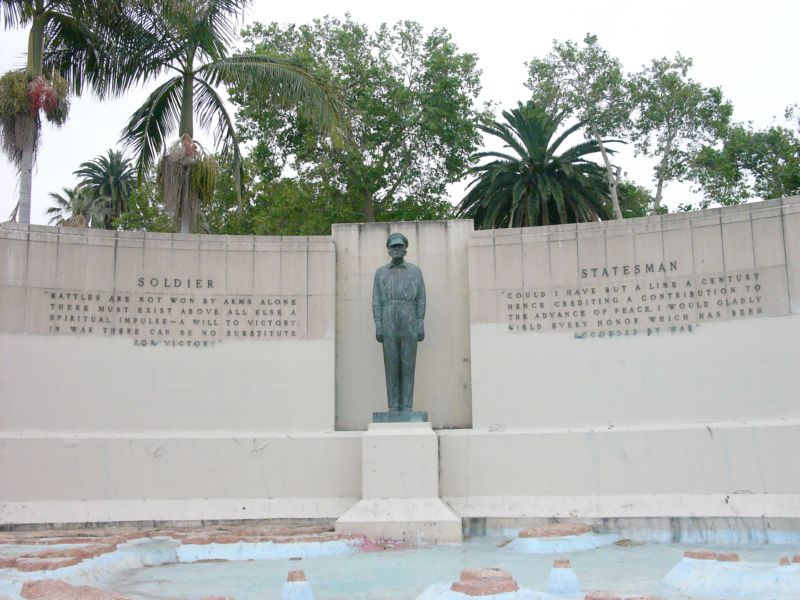
18. Gen. Douglas MacArthur Monument
1955
Southeast corner of MacArthur Park, Westlake

It's sort of strange how a monument to the park's namesake seems almost invisible (Gen John Pershing, MacArthur's WWI counterpart, could totally identify). In fact, most people don't know it's even there, but on the southeast shore of the lake is a dormant memorial fountain featuring a statue of the WWII general overlooking a model of the Pacific theatre (no, not that one) where he led allied forces to eventual victory. It was designed and built in 1955 by Roger Noble Burnham, who previously sculpted the Tommy Trojan statue on the USC campus and taught at the Otis Art School, formerly located nearby.

19. The Spheres at MacArthur Park
2015
MacArthur Park Lake, Westlake

This public art installation by Santa Monica-based nonprofit Portraits of Hope, is one of several projects the organization has done nationwide as a form of creative therapy to benefit seriously ill and disabled children. Nearly 3,000 vinyl spheres, decorated by Portraits of Hope volunteers, were placed in the water (each anchored by a sack of rocks and rope) starting in August, and were originally intended to stay until the end of September. But fortunately, just for you CicLAvians, the installation will remain in time for Sunday, so get your floating ball selfie action on!

20. Gen. Harrison Gray Otis Statue
1920
Northeast corner of Wilshire and Park View, Westlake

Gen. Otis is perhaps the most visible statue at the park, which predates MacArthur's WWII service. This general served in the Spanish-American and Philippine-American wars, and also fought as a Union soldier in the Civil War. But in Los Angeles, he is most known for being the founder, owner and publisher of the Los Angeles Times.

So why is he here? His Wilshire Blvd mansion, called The Bivouac, was located across the street, was later donated to Los Angeles County and became the original campus of Otis Art Institute. It's thought that his statue is pointing to the site of the Elks Lodge, but he's probably just pointing to his old house.

Northern Leg (To Chinatown):


21. Federal Courthouse Site
2016
145 S. Broadway, Downtown

That big-ass hole in the ground by 1st and Broadway has been here for, like, forever. But it was once the site of the Junipero Serra State Office Building, which was damaged in the 1994 Northridge Earthquake and abandoned and demolished in 1998. Right now,  it’s the construction site for a 10-story, 400-foot-tall U.S. Federal Courthouse building (don't we already have a few of those?), designed by Skidmore Owings and Merrill, which will open in 2016.


22. Grand Park
1960, 2012
Open space between Grand Avenue and Spring Street, Downtown

Grand Park isn't really a new park, but a renovation and re-branding of what used to be the Los Angeles County Mall.  Since then, it's become Los Angeles' new town square, hosting everything from concerts, to festivals, to weekend movie screenings, to holiday programs, to just a place where kids can splash around in the fountain. The Militant was there on its opening day back in July 2012!

23. Hall Of Justice
1926
Temple Street and Broadway, Downtown

No, you won't find Superman or any of the Super Friends here.  But this building, the oldest surviving government building in the Los Angeles Civic Center, was built in the mid-1920s as the original Los Angeles County Courthouse and Central Jail (which once housed the likes of Busy Siegel, Sirhan Sirhan and Charles Manson), as well as the headquarters for the Sheriff's Office, the District Attorney and the County Coroner. This Beaux Arts-style building was designed by Allied Architects Association, an all-star team of local architects put together to design publicly-funded buildings. At the moment, its facade is covered in scaffolding and tarp, as part of a major renovation project to modernize the facilities and repair damage from the 1994 Northridge Earthquake. It recently re-opened as a LEED Gold Certified building (gotta be sustainable, y'all), and the Sheriff's and District Attorney's offices will return.

24. Site of Los Angeles' French Quarter
c. 1830s-1960s
Aliso Street and Arcadia Street, Downtown

Beleive it or non, Los Angeles had a French ethnic enclave, called The French Quarter. Before today's Hollywood Freeway trench and nearby parking lots was a bustling community of Franco-American businesses and institutions. When Frenchman Jean-Louis Vignes bought up land on the Yangna village site a few blocks east on Aliso Street, he essentially became the anchor of our French community. In 1912, businessman Marius Taix opened the Champ D'Or Hotel on Commercial Street and then opened his namesake restaurant in the same building in 1927. But the most famous constibution to our French Quarter was Philippe Mathieu's restaurant, which opened in various locations in the area. In 1918, his restaurant on 246 Aliso Street gave birth to The French Dip sandwich. But urban development (and cultural assimilation by the community) destroyed the French Quarter. In 1951, Philippe's moved a few blocks north to their present location on Alameda Street due to Hollywood Freeway construction, and Monsieur Taix's restaurant moved a decade later to Echo Park.

25. Chinatown Gateway Monument
2001
Broadway and Cesar E. Chavez. Avenue, Chinatown

Designed to be the symbolic entrance to Los Angeles' Chinatown District, The Chinatown Gateway Monument, a.k.a. the Twin Dragon Towers Gateway, depicts two dragons grabbing at a central pearl, which symbolizes luck, prosperity, and longevity. The 25-foot-tall structure was put up in 2001 and occasionally emanates steam coming from the dragons' mouths. Unlike Anglo dragons, the creatures in Chinese folklore are the good guys, meant to scare away evil spirits.

26.  Buu Dien
c. 1990s
642 N. Broadway (Facing New High St, south of Ord), Chinatown

If you're ever in some TV trivia contest on your way to being a millionaire and the host asks you, "What is the Militant Angeleno's favorite Vietnamese banh mi place west of the Los Angeles River?" you won't need to call a lifeline, because the answer is Buu Dien. When the Militant has only $4 in his pocket and wants to get a meal in Downtown, this is his go-to joint. A literal hole in the wall in every regard, this place serves bomb-ass (do people still use that phrase) Viet sammiches for less than $3 a pop. And the bread is awesome. And nice and warm. Plus they also serve up spring rolls, desserts, pastries, Vietnamese coffee and pho (never had it here yet, but The Militant's favorite pho WOTLAR is Pho 79 just up the street). People complain about parking in his micro-mini mall, but this is CicLAvia!

27. Capitol Milling Co.
1883
1231 N. Spring St, Chinatown

One of the last visible vestiges of Los Angeles' agricultural industry, this family-owned flour mill operated from 1831 to 1997, before moving its operation to a much larger facility in Colton. The facility that still stands today was built in 1883. The mill supplied flour to clients such as Ralphs, Foix French Bakery and La Brea Bakery. In 1999, the family-owned operation was purchased by industry giant Con-Agra Co.


The historic building, built even before the railroads arrived in Los Angeles, still has a horse-tethering ring, back to the days when grain was hauled by horse carriage from farms in the San Fernando Valley.
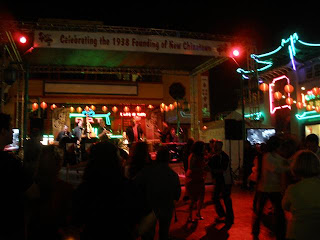
28. Old (New?) Chinatown Central Plaza
1937
Gin Ling Way between Broadway and Hill, Chintown

The new northern terminus of CicLAvia is no stranger to public events; it was made for them. In the Summer it hosted three very popular Chinatown Summer Nights events. But don't let the "Old Chinatown" neon sign fool you -- This is actually Los Angeles' new Chinatown, which dates back to the 1930s. The real Old Chinatown was several blocks south, where a thriving community of Cantonese-speaking immigrants

lived near the river, north of Aliso Street. Of course, they were kicked out in the early '30s to make room for Union Station. So they moved a few blocks north, in the former Little Italy, and they've been there ever since. Well, not really, since some of them moved east to the San Gabriel Valley and were supplemented with Mandarin-speaking immigrants from Taiwan and Mainland China. But you get the idea.

Tuesday, April 1, 2014

The Militant's Epic Militant CicLAvia Tour 5.01!!!!!!

Click here to open the actual interactive map, because the new Google Maps suck ass.
Yes, friends, it's an exciting week for Los Angeles. Dodger baseball season returns to The Stadium on Friday, and this Sunday, CicLAvia season begins!

This time, the route returns to Ironic Iconic Wilshire Boulevard, a route first used in June of last year. The Militant already wrote one of this legendary Epic Militant CicLAvia Tour posts for that one, but he felt it was time for a minor update.

So after much more Militant research, he adds six additional points of interest to the tour, and even slightly updates some of the other points as well.

You know you totally want to eat this up, so here it is, Los Angeles!

1. One Wilshire Building/Wilshire Bookend Palm Trees
1966
624 S. Grand Ave, Downtown

Built during the first wave of modern skyscrapers following the repeal of Los Angeles' building height limit laws, this building, designed by architectural rockstars Skidmore, Owings and Merrill (who also went on to craft Chicago's Sears Tower, among many others) stood for most of its life as the address of legal and financial institutions. After a renovation in 1992, this building is now the location of CoreSite, a major data colocation center, which carries the primary Internet connections for Los Angeles (without this building, you can't read this!)

Take note of the row of palm trees, planted here in the 1970s: They are meant to evoke the end of Wilshire Boulevard, as on the opposite end, at Santa Monica's Ocean Avenue, 16 miles from here, you will also find a row of palm trees.

2. Wilshire Grand Center
2017
Wilshire and Figueroa (SW corner), Downtown

This big-ass hole in the ground used to be the Wilshire Grand Hotel, formerly (in reverse chronological order) the Omni Hotel, Los Angeles Hilton, Statler Hilton and Statler Hotel.

On this site will rise the new Wilshire Grand Center, Los Angeles' (and the West's -- suck on it, Transbay Tower SF!) tallest building at 73 stories and 1,100 feet (kinda sorta, there's a spire, you see...). It will also be Los Angeles' only modern skyscraper without a flat roof. It will house Wilshire Grand Hotel 2.0 and a bunch of shops and condos.

The building will also have a "sky lobby" up at the top and will be the first skyscraper anywhere to sport a mohawk.

The current construction site is the location of "The Big Pour" - which lasted from February 15 -16, where 21,200 cubic yards (81 million pounds) of concrete were continuously poured - earning it a Guinness World Record for that feat.

3. L.A. Prime Matter Sculpture
1991
Wilshire and Figueroa (NW corner), Downtown

Wilshire is full of awesome-looking public art. Here's one relatively-recent sculpture right at the northwest corner of Wilshire and Figueroa. Designed by the late Venice-based artist Eric Orr, who had a penchant for utilizing elemental themes in his art, L.A. Prime Matter features twin 32-foot bronze columns that feature water sliding down its faces, and during random moments, FIRE emanates from the middle channels of the columns! The effect is total bad-ass, and its bad-assnes is magnified at night.

Hopefully participants in a bad-ass event like CicLAvia would get an opportunity to see the pyrotechnics!

4. Urban Chew (April Fools!)
2013
North side of Wilshire Bridge over 110 Fwy

The Militant just discovered this peculiar public art installation by artist Matthew Kasmirofsky while witnessing the Big Pour. About 160 pieces of gum, made of either actual gum pieces or latex rubber, were placed here in an art piece described by the artist as "a commentary on contemporary consumerist culture," especially how things are easily and carelessly discarded after a short time. Kasmirofsky has done similar public art installations in Chicago, Pittsburgh, Montreal and Stockholm.


5. Site of George Shatto Residence/Good Samaritan Hospital
1891
Wilshire Blvd and Lucas Ave, Downtown

Before it was named Wilshire Boulevard, it was once called Orange Street, and on the corner of Orange and Lucas was a Queen Anne-style mansion belonging to George Shatto, a real estate developer who first developed Catalina Island and the city of Avalon. If you read the Epic CicLAvia Tour 4.0 post, his name is brought up as one of the famous Angelenos buried (in a rather ornate pyramid) at Angelus Rosedale Cemetery.

But check this out! Take a look at the picture above, and pay close attention to the masonry wall going uphill that fronts Lucas Avenue. Now, on CicLAvia Sunday, look at the exact same spot, on the northwest corner of the intersection. The house is gone, but the original wall still remains!

Good Samaritan Hospital, which was founded in 1885 and moved to the current site in 1911, is also the birthplace of many native Angelenos, including mayor Eric Garcetti.

6. Site Of "Redbeard" Pirate Lynching (April Fools!)
1879
1675 Wilshire Blvd, Westlake

In 1878 a man known as Cochran "Redbeard" O'Connor, a self-described "pirate," sailed into San Pedro Harbor and arrived into Los Angeles via railroad. He went on a notorious public rampage described, by the old Los Angeles Herald as, "Six months of public drunkenness, vulgarity, and lewd and lascivious behavior, which cannot be fully described in the pages of this publication." Other historical accounts of O'Connor purport he engaged in public displays of urination, indecent exposure, masturbation and groping. Police attempted to arrest him several times, but he somehow eluded them. Finally, on March 27, 1879, he was found attempting to defecate on the front yard of a mansion on Orange Street, when an angry mob chased him down. He was hung by a sycamore tree that stood near where the Home Depot stands today. According to a later Los Angeles Herald article, His boat in San Pedro Harbor was burned and sunken. O'Connor was buried in an unmarked grave at Evergreen Cemetery.

7. Los Angeles Teachers (a.k.a. 'Stand And Deliver') Mural
1997
Wilshire and Alvarado, Westlake

Art imitates life imitating art imitating life in this mural by popular SalvadoreƱo American muralist Hector Ponce depicting actor Edward James Olmos, who portrayed Garfield High School math teacher Jaime Escalante in the 1988 movie Stand and Deliver, standing next to the real-life Escalante, and delivering a mural that's part-Hollywood, part-Los Angeles, part-Latino pride, part Eastside pride and if the Internet were as accessible back in 1988 as it is today, would make one epic photo meme. And it's painted behind the 1926 Westlake Theatre, which is slated for renovation into a community-baed performance arts venue sometime soon. Celebrate the 25th anniversary of Stand and Deliver by having the ganas to stop by.

8. Gen. Harrison Gray Otis Statue
1920
Wilshire Blvd and Park View Ave, MacArthur Park

Gen. Otis is perhaps the most visible statue at the park, which predates MacArthur's WWII service. This general served in the Spanish-American and Philippine-American wars, and also fought as a Union soldier in the Civil War. But in Los Angeles, he is most known for being the founder, owner and publisher of the Los Angeles Times. So why is he here? His Wilshire Blvd mansion, called The Bivouac, was located across the street, was later donated to Los Angeles County and became the original campus of Otis Art Institute. It's thought that his statue is pointing to the site of the Elks Lodge, but he's probably just pointing to his old house. 


9. Bryson Apartment Building
1913
2701 Wilshire Blvd, MacArthur Park

This 10-story Beaux Arts apartment building, built 100 years ago, was the 20th century precursor to today's fancy modern 21-century high-rise residential developments. Built by developer Hugh W. Bryson, it was built in a part of Los Angeles that was known at the time as "the west side" (let's not open that can of worms right now, okay?). It was one of Los Angeles' most luxurious apartment buildings, and had a large neon sign at the roof (characteristic of these kinds of developments back then). Several Raymond Chandler books reference The Bryson. The 110,000 square-foot building is also part of the National Register of Historic Places and a Los Angeles Historic-Cultural Monument.

10. LaFayette Park
1899
Wilshire Blvd and LaFayette Park Place, LaFayette Park

Clara Shatto, the widow of George Shatto (remember him?) donated 35 acres of her land to the City of Los Angeles in 1899, which was once oil wells and tar pits. Her late husband wanted it turned into a city park, and so it became Sunset Park, which existed for 19 years before the locals wanted it renamed to honor the 18th-century Frenchman who was a hero in both the American and French revolutions. Gotta give LaFayette park some props for living so long in the shadow of its more famous neighbor, MacArthur (Westlake) Park.

11. Bullocks Wilshire/Southwestern Law School
1929
3050 Wilshire Blvd

Perhaps one of the most iconic examples of Art-Deco architecture in Los Angeles, this former Bullocks Department Store was designed with a tower to resemble a New York-style skyscraper in then-unabashedly low-rise Los Angeles. It was the epitome of shopping in style in its heyday, with its own rear parking lot and other auto-centric amenities. It ultimately fell victim to the 1992 Los Angeles Riots and was closed down the next year. In 1994, the nearby Southwestern School of Law bought the building and incorporated it into its campus, restoring much of the Roaring 1920s Art Deco aesthetics.

12. Shatto Place
c. 1880s
Wilshire Blvd and Shatto Pl, Koreatown

Gee, we can't get seem to get away from that George Shatto guy, can we? George and Clara owned a plot of land here on this street, which was once home to some of the most beautiful mansions in Los Angeles at the time. Although Clara sold the land in 1904, George stipulated that all properties on the street maintain the character of the exquisite homes there, which was challenged several times until the late 1920s, when the homes started to be demolished in favor of more modern commercial development.

13. Brotherhood Mansion Site (April Fools!)
1898
3183 Wilshire Blvd, Koreatown

The first automobile in Los Angeles took to the streets in 1897 and Delbert J. Walford, businessman and early automobile enthusiast, (and one of the first Angelenos to own a car), created the Most Benevolent Brotherhood of the Horseless Carriage (a.k.a. "The Brotherhood"), perhaps Los Angeles' first-ever car club. Members would offer repairs to stranded motorists, free of charge, hold Saturday afternoon salons to educate the public about the automobile, and offer driving classes for a very small fee. Some though, considered the organization to be a cult-like group, where members lived inside the mansion, maintaining strict standards on uniform dress and hats. In 1903, the group published a 106-page, eerily prophetic utopian (autopian?) manifesto, The Automobile For A Most Glorious California, envisioning a network of "automobile super-roadways" spanning several lanes wide, the creation of "automobile gardens" built around cities and communities oriented towards the car, developed far from the urban core. They also shunned and criticized the use of streetcars, bicycles and long-distance pedestrian travel. Now here comes the strange part: In August 1909, Walford and all of the members who were have known to have lived in the mansion vanished without a trace, leaving all material valuables (aside from their automobiles) behind. Their whereabouts were never found and the mansion was razed in 1917. Ironically, the site is now the location of the Wilshire/Vermont Metro station.

14. "The Vermont" Highrise Apartment Development
2014
Wilshire Blvd and Vermont Ave., Koreatown

What's with the construction? It's a 30- and 25- story highrise mixed-use apartment development called "The Vermont" by J.H. Snyder Co. which is slated to open sometime this year. It's Metro-accessible, but who the hell can afford the rents for this place?

15. Consulate Row
Various locations along Wilshire Blvd between Vermont and Crenshaw

Some 62 countries have consular offices in the Los Angeles area and 41 of them have addresses on Wilshire Boulevard. Proximity to various foreign financial institutions on Wilshire, as well as nearby Hancock Park, where many consul-generals have traditionally resided, are the main reasons for such a high concentration of consulates on this stretch of Wilshire. The consulate offices for Bangladesh, Bolivia, El Salvador, Ethiopia, Guatemala, Honduras, Indonesia, South Korea, Nicaragua, Peru, The Philippines, Sri Lanka and Taiwan are all located on Wilshire between Vermont and Crenshaw. Many of them display their national flags in front of their respective office buildings. How many can you spot during CicLAvia?

16. Gaylord Apartments
1924
3355 Wilshire Blvd

Though the building's prominent neon sign has been source of many a snicker by immature junior high school kids, this building represents some serious history. It was named after Wilshire Boulevard's namesake, Henry Gaylord Wilshire, who was known as a wealthy real estate developer and outspoken socialist (Does that make sense?), who donated a 35-acre strip of barley fields to the City of Los Angeles on the condition that it would be free from railroads or trucking.

The building itself is a 13-story Italian Renaissance-style apartment building that actor John Barrymore (a.k.a. Drew's grandpa) and then-presidential candidate Richard Nixon once called home.

17. Brown Derby Site
1926
3427 and 3377 Wilshire Blvd

The now-defunct "The Brown Derby" local chain of restaurants were synonymous with Hollywood glitz and glamour. The Wilshire Boulevard location was the first of four (the others were in Hollywood, Beverly Hills and Los Feliz). In close proximity to The Ambassador Hotel and its Cocoanut Grove swing/jazz club, this was the original hipster joint back in the day, only back then the hipsters were actually cool and looked good. In 1937 the building was moved across the street and closed in 1975. In 1980, a shopping center was built on the site and the iconic dome structure was incorporated into the shopping center that exists today. It's situated on the third floor, above The Boiling Crab seafood restaurant. It's something to ponder on while you wait 90 minutes for your table.

Note that the pictures for #13 and #14 connect vertically - that's the Gaylord Apartments behind the Brown Derby!

18. Robert F. Kennedy Inspiration Park/Ambassador Hotel Site
2010
Wilshire Blvd between Catalina Street and Mariposa Avenue

The Militant wrote a post in 2010 about this unique public space dedicated to Sen. Robert F. Kennedy, who was assassinated just yards away at the Ambassador Hotel, which was demolished in 2005 and where the LAUSD's sprawling and costly  RFK Community Schools campus now stands. There's Kennedy quotes on public art installations and benches for you to chill on. There's also speakers playing recordings of some of the jazz music that was performed at the hotel's famed Cocoanut Grove swing and jazz club.

On April 18-19, the school campus will host the first-ever K-Town Night Market with food, vendors and live entertainment.

19. Site of DeBeers Paradise Flower Garden (April Fools!)
1897
Wilshire Blvd and Normandie Avenue, Koreatown

Everyone knows that The Bird of Paradise is Los Angeles' official flower, but how did it become so popular? South African trade importer and horticulturist Wouter DeBeers, who built the DeBeers mansion and gardens in Garvanza, bought a plot of land on Wilshire Boulevard at Normandie Avenue in 1896 in hope of building a second home closer to the city. Having discovered he lacked the funds for constriction, and not wanting his land to remain vacant, imported several Bird of Paradise plants from his native Durban and grew an exotic plant garden on the plot, called "Paradise Flower Garden." Visitors were amazed at the orange bird-like flowers that seemed to flourish with little watering. DeBeers later sold seedlings and eventually became profitable enough to finance construction of his mansion, which he eventually built in 1905. The residence and legendary garden were eventually razed in 1919. The popularity of the flower in Los Angeles was largely credited to DeBeers.

20. Wiltern Theatre/Pellissier Building
1931
Wilshire Blvd and Western Avenue (duh...), Koreatown

The 12-story structure, designed by Stiles O. Clements, is Los Angeles' emerald-green temple to all that is Art Deco. Originally operating as the "Warner Theatre" (Specifically the Western Avenue location of Warner Bros. chain of movie theaters; The Warner Theatre in San Pedro is another example), The Wiltern (named so since 1935) has seen many cycles of decay and rebirth, most recently in the 1980s, when preservationists renovated the theatre to a performing arts venue. The contemporary Wiltern Theatre has been operating since 1985.

21. The Last House On Wilshire
1918
4016 Wilshire Blvd, Hancock Park

Wilshire Boulevard was once a prestigious address for many a prominent Angeleno, from General Otis to, yep, George Shatto (don't worry, this is probably the last Shatto reference in this post). But after the 1920s, Wilshire became undeniably commercial and even the most dignified free-standing household succumbed to the wrecking ball.

Except this one, standing (quite nicely) on 4016 Wilshire, just yards west of Wilton Place. Built in 1918, this six bedroom, three bathroom, 3300 square-foot single-family home is literally the last of its kind on Wilshire. The earliest recorded owner, John and Katherine Neeland (circa 1921), of Canada, sold it in 1925 to Elmer & Clara Neville. The Neville family trust still owns the house to this day. If you owned the last house on the street, you'd hang on to it, right?

22. Crenshaw Tar Pits (April Fools!)
Discovered 1902
Wilshire and Crenshaw boulevards, Hancock Park

Everyone knows about the world-famous tar pits of La Brea just down the street, but did you know there's a (much smaller) tar deposit by Wilshire and Crenshaw? Look around towards the back end of the parking lot on the southwest corner and you'll find less than a dozen tar puddles and seeps peeking through the pavement.


23. Rimpau Blvd/Rancho Las Cienegas
1823-1920s
South of Wilshire Blvd between Norton Avenue and La Cienega Boulevard, Hancock Park

You may or may not notice that all of the streets south of Wilshire from Norton Avenue to just past the Fairfax Avenue terminus of the CicLAvia route run in a diagonal fashion, akin to the way Downtown Los Angeles streets run. Why? This was once part of the old Rancho Las Cienegas Spanish land grant, which was given in 1823 to Francisco Avila, once mayor of Spanish-era Los Angeles. In 1866, the land was divided among his four children, one of whom was his daughter Francisca, who married a German dude named Theodore Rimpau...Does that name sound familiar? Yep, it's the namesake of Rimpau Blvd. The last remaining rancho land was eventually sold and subdivided by Theodore and Francisca's sons in the 1920s.

24. E. Clem Wilson Building (aka Samsung Building)
1929
Wilshire Blvd and La Brea Ave, Miracle Mile

At 191 feet, it was once the tallest commercial building in Los Angeles (honoring the height-limit restrictions at the time). Built during the first wave of commercial migration from Downtown Los Angeles, this structure originally housed legal and medical offices belonging to Jewish professionals, and was part of the genesis of the Jewish community in this area (centered on Fairfax Avenue). The building once featured a large mast on top to serve dirigible blimps(!) but is most famous for the massive 4-sided neon advertisements installed on the crown in the 1960s: First,  Mutual of Omaha Life Insurance, then Asahi Beer and now Samsung Electronics.


25. The Los Angeles "Hair District"
c. 1970s
Wilshire Blvd between Cloverdale and Burnside avenues.

The Militant wrote about this interesting little business corridor five years ago, noting an unusually high concentration of wig, weave and human hair retailers along this part of Wilshire.

26. The Desmond's Department Store Building
1928
5500 Wilshire Blvd

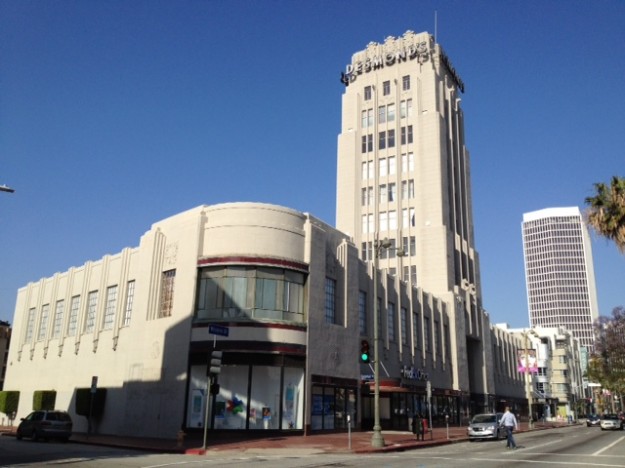
This is the building that started it all, the archetype that led to many miracles on this mile of Wilshire Boulevard. The Wilshire location of Desmond's Department Store was the first high-end department store on Wilshire, and the retail development anywhere to sport a rear parking lot, and a main entrance that faced the back, rather than the street, as well as large circular display windows to attract motorists.

The 10-story building will soon be adaptively-reused into 175 (luxury, The Militant can assume...) apartments which will open sometime next year.

27. A.W. Ross Monument
1956
5700 Wilshire Blvd (Wilshire Blvd and Curson Ave)

"A. W. Ross, founder and developer of the Miracle Mile. Vision to see, wisdom to know, courage to do."

The story goes: Real estate developer A.W. Ross bought an 18-acre stretch of property along Wilshire Blvd in 1921 for $54,000 and in less than a decade's time, turned that stretch of dirt road, oil fields and farmland into Los Angeles' bougiest stretch of retail, which boomed -- of all times -- during The Great Depression. You can call that a miracle.

Ross was considered an innovator in his day; he brought large-scale, ritzy retail developments to his district, all with rear parking lots, and all made to be visible at 30 miles per hour. Left-turn lanes and synchronized traffic signals were credited to Ross.  Streamline Moderne and Art Deco architecture flourished thanks to Ross' development.

In 1956, this bronze bust was placed on this landscaped traffic island to honor the man who brought the "town" out of Downtown and stretched it out like Laffy Taffy.

But little else is known about A.W. Ross (no, he was not affiliated with the Ross Dress For Less stores). Where did he come from? What was his real estate dealings before the his purchase of Wilshire? What did "A.W." stand for, anyway?

28. Some Hairy Elephants In Some Oily Lake
16,000 B.C.
5801 Wilshire Blvd, Miracle Mile

You may or may not know about this place, built in 1976, and if you don't, there's really no hope for you.

George Allan Hancock, who owned the Rancho La Brea Oil Company, donated a large plot of land to the Los Angeles County Museum of History, Science and Art, who dug the area for Ice Age-era fossils. In 1965, the "Art" part of the LACMHSA (pronounced, "Lakum-Hissa") outgrew Exposition Park and the County gave it its own digs at the western end of the Rancho La Brea site.

29. The Berlin Wall
2009
5900 Wilshire Blvd, Miracle Mile

You already know Wilshire Boulevard is full of local history, but it's also home of world history. An art installation from The Wende Museum called The Wall Project features ten actual sections of the Berlin Wall brought here for the 20th anniversary of its fall (Note to Millennials: Google "Fall of the Berlin Wall," it was a pretty big deal in world history back in the day) and decorated by several famous artists. As you may or may not know, Berlin is one of Los Angeles' 25 Sister Cities.

30. May Company Building/LACMA
1939
6067 Wilshire Blvd, Miracle Mile

Many people know the May Company Building - today part of the LACMA campus, and tomorrow the new home of the Academy of Motion Picture Arts and Sciences Museum - as a Streamline Moderne department store. But did you know it was instrumental in moving Los Angeles' Jewish community from The Eastside and Downtown to Fairfax Avenue?

It all began in 1881 when Asher Hamburger, a well-respected Jewish merchant, opened his People's Store on Main Street in Downtown. The business grew and moved in 1911 to a much larger building on 8th and Broadway and was then known as A. Hamburger and Sons Co until 1923, when the company merged with the Missouri-baed May Company. The new operation, formally known as May Company California, was largely run by the Hamburger family and enjoyed much support and patronage by the local Jewish community.

The opening of the aforementioned E. Clem Wilson Building attracted Jewish professionals farther west. In 1935, there were four synagogues along the Fairfax corridor. In the years following the 1939 opening of May Company's new flagship store on Wilshire and Fairfax, the Jewish population boomed, the number of synagogues tripled by 1945. Post-War growth continued the population boom along Fairfax.

Enjoy your CicLAvia and STAY MILITANT!

Monday, June 24, 2013

Miracle Smile: CicLAvia Takes On Wilshire Blvd


When The Militant first heard that there would be another CicLAvia added between the April and October editions, he was stoked. Then when he found out the route was a simple 6-mile stretch of Wilshire, he was bummed. But then when it was revealed that the event's hours were finally extended to 9 a.m. to 4 p.m., he was stoked again.

The six-mile course was the shortest to date and the first one to not incorporate any parts of previous routes. Billed as "Iconic Wilshire Boulevard," The Militant couldn't help but read that as "Ironic Wilshire Boulevard." No, not because of all the hipsters blasting Daft Punk's Random Access Memories album on their iPod boom boxes, but because Wilshire was, for all intents and purposes, a road developed for the car. H. Gaylord Wilshire donated his land along the former Orange Street on the condition that it not have streetcars or commercial trucks run along the thoroughfare. And when developer A.W. Ross pulled a Miracle some three decades later, the stores were built to autocentric scale. So how ironic, yet how appropriate, to have the street closed to cars and open to human-powered transport.

The six-mile course wasn't actually that bad. Though it lacked the sense of adventure and accomplishment of April's Sea-cLAvia, it was short and sweet enough to enjoy multiple times over if one wished. At no point did The Militant feel the need to rush the route (whereas he always did before).  There were shops, green space and historical wonders galore. There was almost something for everyone - yoga, zumba and KBBQ. And it was also quite walkable. The Militant probably walked almost two miles of the route (of course, with the large dismount areas at the ends, everyone walked 1/6 of the route).

Since two months fly by just like that, here we are...and there it went. Time flies when you're having fun, and despite the longer CicLAvia hours, the final CicLAvia of the Villaraigosa administration still went by all too quickly. Still, the two additional hours were much MUCH appreciated since The Militant was not only able to ride the entire course and back, but was able to chill out along the route. One downside though, was the lack of the 30-minute or so grace period after the official end of CicLAvia's hours, that grey area where cars aren't sure whether they should be back on the road yet, so, at least for part of the route, CicLAvia goes on extended play.
Not so this time. In fact, it was 3:55 p.m. when LAPD cruisers and City vehicles sweeped through Wilshire telling cars, in a stoic loudspeaker voice to "move to the right." So while CicLAvia might have gained two hours on paper, in reality, because there was never anyone keeping us off the route before the start time anyway, we really only gained half an hour.

How about CicLAvia follow this formula: One hour per mile, plus one, equals the appropriate length in hours of a CicLAvia event? Sunday's route was 6 miles, plus one equals the 9 a.m. to 4 p.m. span of the event. Perfect. Ergo, this just means that the 16-mile "To The Sea" route via Venice Boulevard will have to be 17 hours long next year [wide grin].

This being the first CicLAvia to experience June Gloom, Sunday's seventh iteration of CicLAvia may or may not have broken the streak of cloudless CicLAvia days, but as the afternoon wore on, the sun shone through the rest of the day. Never fails. The Despicable Me 2 blimp also never failed to stalk us.

Of course, one asshole (most likely talking on their cellphone like all motorists do) decided to stage an AutoLAvia for a few yards and strike and injure a cyclist. Unfortunately, The Asshole In The Car got away. If such a thing happens again at CicLAvia, The Militant hopes all you CicLAvians mob together en masse, force them to stop, force the asshole out from their car, dangle a noose from the nearest tree and proceed with the lynching, wild west style.

That aside, why don't we ask some experts what they thought of Sunday's CicLAvia? Thanks to a couple of his San Dimas-based operatives, The Militant was able to obtain a phone booth and travel back in time to gather some of the most influential white males in the history of Wilshire Boulevard! Joining us in our panel of experts (If you read the recent Epic CicLAvia Tour post, these names should be familiar to you by now...) is developer and Great Depression-era Miracle Mile founder, A.W. Ross; late 19th-century real estate magnate George Shatto and last, but certainly not least turn of the 20th century land developer, publisher and failed politician H. Gaylord Wishire.

MA: Gentlemen, thank you for being here.

George Shatto: We cannot see your face, young sir.

MA: The Militant's face is irrelevant to the topic. What did you think of Sunday's CicLAvia?

Gaylord Wishire: It was delightful to see so many bicycles on my street. They come in so many colors. Just like the people riding them. But I was much bothered by the trucks parked along the road. I specifically told the city, no trucks allowed on my street.

MA: Oh, those are food trucks, sir.

GW: Food trucks? Where are they delivering them to?

MA: They're not delivering food, they're selling food.

A.W. Ross: Food-selling trucks? Why, that's just nifty! I oughtta try that sometime on The Mile!

MA: No, don't do that, you'll mess up the space-time contin...oh never mind.

GW: Ross, was it you who erected these horrid capitalist edifices on my street?

AWR: Why, yes I did.

GW: You...swine!

AWR: Why, I oughtta pound you!

MA: Gentlemen! Gentlemen! Let's all just calm down. We're here to talk about CcLAvia. Mr. Shatto, your thoughts?

GS: What in criminy's name happened to my house? What happened to the other houses?

MA: Well, it's now a hospital. They demolished your house after you die...err...uhh...feeling awkward right now.

GS: I died? When?

MA: Die...di...dial..ed...dialed the telephone. Yes, that's it.

GS: What is the "telephone," exactly?

MA: Never mind. Hey, did you know a bowling alley was named after you?

GS: You don't say!

MA: Back on topic...Mr. Ross, what were your impressions of CicLAvia?

AWR: What happened to all the cars?

MA: Well, CicLAvia is a day where we close off the streets to cars.

AWR: Now why in tarnation's name would you ever want to do that?

MA: Well, because there's too many cars on the streets these days.

AWR: And that's a swell thing!

MA: No, because we have congestion and air pollution now.

AWR: Bah, that's just a bunch of applesauce.

GW: What does he know? That Ross is nothing but capitalist swine.

AWR: Oh dry up, Gaylord!

GW: Do you want to settle this in fisticuffs?

MA: HEY HEY GUYS! STOP! PLEASE!

GS: Is anyone interested in investing in some Santa Catalina Island property?

[Ross and Wilshire engage in a fistfight]

MA: Okay, gentlemen, thank you for participa...YO, SECURITY!

[The three panel guests were quickly escorted back into the phone booth time machine. Huh? "Station?" Who said that?]

Enjoy The Militant's Epic Militant CicLAvia Photo Gallery!

What's left of the Wilshire Grand Hotel, soon to be the freaking tall Wilshire Grand Center building.

CicLAvia has clearly gone to the birds this time.

The Militant sincerely hopes this dude's tongue was planted firmly within his cheek with this one.

Gen. Otis directs CicLAvians to the yoga class at Mac Arthur Park.

JAIME: Hey Edward James, do you think Los Angeles is a bike-friendly city now?
EDWARD JAMES: Olmos!

Stupid tall bikes were soooo April 2013. This is the newest bad-assness right now.

Homeboy kept following us the whole time.

Los Angeles County presents the highest-capacity bike rack ever made.

And the Oscar goes to...

Wilshire Hopscotch at Crenshaw.

...'Til the Po-Po shuts us down.